<?xml version="1.0" encoding="utf-8"?><feed xmlns="http://www.w3.org/2005/Atom" ><generator uri="https://jekyllrb.com/" version="4.4.1">Jekyll</generator><link href="https://mathoffthegrid.net/feed.xml" rel="self" type="application/atom+xml" /><link href="https://mathoffthegrid.net/" rel="alternate" type="text/html" /><updated>2026-05-03T16:49:10-04:00</updated><id>https://mathoffthegrid.net/feed.xml</id><title type="html">Math Off The Grid</title><subtitle>A blog exploring mathematical concepts and problem-solving techniques for math circles aimed at middle school and highschool</subtitle><author><name>Benjamin Leis</name><email>benleis1@gmail.com</email></author><entry><title type="html">Two Boxes in a Circle</title><link href="https://mathoffthegrid.net/2026/04/30/two-boxes-in-a-circle.html" rel="alternate" type="text/html" title="Two Boxes in a Circle" /><published>2026-04-30T00:00:00-04:00</published><updated>2026-04-30T00:00:00-04:00</updated><id>https://mathoffthegrid.net/2026/04/30/two-boxes-in-a-circle</id><content type="html" xml:base="https://mathoffthegrid.net/2026/04/30/two-boxes-in-a-circle.html"><![CDATA[<h2 id="the-march-mathsjam-had-an-interesting-geometry-puzzle">The March MathsJam had an interesting geometry puzzle.</h2>

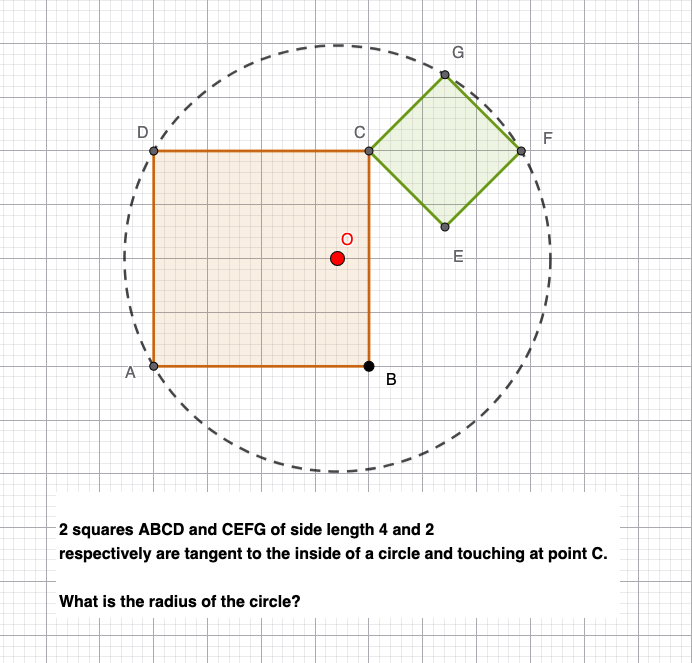
<p><img src="/assets/img/2026-04-30/problem.png" alt="See text" /></p>

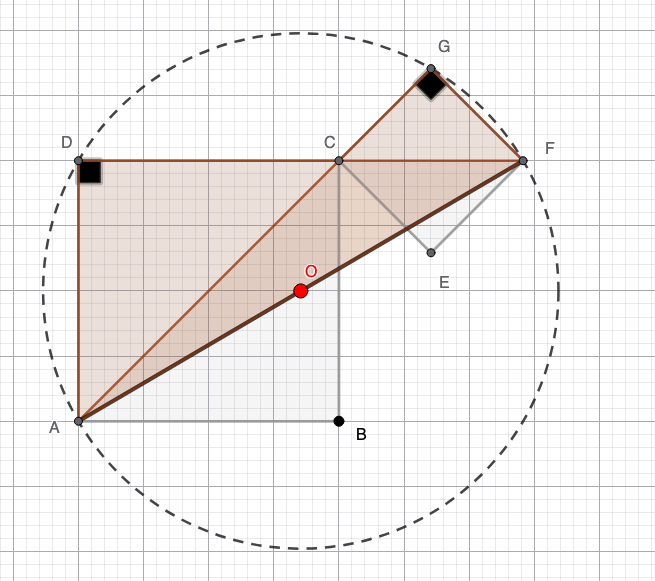
<p>In the course of the evening, we noodled on this for a while and initially made no progress. So I decided to model it in geogebra to confirm whether there was a unique solution.  What I found visually was that there appeared to be one when the smaller box was tilted 45 degrees. And that was in fact not hard to confirm because the triangle DFA inscribes the diameter in that case, along with the triangle FGA. You can then solve with the Pythagorean theorem and verify that they give the same result in this configuration.</p>

<p><img src="/assets/img/2026-04-30/step2.png" alt="See text" /></p>

<p>\(\text{the diameter: } AF^2 = AD^2 + DF^2  = 16 + (4 + 2\sqrt{2})^2 = 40 + 16 \sqrt{2}\)
\(\text{and also the diameter: } AF^2 = FG^2 + AG^2 = 4 + (2 + 4 \sqrt{2})^2 = 40 + 16 \sqrt{2}\)</p>

<p>But this isn’t entirely satisfying because it basically presumes that answer and confirms it works <strong>and</strong> it doesn’t settle whether this is the only answer.</p>

<h2 id="trying-to-prove-the-configuration">Trying to prove the configuration</h2>
<p>One of the central things the above process used was the inscribed right angles embedded in the circle at D and G. This seemed like an important part of the solution. I tried out a bunch of variants including adding lines through the center of the circle to middle of the squares and to the outer corners. Nothing seemed to prove that interior angle was 45 like I hoped. So I turned to a different approach: trying to prove uniqueness of the solution and settling for a known solution for existence.</p>

<h2 id="the-sprirograph-approach">The Sprirograph Approach</h2>
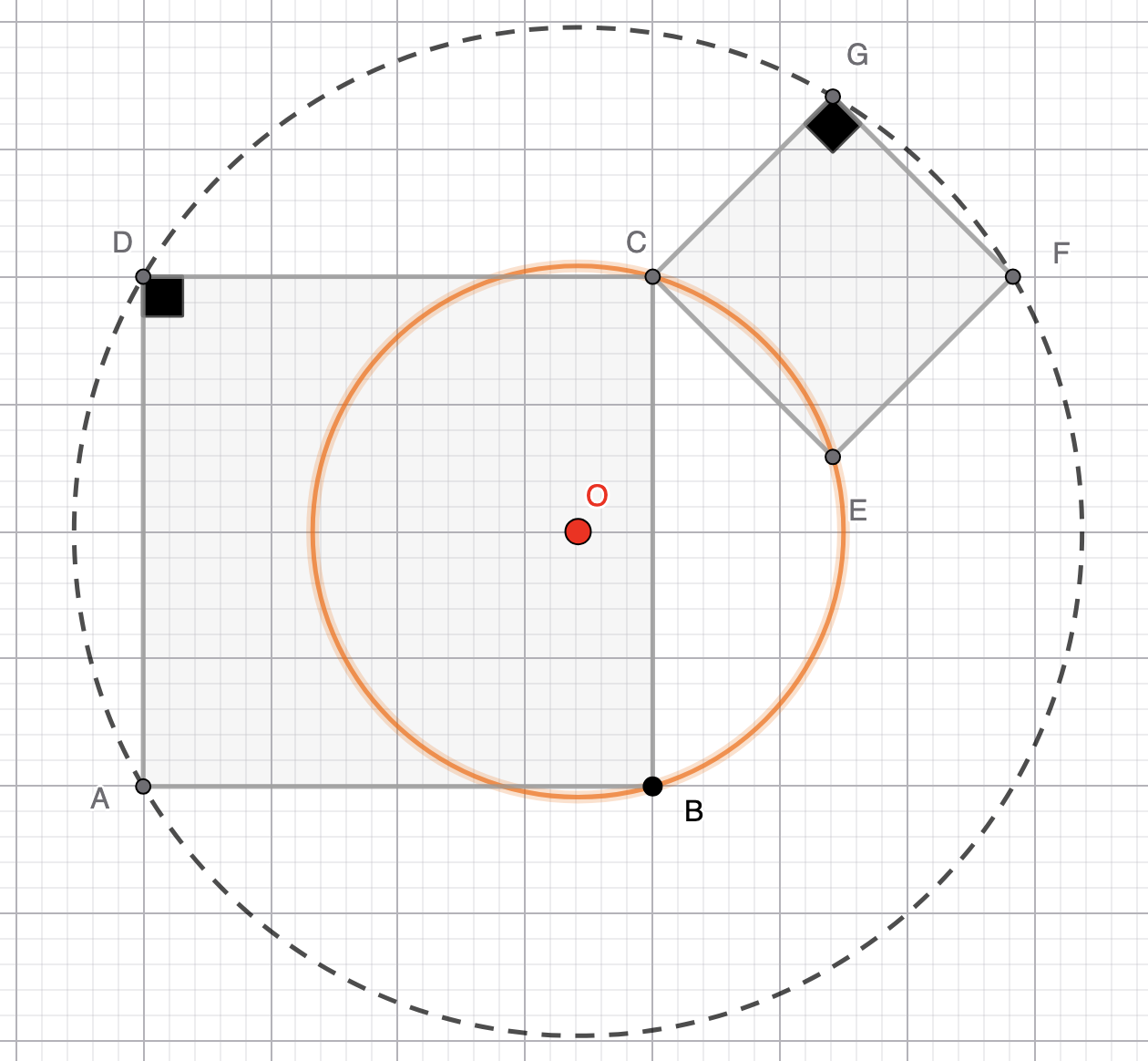
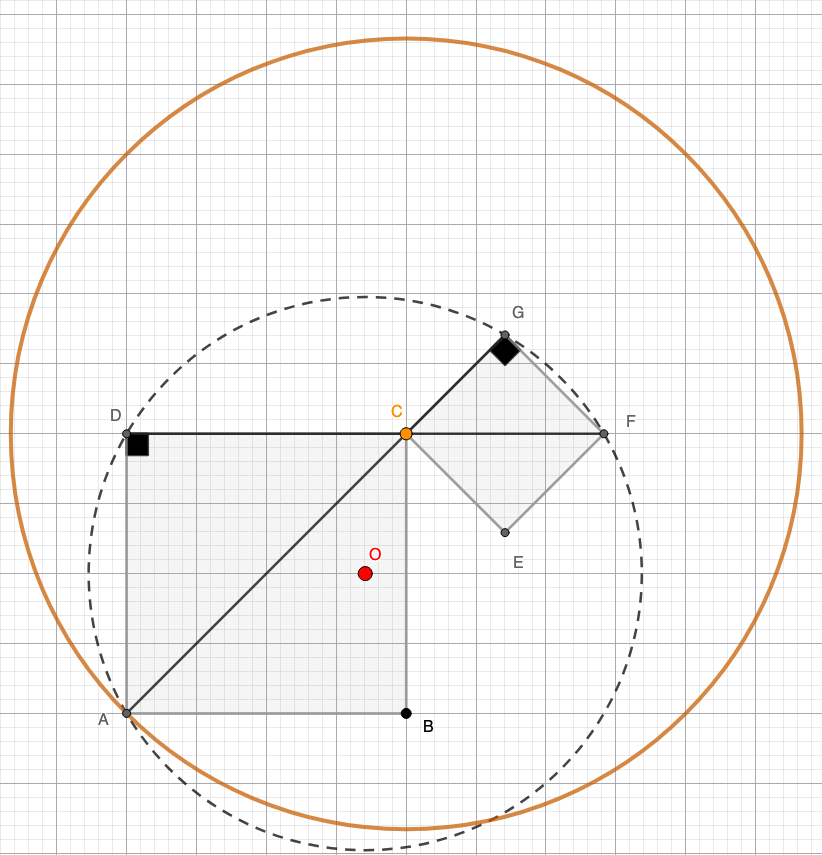
<p>Imagine taking the smaller box and rotating it fully around the circle. Because the box is rigid and a fixed length you end up tracing a smaller circle like below</p>

<p><img src="/assets/img/2026-04-30/spirograph.png" alt="See text" /></p>

<p>Its clear the smaller square can only intersect when either one of the corners overlaps point C and only two configuration work for that case. Every other position will place the ends of the square at other locations on the smaller circle. This provides a uniqueness proof of sorts* Although it actually suggests there are 2 configurations depending on which corner of the two corners of the small square is used and the 45 degree rotation is only one of them.</p>

<h2 id="a-difficult-construction-that-works">A difficult construction that works</h2>

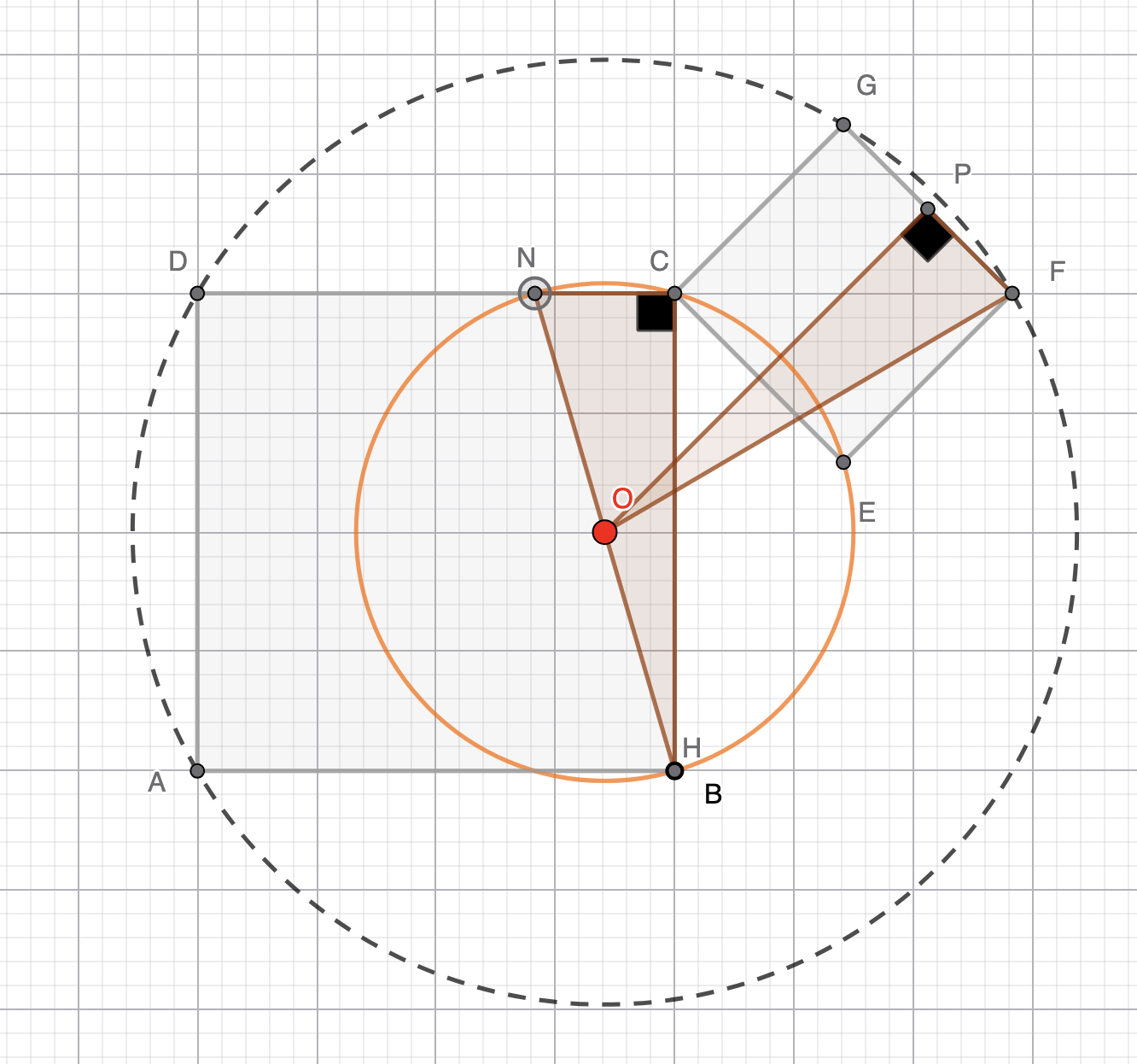
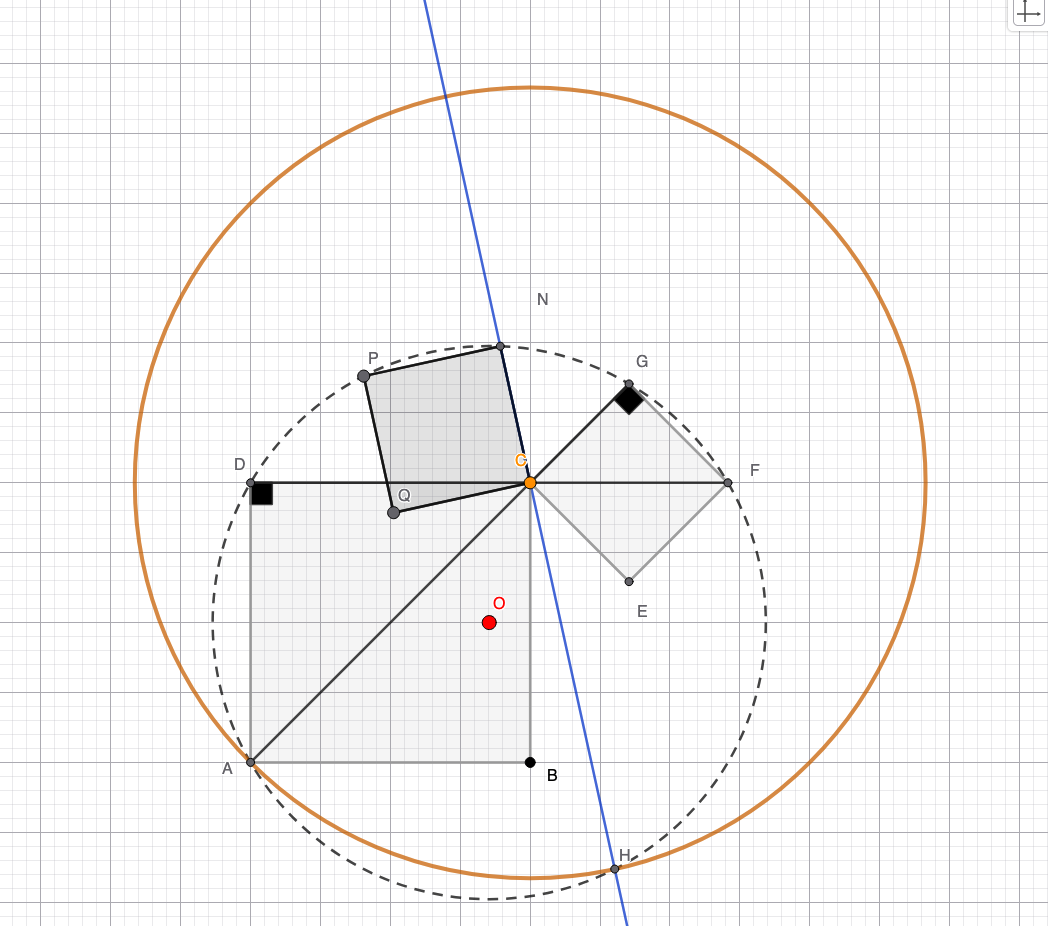
<p>Later on I realized that the inner circle was interesting because it created another inscribed angle at C.</p>

<p><img src="/assets/img/2026-04-30/spirograph2.png" alt="See text" /></p>

<p>This creates the triangle HCN and if we let r be the radius of the inner circle: $(2r)^2 = 4^2 + CN^2$.  And CN is discoverable using the radius of the outer circle which I’ll call R.</p>

<p><img src="/assets/img/2026-04-30/spirograph3.png" alt="See text" /></p>

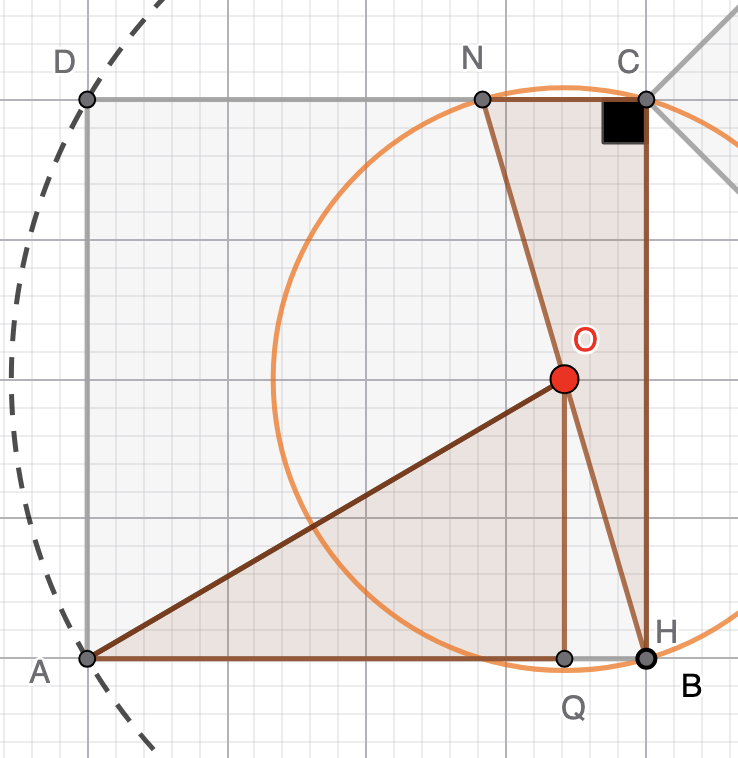
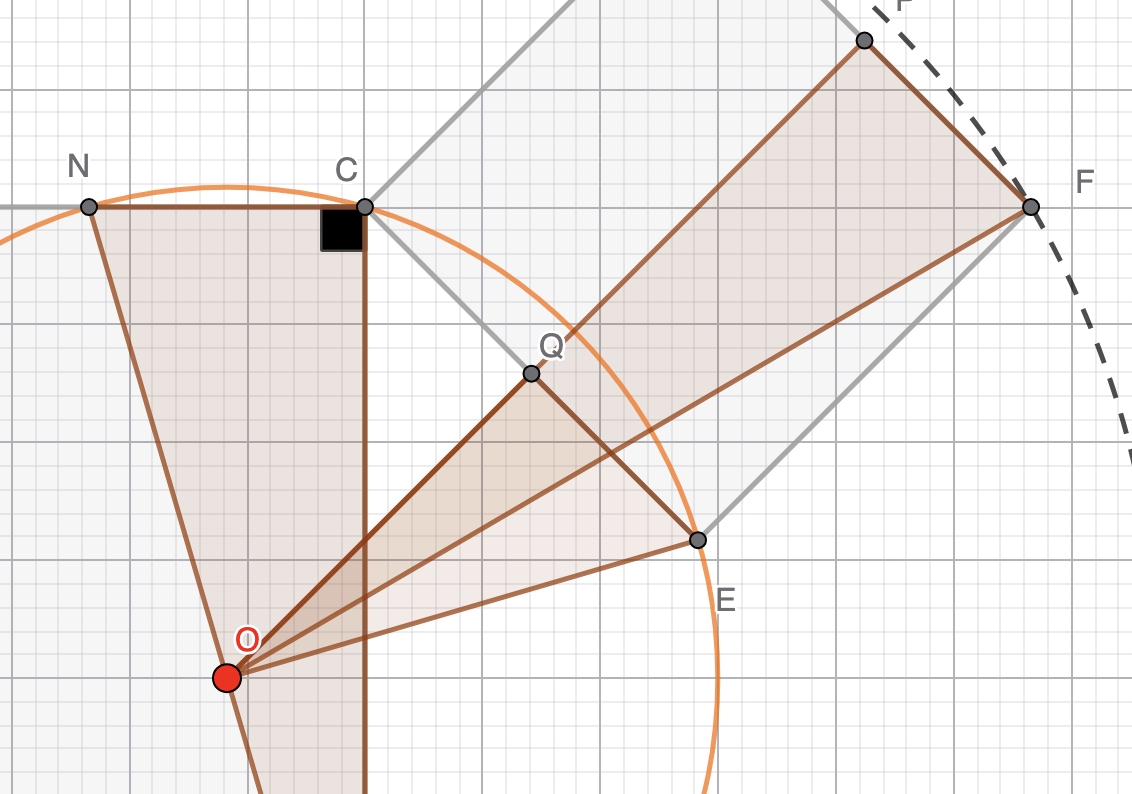
<p>From triangle AOQ we can get $R^2 = AQ^2 + 2^2$ and $AQ = 4 - \frac{1}{2}CN$</p>

<p>All I needed was one more relationship between r and R to solve. So I introduced the addtional triangle OPF from the first figure.
That has a Pythagorean relationship $R^2 = 1^2 + OP^2$ and  we can OP in terms of r as well by introducing yet another triangle.</p>

<p><img src="/assets/img/2026-04-30/spirograph4.png" alt="See text" /></p>

<p>Triangle OQE gives us $r^2  = OQ^2 + 1^2$ and $OP = OQ + 2$. So we eventually end up with a more complicated than desired system but it is solvable:</p>

\[4r^2 = 16 + (R^2 - 4) - 8\sqrt{R^2 - 4} + 16\]

\[R^2 = 1 + (r^2 - 1) + 4 \sqrt{r^2 -1} + 4\]

<p><em>*I’ll leave the algebra as an exercise for the reader.</em></p>

<h2 id="breakthrough">Breakthrough</h2>
<p>That felt decent but more complicated than should be possible so eventually I went back to a simpler variant of on my original experiments: looking at the intersecting chords formed by the two squares.</p>

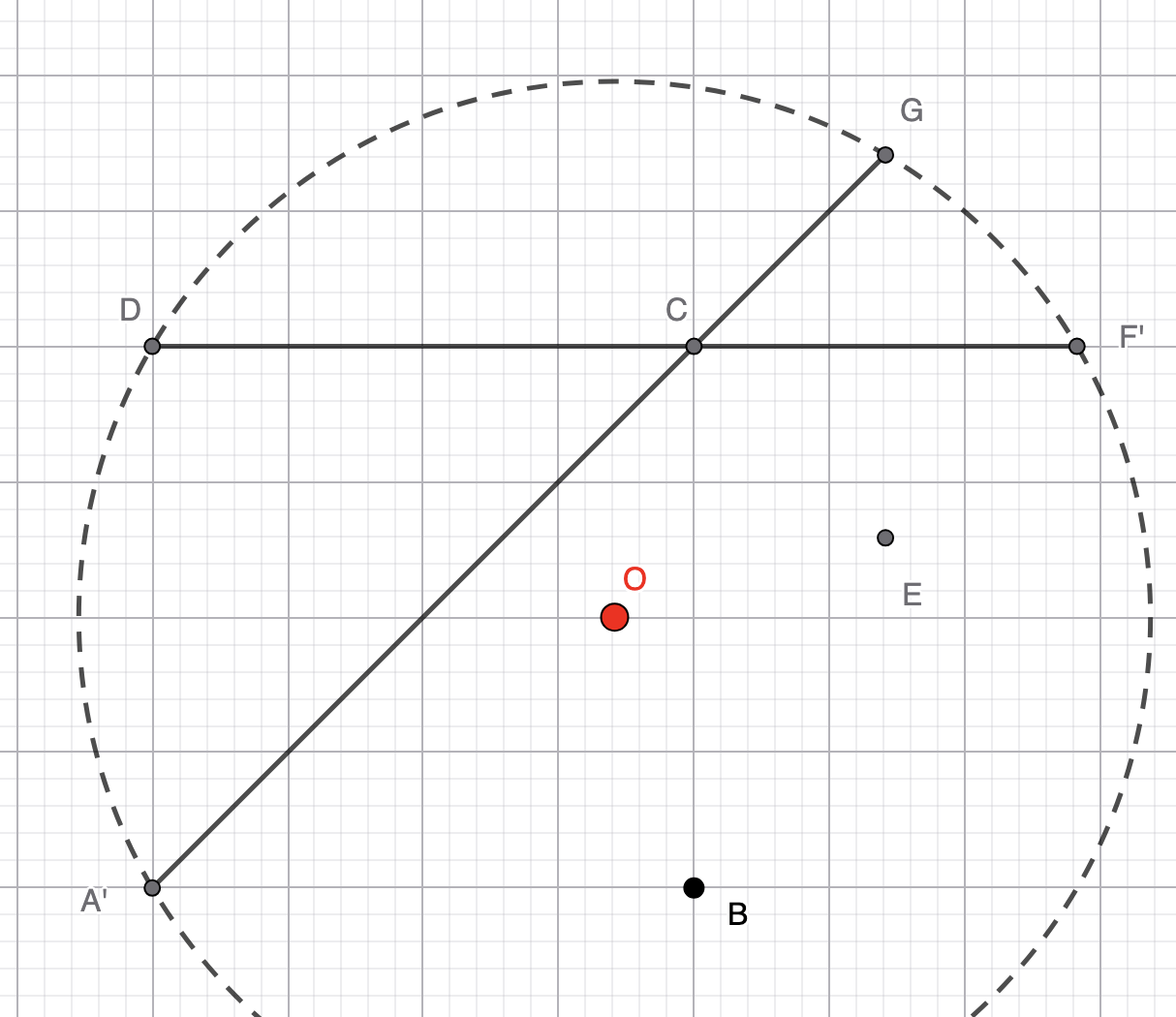
<p>Let consider extending CD to F’ and CG to A’.  Note we don’t know if A’ = A or F’ = F yet. This gives us two intersecting chords A’G and DF’.</p>

<p><img src="/assets/img/2026-04-30/chords.png" alt="See text" /></p>

<p>These must satisfy the relationship: $DC \cdot CF’ = CG \cdot CA’$ which simplifies to $2CF’ = CA’$</p>

<p>Let w = CF’ for the rest of this proof. We now can go back to our original inscribed angles. We don’t know if they overlap each other this time but each inscribed angle D and G  defines a triangle on a diameter of the circle and those diameters are the same length. So:</p>

\[4^2 + (4 + w)^2 = 2^2 + (2 + 2w)^2\]

<p>That’s a lot easier than the previous systems and simplifies to $3w^2=24$ or $w=2\sqrt{2}$
<strong>Note</strong> that’s exactly the diagonal of our smaller square as expected.</p>

<p>We don’t have to really prove this is the case because w is enough to calculate the radius by just plugging into the Pythagorean formula for either inscribing triangle like I did initially.</p>

<p>But for fun let’s look at all points that are $4\sqrt2$ from C and and since that forms a circle there must be a second intersection.</p>

<p><img src="/assets/img/2026-04-30/uniqueness.png" alt="See text" /></p>

<p>Clearly that second intersection isn’t collinear with either of the segments CD or CG and the diagonal on AC really is.</p>

<p>But if we extend to see what it’s connecting to - voila the second case I alluded to at the top pops out. We can also have the smaller triangle touching and slightly overlapping the larger one.</p>

<p><img src="/assets/img/2026-04-30/uniqueness2.png" alt="See text" /></p>]]></content><author><name>Benjamin Leis</name></author><category term="walkthrough" /><category term="geometry" /><category term="cyclic quad" /><category term="circle" /><summary type="html"><![CDATA[The March MathsJam had an interesting geometry puzzle.]]></summary></entry><entry><title type="html">New Beginnings</title><link href="https://mathoffthegrid.net/2026/04/29/new-beginning.html" rel="alternate" type="text/html" title="New Beginnings" /><published>2026-04-29T00:00:00-04:00</published><updated>2026-04-29T00:00:00-04:00</updated><id>https://mathoffthegrid.net/2026/04/29/new-beginning</id><content type="html" xml:base="https://mathoffthegrid.net/2026/04/29/new-beginning.html"><![CDATA[<h2 id="im-back">I’m back</h2>

<p><img src="/assets/img/2026-04-29/flower.png" alt="Flower in the snow" /></p>

<p>It’s been a long 3 years. In the course of Covid and life changes, I took a hiatus from my the old blog site and in the interim it broke down. But the itch to post math related posts has been growing along with the desire to migrate off of blogger and onto to a more open source platform.</p>

<h2 id="math-updates">Math Updates</h2>

<p>I’ve switched my focus for the last 2 years and am now leading classes at <a href="https://www.huskymath.org/">HMA</a>. This has been fun because in this format, I have a block of kids who are following a curriculum with homework and unlike in a math circle, its appropriate to have a sequence that builds on itself. The kids are a mixture of 7th to 10th graders currently and room sizes are around 15 kids with me and an undergraduate or graduate IA. Currently I’m leading a Algebra block and assisting on a Counting Theory one. I’m thinking a lot about curriculum sequences as I’ve become acquainted with IDEA math, our textbook.   You can see my official bio here: <a href="https://www.huskymath.org/staff#h.nb3a3f61ey69">Bio</a></p>

<p>As usual there is a bit of the normal tension to whether I think of myself as a <em>teacher</em>.  Despite being a volunteer position 3 hours a week, the format is not much different than any other math classroom. I prefer the terms “leading a room” or sometimes “instructor” to avoid misconstruing the work.</p>

<h2 id="blog-migration">Blog Migration</h2>

<p>As I mentioned above, this time around I wanted more control. Blogspot was on life support under google and had basically no tech support and the configuration was what it was. I also wanted to write things in markdown rather than a proprietary markup language so that I wasn’t as tightly bound to a platform.</p>

<p>In my first attempt, I took a look at hugo but wasn’t able to easily get it up and running. The second time around, I decided to try out jekyll instead given this <a href="https://medium.com/coffee-in-a-klein-bottle/creating-a-mathematics-blog-with-jekyll-78cdee0339f3">post</a> .  With some minor work to get ruby installed on my Mac that required some digging around, the basic instructions worked fairly well and my test posts were working.  Deployment on github also was smooth.</p>

<p>I then discovered that jekyll themes are not seamlessly interchangeable.  My sample was setup on the basic, minimal theme and  I wanted to try out chirpy which seemed promising based on web research. That was most easily done by just starting from scratch with a starter template on github. This also required changing to github actions for deployment but once that was understood the process again was smooth enough. What I did a bit differently next was leverage claude to munge the config files directly rather than the starter pack. After twiddling things around I again was up but the UI wasn’t exactly what I wanted. It took some work to get tags going, turn off categories, make the summaries include a picture etc.  During this process, I became a bit more familiar with jekyll and realized chirpy wasn’t as flexible as I would have liked and I was cloning off various configuration elements to customize. I also couldn’t get it to present the view I wanted: a list of full or mostly full blog posts rather than summaries on the home page.</p>

<p>So I researched again and arrived at the <a href="https://mmistakes.github.io/minimal-mistakes">minimal mistakes theme</a>. The docs for this one were more detailed than chirpy and it had more accessible tuning knobs built in.  I used claude again to migrate the main configuration. Then began the slog of exporting all the blog entries from google and converting them over.  Among other things I had to:</p>

<ul>
  <li>Remove mathjax and css headers</li>
  <li>Fix up the tags and get them into the front matter</li>
  <li>Fix up the images and properly organize them under assets.</li>
  <li>Change all mathjax inline separators to $ which was more natural for jekyll’s built in mathjax support.</li>
  <li>Fiddle with image scaling.</li>
  <li>Tinker with the amount of paragraphs to include in the archive summaries. I’m still not completely happy with where this stands.</li>
</ul>

<h2 id="things-left-to-do">Things left to do</h2>
<p>I still have to manually confirm the edits on a bunch of the older posts and fix up anything that looks broken. Also I have learned that it was a mistake to embed twitter links like I did for a period of a time. Many of those have broken over time. Moral of the story: keep a local copy of images instead if you want more permanence. Its possible I can find these on the wayback machine and I’ll have to test and try for that.</p>

<p>I also want to improve my local editing setup. I currently use emacs, in markdown mode. I need to set up a template for the front matter to save some time and also see if I can find a way for it to inline display images. That’s currently broken by the format that uses a template {site.baseurl} rather than a full path.</p>]]></content><author><name>Benjamin Leis</name></author><category term="blogging" /><summary type="html"><![CDATA[I’m back]]></summary><media:thumbnail xmlns:media="http://search.yahoo.com/mrss/" url="https://mathoffthegrid.net/%7B%7B%20site.baseurl%20%7D%7D/assets/img/2026-04-29/addme.png" /><media:content medium="image" url="https://mathoffthegrid.net/%7B%7B%20site.baseurl%20%7D%7D/assets/img/2026-04-29/addme.png" xmlns:media="http://search.yahoo.com/mrss/" /></entry><entry><title type="html">Two Hinged Triangle Geometry Walk Through</title><link href="https://mathoffthegrid.net/2023/07/18/two-hinged-triangle-geometry-walk-through.html" rel="alternate" type="text/html" title="Two Hinged Triangle Geometry Walk Through" /><published>2023-07-18T00:00:00-04:00</published><updated>2023-07-18T00:00:00-04:00</updated><id>https://mathoffthegrid.net/2023/07/18/two-hinged-triangle-geometry-walk-through</id><content type="html" xml:base="https://mathoffthegrid.net/2023/07/18/two-hinged-triangle-geometry-walk-through.html"><![CDATA[<h2 id="setup">Setup</h2>

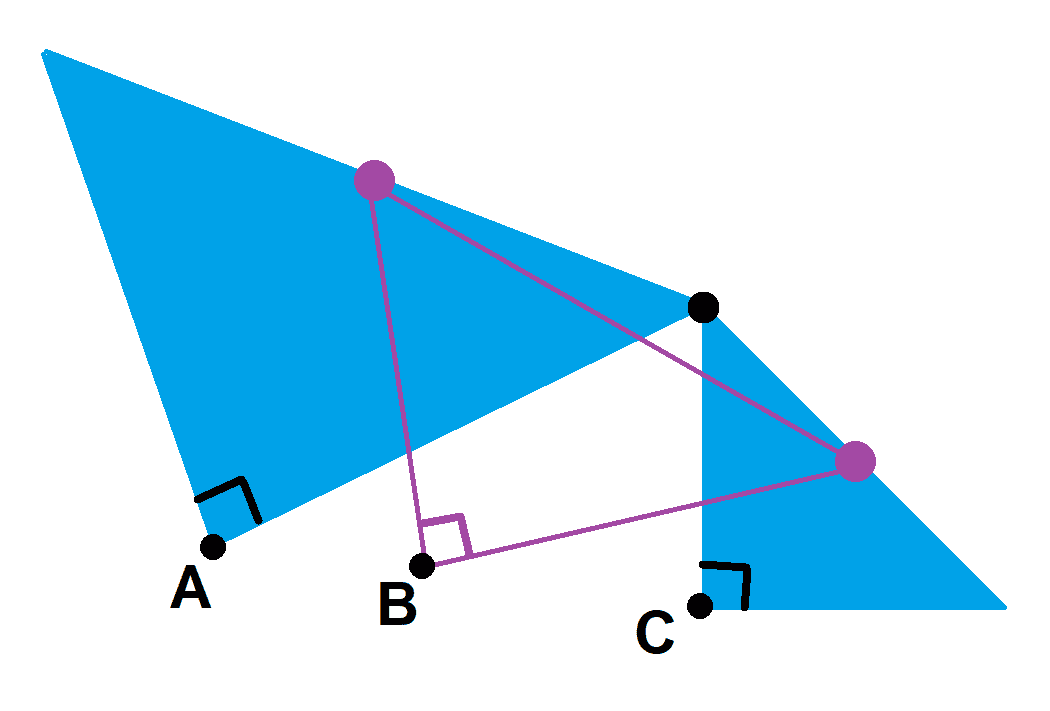
<p>It’s time for another geometry walkthrough motivated this week by this interesting problem from James Tanton.</p>

<p><img src="/assets/img/posts/two-hinged-triangle/orig.png" alt="Problem diagram" width="75%" /></p>

<p>“Two isosceles right triangles are hinged at corners as shown. Line segment connecting midpoints of their hypotenuses is used as the hypotenuse of yet another isosceles right triangle.</p>

<p>Prove A, B, C lie on a straight line.
Can anything be said about where B sits on segment AC?”</p>

<h2 id="initial-impressions">Initial Impressions</h2>

<p>My first impression was that this reminded me a bit of the <a href="/2015/05/20/cool-geometry-problem.html">3 hinged squares</a> problem where among the key observations was that the area of the triangles between the hinges was always the same. This problem has right triangles which are effectively half squares and involves the midpoints (or centers of the squares if they were there) so it’s not quite the same at least at first but keep that thought in the back of your head.</p>

<p>Secondly I wondered if it could be as easy as an angle chase. Sadly after working things out that appeared to not be the case. So this would take some more serious work.</p>

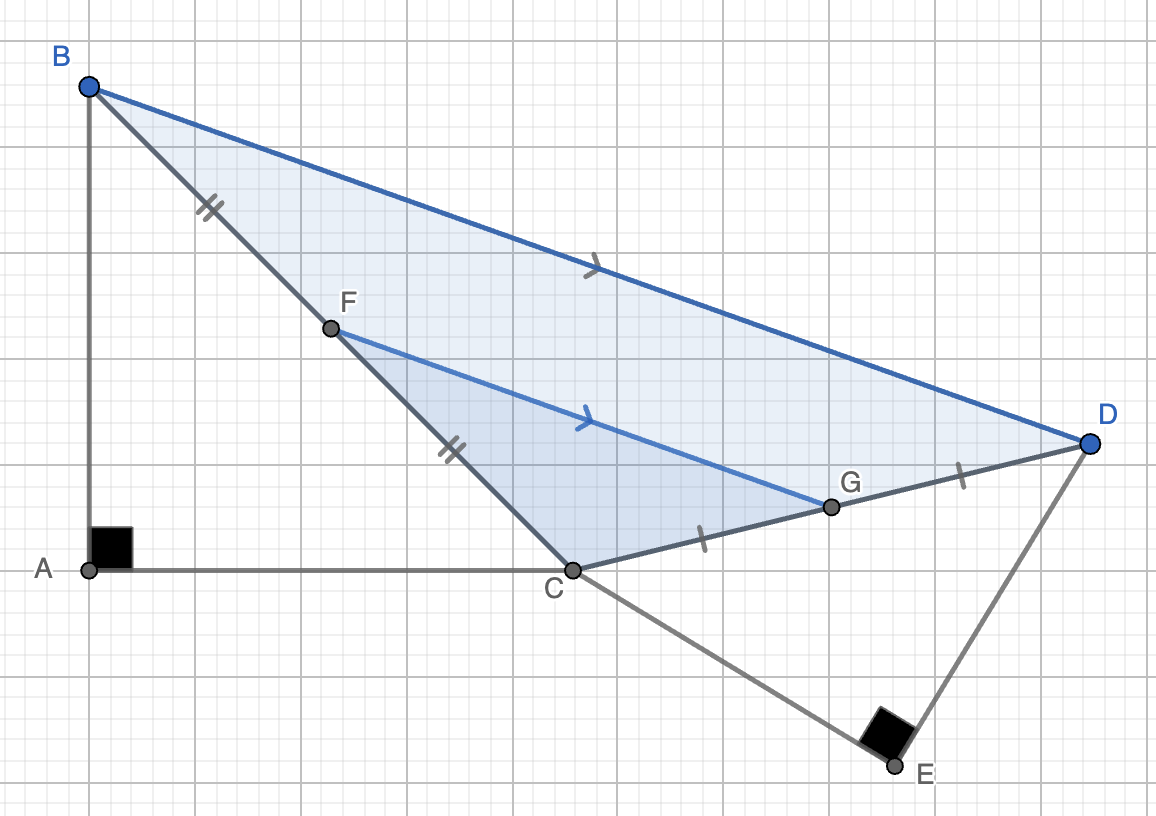
<p>The third observation I had is midpoints tend to generate similar triangles:</p>

<p><img src="/assets/img/posts/two-hinged-triangle/screenshot-1.png" alt="Similar triangles observation" width="75%" /></p>

<p>And if you draw in the extra line BD that is indeed the case here. Triangle BCD is similar to triangle BCG. BD is parallel to FG and the scale factor is 2:1.</p>

<p>But I wasn’t quite sure yet what to do with all of that. Colinearity is one of those slippery properties that is less directly proven. I hadn’t been able to find the angles to show that they all added up to 180 via an angle chase which would be the most direct method.</p>

<h2 id="analytic-approach">Analytic Approach</h2>

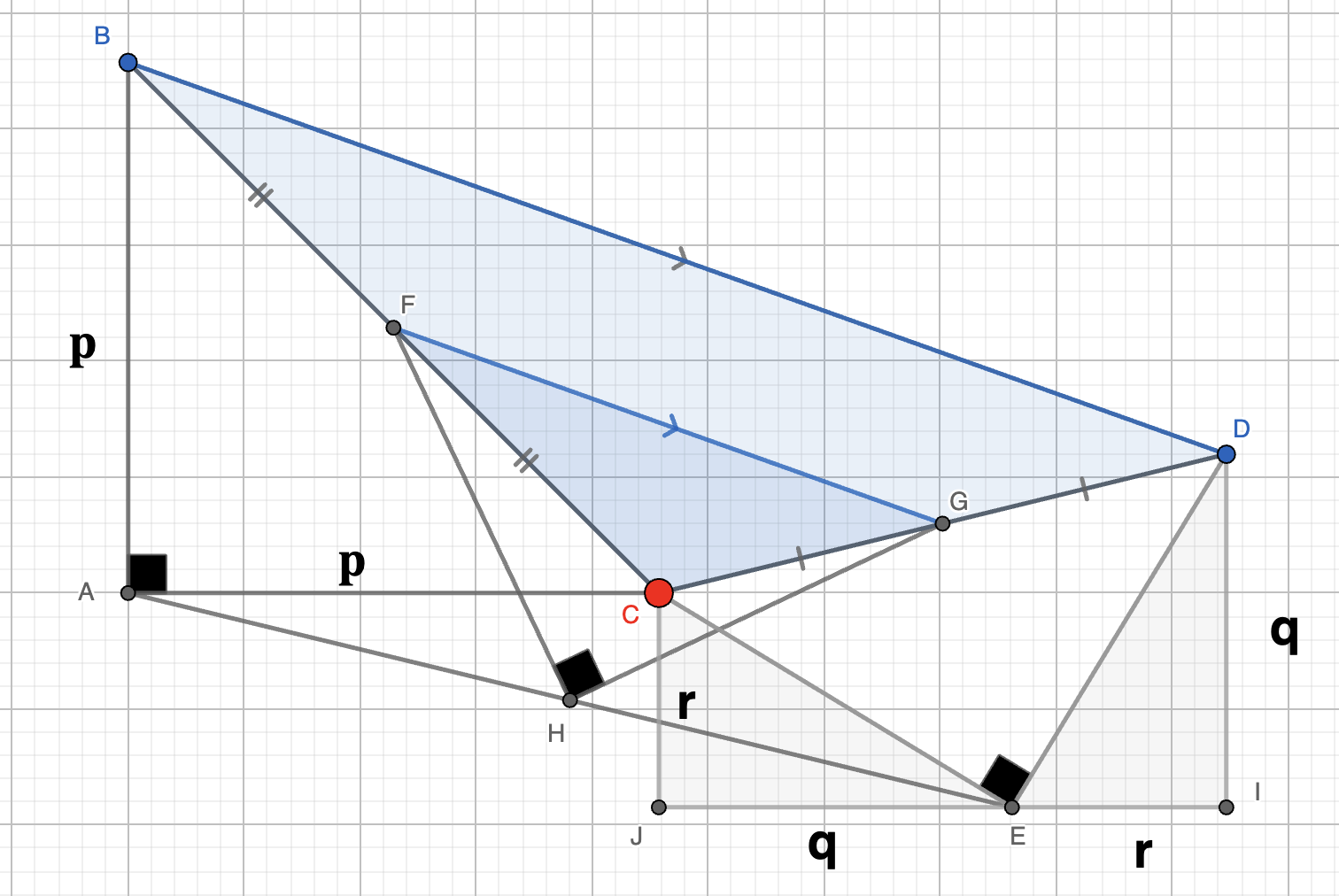
<p>So out of ideas I started going down an analytic path.</p>

<p><img src="/assets/img/posts/two-hinged-triangle/screenshot-2.png" alt="Analytic setup" width="75%" /></p>

<p>First I set C, the hinge point, to (0,0) and oriented one triangle ABC on the X and Y axes and assigned it length p. Then I squared off the second triangle and assigned those triangles length q and r. From there I eventually derived an expression for H that showed it was indeed on the line AE. This was a bit complicated and I don’t tend to find the analytic solutions to be quite as explanatory as the synthetic ones.</p>

<p>However, via @jimsimons@mathstodon.xyz there is a nice improvement on this approach using the complex plane.</p>

<p>“Put C the point where the triangles meet at the origin, and let the points A and E be the complex numbers 4a and 4e (the 4’s avoids fractions later).</p>

<p>The remaining vertices are B at 4a(1-i) and D at 4e(1+i). Note: how natural the 90 degree rotations are via complex multiplication.</p>

<p>The midpoints of the hypotenuses are 2a(1-i) and 2e(1+i).
The midpoint of the line joining them is a(1-i)+e(1+i).</p>

<p>So B is a(1-i)+e(1+i) + i(a(1-i)-e((1+i)) = 2a+2e, which is H the midpoint of AE!”</p>

<p>This makes all the calculations quite simple and is quite lovely.</p>

<h2 id="synthetic-approach">Synthetic Approach</h2>

<p>Back during my own investigation I still wanted a synthetic approach. Two more things occurred to me next.</p>

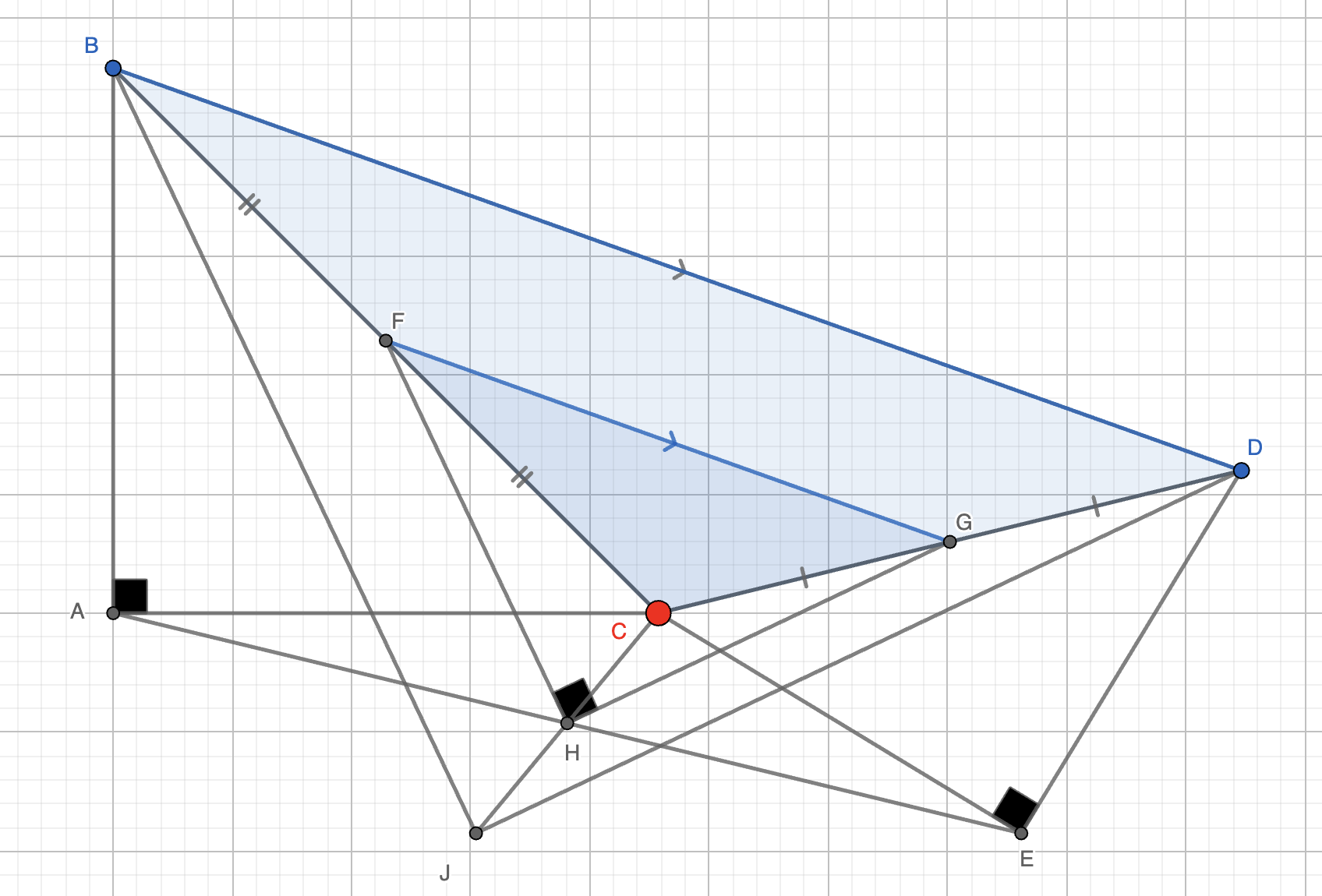
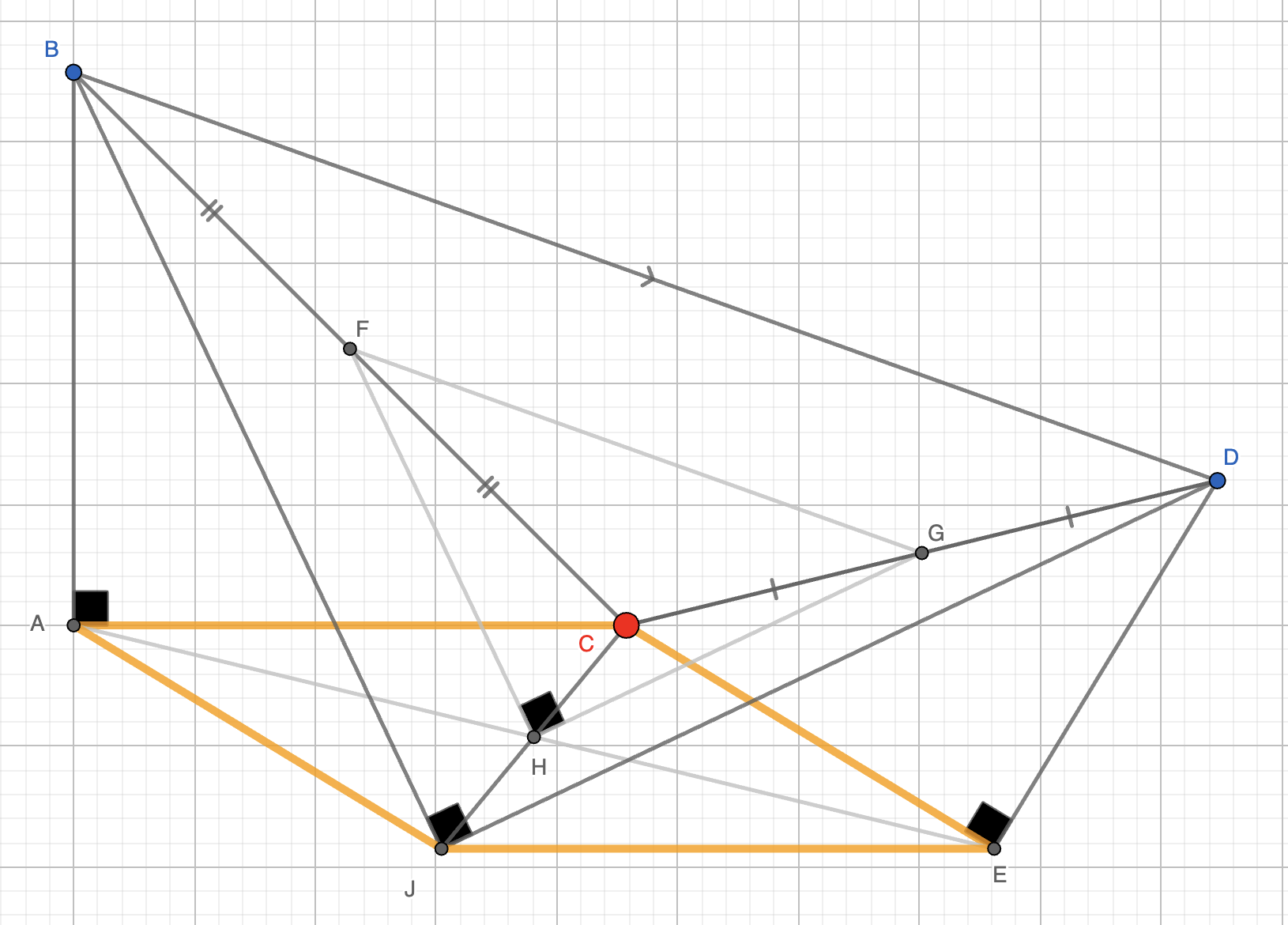
<p>The two parallel lines BD and FG meant I could make a second right triangle oriented at exactly the same way as FGH as so:</p>

<p><img src="/assets/img/posts/two-hinged-triangle/screenshot-3.png" alt="Second right triangle construction" width="75%" /></p>

<p>After staring a while (probably over an hour or two in between other activities) it sure looked like H was the midpoint of CJ and J looked like it was exactly at the same vertical coordinate as E. A bit later after experimenting with variations of hinged triangles and seeing that these seemed to be invariants I added some more lines and came up with this lemma:</p>

<p><img src="/assets/img/posts/two-hinged-triangle/screenshot-4.png" alt="Parallelogram lemma" width="75%" /></p>

<p>Given the same original hinged triangle ABC and CDE the big right isosceles triangle off of BD, BDJ forms the orange parallelogram ACEJ.</p>

<p>Process wise I assumed this and went onto to the next step and verified later but for clarity I’m going to show that is the case here and it turns out to be simpler than the original problem.</p>

<p>Let’s go backwards and form the parallelogram ACEJ first and show BDJ is a right isosceles triangle.</p>

<ul>
  <li>First triangles BAJ and JED are congruent via SAS so the two edges DJ and BJ are congruent as well.</li>
  <li>Then a quick angle chase shows BJD is indeed 90 degrees.</li>
</ul>

<p>Note: the similarities to the other problem I mentioned with the hinged squares. We once again are adding in congruent sides from each of the original figures to create 2 new triangles that share a congruent side from each of the originals.</p>

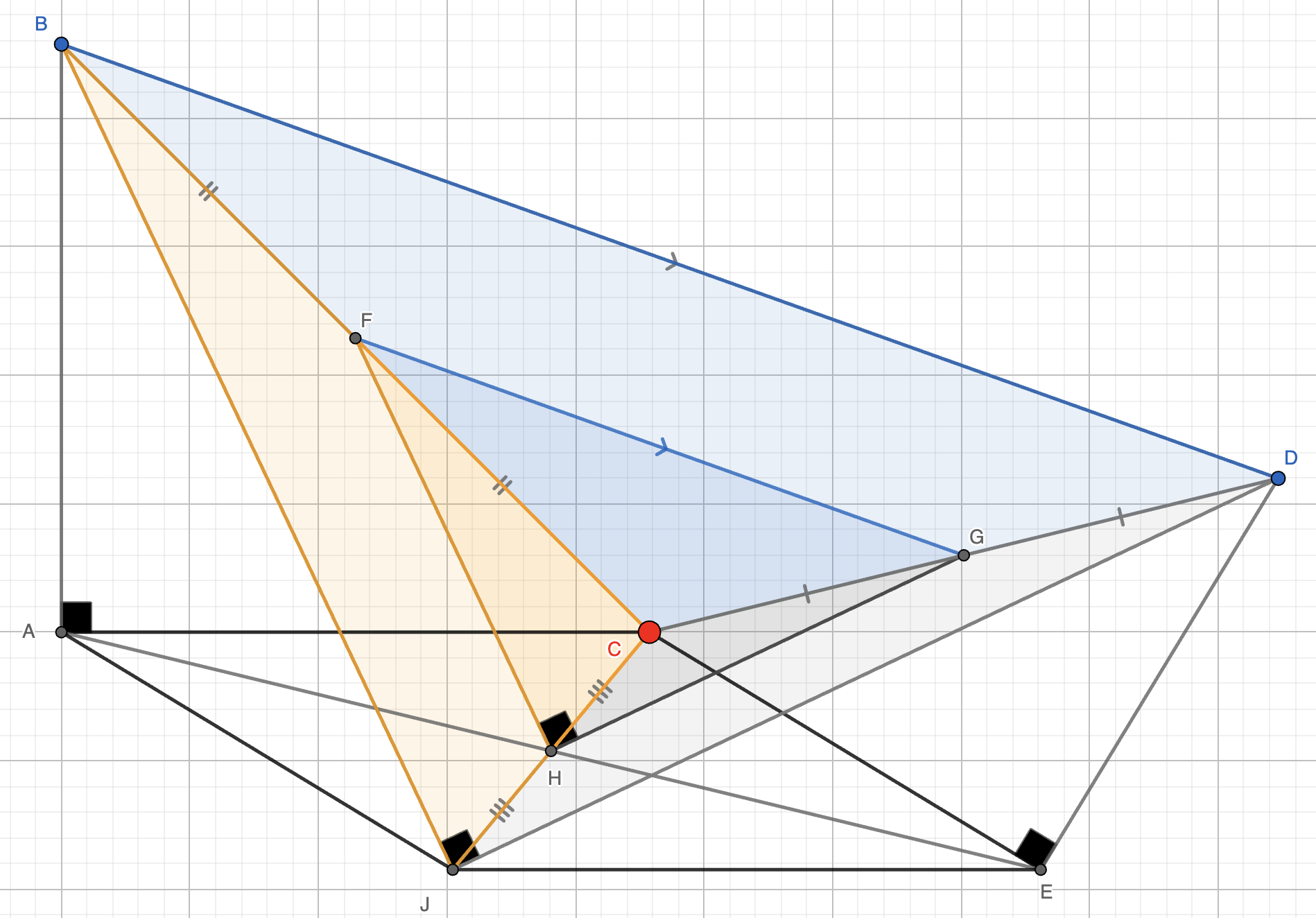
<p>With that in hand and remembering that H the intersection of the parallelogram’s diagonals bisects both diagonals we can see:</p>

<p><img src="/assets/img/posts/two-hinged-triangle/screenshot-5.png" alt="Final proof" width="75%" /></p>

<p>Triangle FGH is surrounded by three similar triangles all in a 1:2 ratio. Or in other words FGH is a dilation of BDJ around point C scaling by a factor of 1:2.</p>

<p>Since via the lemma above, BDJ was a right triangle FGH must also be one! And further by definition its end point is on the diagonal AC and in fact at its midpoint. QED</p>]]></content><author><name>Benjamin Leis</name></author><category term="geometry" /><category term="triangles" /><category term="complex numbers" /><category term="math club" /><summary type="html"><![CDATA[Setup]]></summary><media:thumbnail xmlns:media="http://search.yahoo.com/mrss/" url="https://mathoffthegrid.net/%7B%7B%20site.baseurl%20%7D%7D/assets/img/posts/two-hinged-triangle/orig.png" /><media:content medium="image" url="https://mathoffthegrid.net/%7B%7B%20site.baseurl%20%7D%7D/assets/img/posts/two-hinged-triangle/orig.png" xmlns:media="http://search.yahoo.com/mrss/" /></entry><entry><title type="html">Trig identity Three Ways (at least)</title><link href="https://mathoffthegrid.net/2023/02/03/trig-identity-three-ways.html" rel="alternate" type="text/html" title="Trig identity Three Ways (at least)" /><published>2023-02-03T20:43:00-05:00</published><updated>2023-02-03T20:43:00-05:00</updated><id>https://mathoffthegrid.net/2023/02/03/trig-identity-three-ways</id><content type="html" xml:base="https://mathoffthegrid.net/2023/02/03/trig-identity-three-ways.html"><![CDATA[<p><img src="/assets/img/2023-02-04/trig-identity-triangle.png" alt="Trig Identity Triangle" width="640" /></p>

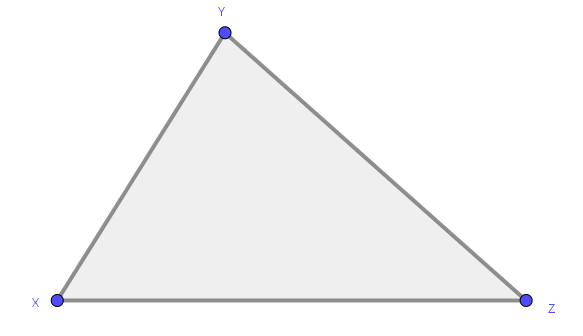
<p>This post starts with reading elsewhere about someone struggling with the following trig identity given a triangle with three angles x, y, z show:</p>

\[\tan{x} + \tan{y} + \tan{z} = \tan{x}\cdot\tan{y}\cdot\tan{z}\]

<h2 id="the-straightforward-approach">The Straightforward approach</h2>

<p>The first way I ended up doing this which was colored by some similar problems was just by working left to right and simplifying the expression with the hope I ended up with the right hand side.</p>

<p>Before getting going though its useful to examine the relationship between x, y, and z and how that plays out with the basic trig functions</p>

<ol>
  <li>$\sin{z} = \sin{(\pi - (x + y))} = \sin{(x + y)}$</li>
  <li>$\cos{z} = \cos{(\pi - (x + y))} = -\cos{(x + y)}$</li>
</ol>

<p>First looking at the first two terms restate in terms of sine and cosine:</p>

\[\tan{x} + \tan{y} = \frac{\sin{x}}{\cos{x}} + \frac{\sin{y}}{\cos{y}} = \frac{\sin{x}\cdot\cos{y} + \sin{y}\cdot\cos{x}}{\cos{x}\cdot\cos{y}}\]

<p>That top expression should look familiar: its sine addition</p>

\[\tan{x} + \tan{y} = \frac{\sin(x + y)}{\cos{x}\cdot\cos{y}}\]

<p>And we can then restate in terms of z</p>

\[\tan{x} + \tan{y} = \frac{\sin{z}}{\cos{x}\cdot\cos{y}}\]

<p>That feels like progress since we’ve converted everything into products and we have part of the right hand side already. Next we need to combine the remaining piece on the left hand side:</p>

\[\tan{x} + \tan{y} + \tan{z} = \frac{\sin{z}}{\cos{x}\cdot\cos{y}} + \tan{z} = \frac{\sin(z)\cdot\cos{z} + \sin{z}\cdot\cos{x}\cdot\cos{y}}{\cos{x}\cdot\cos{y}\cdot\cos{z}}\]

<p>I’m going to factor out $\sin{z}$</p>

\[\tan{x} + \tan{y} + \tan{z} = \sin{z} \cdot \frac{\cos{z} + \cos{x}\cdot\cos{y}}{\cos{x}\cdot\cos{y}\cdot\cos{z}}\]

<p>And now we’ll once again replace $\cos{z}$ with its equivalent in terms of x and y (after all we only want x and y now in the remaining expression)</p>

\[\tan{x} + \tan{y} + \tan{z} = \sin{z} \cdot \frac{-\cos{(x + y)} + \cos{x}\cdot\cos{y}}{\cos{x}\cdot\cos{y}\cdot\cos{z}}\]

<p>That’s convenient for when we expand the cosine addition we get:</p>

\[\tan{x} + \tan{y} + \tan{z} = \sin{z} \cdot \frac{-\cos{x}\cdot\cos{y} + \sin{x}\cdot\sin{y} + \cos{x}\cdot\cos{y}}{\cos{x}\cdot\cos{y}\cdot\cos{z}} = \sin{z} \cdot \frac{\sin{x}\cdot\sin{y}}{\cos{x}\cdot\cos{y}\cdot\cos{z}}\]

<p>And that’s exactly the right hand sign expression!</p>

<h2 id="but-wait-">But wait …</h2>

<p>I translated to sine and cosine reflexively when starting before because it usually makes things more approachable. But can we directly manipulate the tangents and follow the same general flow?</p>

<p>To start I’m going to add the a third equivalence relation</p>

<ol>
  <li>$\tan{z} = \tan{(\pi - (x + y))} = -\tan{(x + y)}$</li>
</ol>

<p>Lets substitute that in</p>

\[\tan{x} + \tan{y} + \tan{z} = \tan{x} + \tan{y} - \tan{(x+y)}\]

<p>And then apply the tangent addition identity</p>

\[\tan{x} + \tan{y} + \tan{z} = \tan{x} + \tan{y} - \frac{\tan{x} + \tan{y}}{1 - \tan{x}\cdot\tan{y}}\]

<p>Simplifying that into a common fraction we get a few cancellations:</p>

\[\tan{x} + \tan{y} + \tan{z} = \frac{ -(\tan{x} + \tan{y}) \cdot\tan{x}\cdot\tan{y} }{1 - \tan{x}\cdot\tan{y}}\]

<p>And then we can just apply 3. again and do everything in reverse to get the desired result</p>

\[\tan{x} + \tan{y} + \tan{z} = \tan{x}\cdot\tan{y}\cdot \frac{ -(\tan{x} + \tan{y}) }{1 - \tan{x}\cdot\tan{y}}\]

\[\tan{x} + \tan{y} + \tan{z} = \tan{x}\cdot\tan{y}\cdot -\tan{(x + y)} = \tan{x}\cdot\tan{y}\cdot\tan{z}\]]]></content><author><name>Benjamin Leis</name></author><category term="trigonometry" /><category term="identities" /><category term="proofs" /><summary type="html"><![CDATA[This post starts with reading elsewhere about someone struggling with the following trig identity given a triangle with three angles x, y, z show: $$ \tan{x} + \]]></summary><media:thumbnail xmlns:media="http://search.yahoo.com/mrss/" url="https://mathoffthegrid.net/%7B%7B%20site.baseurl%20%7D%7D/assets/img/2023-02-04/trig-identity-triangle.png" /><media:content medium="image" url="https://mathoffthegrid.net/%7B%7B%20site.baseurl%20%7D%7D/assets/img/2023-02-04/trig-identity-triangle.png" xmlns:media="http://search.yahoo.com/mrss/" /></entry><entry><title type="html">Mastodon: The Wild Wild Neolithic West</title><link href="https://mathoffthegrid.net/2022/11/08/mastodon-the-wild-wild-neolithic-west.html" rel="alternate" type="text/html" title="Mastodon: The Wild Wild Neolithic West" /><published>2022-11-08T12:20:00-05:00</published><updated>2022-11-08T12:20:00-05:00</updated><id>https://mathoffthegrid.net/2022/11/08/mastodon-the-wild-wild-neolithic-west</id><content type="html" xml:base="https://mathoffthegrid.net/2022/11/08/mastodon-the-wild-wild-neolithic-west.html"><![CDATA[<p>Its been a long while since my last social media post: <a href="/2017/08/08/how-i-use-twitter.html">how-i-use-twitter</a>  and everything is all of a sudden in huge flux.  With all the turmoil on Twitter I’ve been exploring Mastodon on the math focused server a friend runs: <a href="http://mathstodon.xyz">mathstodon.xyz</a>.   However, a new platform means starting over again</p>

<ul>
  <li><strong>You have to rebuild your network of follows and followers</strong>.  This is huge and discovering people has made my previous two attempts at using Mastodon unsatisfying.   But this time is different due to the chaos at Twitter. Large enough groups of people I know have migrated that I could start with a core group of folks and participate in enough conversations to have fun while finding new people.</li>
</ul>

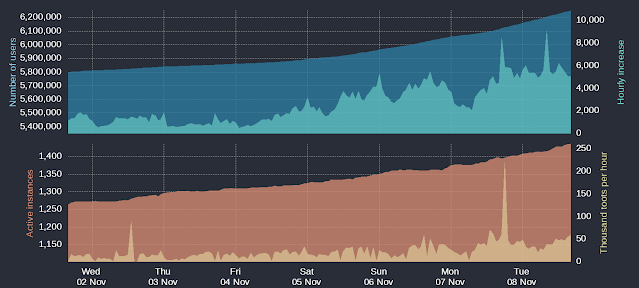
<p><img src="/assets/img/mastodon-the-wild-wild-neolithic-west/blogger_2ff09a2b.png" alt="" />
Why things are vital this time - The extraordinary growth of the network</p>

<ul>
  <li>
    <p><strong>Peculiarities</strong>.   Mastodon isn’t twitter and has a few quirks that you have to get used. No quote tweets due to a fear of harassment (which seems overly paranoid to me - since you’re just a screenshot away from the same effect)  and a general stance that makes discoverability harder.  You have to use hashtags since full text search doesn’t exist across the fediverse. And sometimes the other instance’s data is an extra hop away from your server . For instance, you’re surfing a profile on another server and sometime have to click to it to get full info.  Crucially, since each instance only stores the posts that users on it follows - there is a **deep effect on search **even for hashtags. You can only see what you know about or someone else on your instance knows about.  As a consequence, the larger the server grows the more useful it becomes if you’re interested in finding things . There’s also an overly precious stance on content warnings that doesn’t fit my theory of action. But I can live with that. </p>
  </li>
  <li>
    <p><strong>Usability</strong> Once you have enough people in your network Mastodon is quite usable despite the large discoverability issues. Can it be your only microblogging platform? That remains an open question for me.  The overall network is <em>much</em> smaller than twitter. I don’t need most of the twitterverse though just the parts I read.  And on that front - the missing piece is probably government and media accounts.  For now there are bridge sites like birdsite.wilde.cloud that will publish tweets to toots.  But they aren’t quite realtime or completely reliable.  But the network is growing very rapidly (See above) so the situation could very easily shift in the upcoming months.</p>
  </li>
  <li>
    <p><strong>Trust</strong>.  This is a huge general issue. I went with mathstodon because I knew the admins and could implicitly assume they would operate in good faith.  But how are millions of people going to make that leap?   I feel like there needs to be some type of  vetting process or change in structure  for many of the instances to answer this question.  Perhaps there will be multitudes of small sites where everyone personally knows someone involved - perhaps companies will enter the space and you’ll pay for some additional guarantees of stability/security?  This also remains to be seen and I expect new developments as growth continues.  But that’s the key as well - the network is growing despite this issue so its not an adoption blocker yet.</p>
  </li>
  <li>
    <p><strong>Scalability.  </strong>In addition to the question of trust across large networks Mastodon is untested technically at twitter-like scales.  What’s going to happen when instead of 50k posts per hour there are 1M?  I could easily imagine a rewrite in its future off Ruby for instance. But even if you make technical fixes when everyone runs there own server you can’t easily distribute them. The same goes for scaling up infrastructure when your not running in a single companies datafarm.  Its a huge distributed process.</p>
  </li>
  <li>
    <p><strong>Maintainability.   </strong>I don’t see how longer term, all the infrastructure can continue to be supplied by volunteers.  Keeping servers up and running at scale is real wor and  I’m not sure if enough new people are going to step up to provide sites for a 10x increase in users.  Practically, it all costs $$$ to run larger sites. Perhaps this is going to be solved with donations but that will be a long term issue. As will governance and long term succession plans.  How will each site organize to spread out serveradmin tasks, make sure if someone retires there is plan going forward, make crucial moderation decisions etc. </p>
  </li>
</ul>

<p>But nevertheless, I’m having fun and experimenting.  I think people are going to tackle most of the issues I raise out of necessity.  So despite all the open questions I’m in for the ride for now and we’ll see where things go …   You can fine me @benleis@mathstodon.xyz
<img src="/assets/img/mastodon-the-wild-wild-neolithic-west/blogger_61c970b9.png" alt="" /></p>]]></content><author><name>Benjamin Leis</name></author><category term="mastodon" /><category term="twitter" /><summary type="html"><![CDATA[Its been a long while since my last social media post: how-i-use-twitter  and everything is all of a sudden in huge flux.  With all the turmoil on Twitter I’ve been exploring Mastodon on the math focused server a friend runs: mathstodon.xyz.   However, a new platform means starting over again]]></summary><media:thumbnail xmlns:media="http://search.yahoo.com/mrss/" url="https://mathoffthegrid.net/%7B%7B%20site.baseurl%20%7D%7D/assets/img/mastodon-the-wild-wild-neolithic-west/blogger_2ff09a2b.png" /><media:content medium="image" url="https://mathoffthegrid.net/%7B%7B%20site.baseurl%20%7D%7D/assets/img/mastodon-the-wild-wild-neolithic-west/blogger_2ff09a2b.png" xmlns:media="http://search.yahoo.com/mrss/" /></entry><entry><title type="html">Unexpected Binomial Theorem Connection</title><link href="https://mathoffthegrid.net/2022/09/03/unexpected-binomial-theorem-connection.html" rel="alternate" type="text/html" title="Unexpected Binomial Theorem Connection" /><published>2022-09-03T14:32:00-04:00</published><updated>2022-09-03T14:32:00-04:00</updated><id>https://mathoffthegrid.net/2022/09/03/unexpected-binomial-theorem-connection</id><content type="html" xml:base="https://mathoffthegrid.net/2022/09/03/unexpected-binomial-theorem-connection.html"><![CDATA[<p><img src="/assets/img/unexpected-binomial-theorem-connection/blogger_8b675d03.png" alt="" /></p>

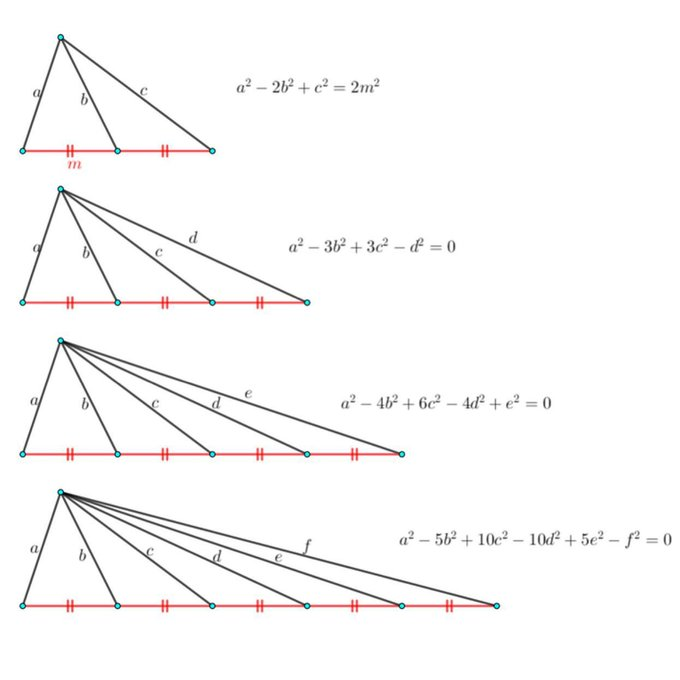
<p>Source: @ElyemGercek</p>

<p>I saw this post and immediately thought: “What an odd connection to Pascal’s
 Triangle. What’s going on?”</p>

<p>Due to time constraints I didn’t get a chance to look into this for several
 weeks and while its not quite as geometric as I hoped the connection is fairly
 natural.</p>

<p>First just as in the triangle you need an initial row of values from which the
 relation will then generate all the rest of the rows.  In this case its
 the triangle with a single median.  <a href="https://en.wikipedia.org/wiki/Stewart%27s_theorem">Stewart’s Theorem</a>  is helpful here for finding the initial equation.  What’s novel
 is while I’ve done this before I’ve never rearranged in this fashion.</p>

<p>$ a^2 \cdot m  + c^2 \cdot m = 2m \cdot (m^2 + b^2) $</p>

<p>$a^2 + c^2 = 2 \cdot (m^2 + b^2) $</p>

<p>$ a^2 - 2b^2 + c^2 = 2m^2 $</p>

<p>What then happens in each iteration is we split the triangle into two smaller
 versions which we can then find find an equation for using the previous
 step.  Note: how there are two inputs just like in Pascal’s triangle.</p>

<p>For example:</p>

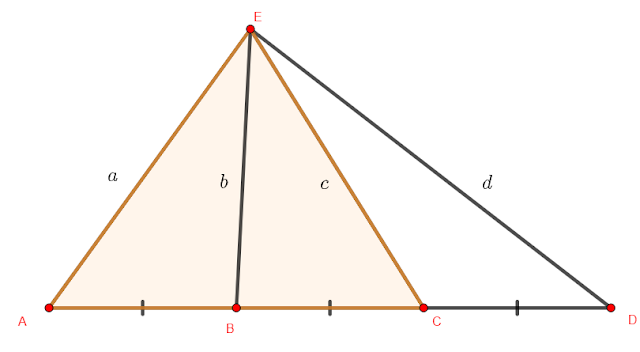
<p><img src="/assets/img/unexpected-binomial-theorem-connection/blogger_8b718289.PNG" alt="" /></p>

<p>From the left hand triangle we get $a^2 - 2b^2 + c^2 = 2m^2$. Then we can do
the same on the right hand side:</p>

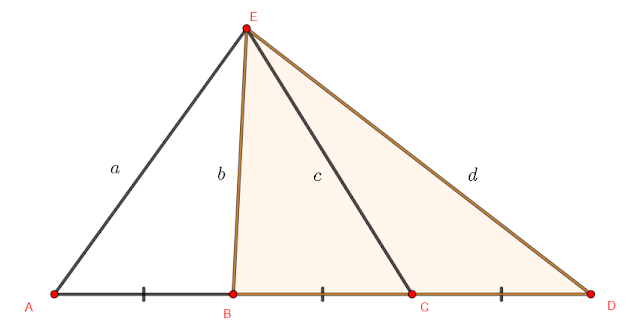
<p><img src="/assets/img/unexpected-binomial-theorem-connection/blogger_b60bce46.PNG" alt="" /></p>

<p>The right hand triangle gives us $b^2 - 2c^2 + d^2 = 2m^2$.   
 Since both equations are equal to $2m^2$ we can then form the following
 new equality:</p>

<p>$a^2 - 2b^2 + c^2 = b^2 - 2c^2 + d^2 $</p>

<p>$ a^2 + -2b^2 - b^2 + c^2 + 2c^2 - d^2 = 0 $</p>

<p>$ a^2 - 3b^2 + 3c^2 - d^2 = 0$</p>

<p>This same pattern can be now repeated each time we divide into a left and right hand triangle and use the previous result.  Each of these expressions are equal to 0 (after the first median triangle). We can then equate them and simplify.  Each time we get the same shifting of the variable over by one between the two triangles and so just like in pascal’s triangle we’re adding the adjacent terms to generate the next row.  </p>]]></content><author><name>Benjamin Leis</name></author><summary type="html"><![CDATA[Source: @ElyemGercek]]></summary><media:thumbnail xmlns:media="http://search.yahoo.com/mrss/" url="https://mathoffthegrid.net/%7B%7B%20site.baseurl%20%7D%7D/assets/img/unexpected-binomial-theorem-connection/blogger_8b675d03.png" /><media:content medium="image" url="https://mathoffthegrid.net/%7B%7B%20site.baseurl%20%7D%7D/assets/img/unexpected-binomial-theorem-connection/blogger_8b675d03.png" xmlns:media="http://search.yahoo.com/mrss/" /></entry><entry><title type="html">Properly fitting Problems</title><link href="https://mathoffthegrid.net/2022/04/23/properly-fitting-problems.html" rel="alternate" type="text/html" title="Properly fitting Problems" /><published>2022-04-23T21:07:00-04:00</published><updated>2022-04-23T21:07:00-04:00</updated><id>https://mathoffthegrid.net/2022/04/23/properly-fitting-problems</id><content type="html" xml:base="https://mathoffthegrid.net/2022/04/23/properly-fitting-problems.html"><![CDATA[<h1><img src="/assets/img/properly-fitting-problems/blogger_a086d804.png" alt="" /></h1>

<p>What motivated this essay was two posts I recently saw. The first started with the idea that no student should take more than five minutes on a problem. If stuck it was unlikely to be productive and they should just move on.  In case, there was any confusion this expanded to the idea that investigations or inquiry based learning was ineffective. Secondly, was a note from an acquaintance about how he was about to start a class for pre-service teachers about the pedagogy of problems in the classroom which piqued my interest about which problems he would be using.  Together these readings motivated me to think again about “Where do mathematical problems fit?” 
<img src="/assets/img/properly-fitting-problems/blogger_9f065568.png" alt="" /></p>

<p>To start though you have to step back and define the problem.  The classic “word problems” of elementary school are generally a misnomer.  Students typically (but there are exceptions) know all the operational procedures to solve them and are being asked to practice translating from natural language into mathematical statements.  Instead, I’m fond of the dichotomy between an exercise versus a problem.  An exercise is a mathematical task that one knows how to do or has seen demonstrated and is aimed at practicing a skill or procedure in the service of mastery.  On the other hand, a problem is a mathematical task where the solution is unknown at the start and one must reason how to solve it along the way. Importantly, this distinction is relative to the practitioner.  What may be an exercise for me, can be a problem for someone else or vice versa depending on what prior knowledge we each have.  That also means problems exist at every grade level but because they reflect where the solver is, have almost infinitely different and evolving forms. 
For me, problems are also central to learning mathematics.  Skills like basic arithmetic are important in of themselves but also are only stepping stones and tools towards the service of mathematical exploration and understanding.  This creates some difficult tensions though.  Especially when beginning what is the proper balance between mastering skills and thinking about unsolved questions? Channeling the first author, the answer would be initially its mostly useless to try problems, the learner doesn’t have enough prior knowledge and domain experience.  Problems just waste time and more seriously are ineffective for knowledge acquisition. In other words, even when one solves one, the process is not well synthesized.  There’s usually some discussion of how experts approach problems differently but not much discussion of how or when one reaches that state (other than usually the impression its postsecondary at least)</p>

<p><img src="/assets/img/properly-fitting-problems/blogger_d77e4623.png" alt="" />
On the other hand, there are plenty of Inquiry Based Learning advocates that are all in with problems on a daily basis.  Its easy to find a class vignette with everyone standing around whiteboards working on some communal task that will take a class period.  All of which seems delightful but then the sneaking suspicions enter about the amount of mathematical ground being covered or if enough practice is occurring for growth to occur.  After seeing yet another task involving rearranging the digits 1-10 to fit into some equations I often end up thinking how its very easy to idle in the domain of pre-algebra and never really get anywhere. 
Instead, I inhabit a middle ground. Time is limited but its important to constantly encounter problems through school in the service of  developing patterns of thinking. At the same time, there needs to be a large amount of exercises along the way or you flounder without ever mastering concepts confidently enough to utilize them later. That’s a very tricky space given the constraints. So I think you always have to be strategic in what you choose not only in how to to balance the hours between longer problems and practice exercises but what forms each take.  To keep to the flow, the problems should riff on the concepts being worked on in an exercise or require one to practice a skill in the service of the solution so you are getting double duty out of it. They should also advance the arc of the subject being explored.  That’s constraining in the sense there are plenty of interesting non-curricular tasks one could do but only a subset align well with the overall goals for a class. Like many artforms though within those limits there still is tremendous opportunity for creativity and interesting experiences.
Example:
I’m going to draw from my own experience doing math circle activities where I’m very purposely fairly random about activities because we exist outside the curriculum. But I often run into things that would work really well in a classroom setting paired with a learning goal. Recently we tried out determining the number of rectangles that could be fit in one larger one.</p>
<p><img src="/assets/img/properly-fitting-problems/blogger_4db03f47.png" alt="" />There are 60 sub rectangles in the above 3x5
The process for exploring this was fairly messy and time consuming and involved a lot of counting strategies and looking for patterns. But the ultimate solution has deep connections to combinatorics and would work really well embedded in a unit on combinations, pascal’s triangle (or both).  If doing so you’d want to combine it with simpler exercises on calculating combinations and using their properties along with other simpler problems that built towards being able to tackle this one.
Creating, integrating and curating these tasks is the crux of the instructor “problem”.  Its easy to go a little astray and end up with a problem that falls flat and no one can solve or is too easy or fails to make the crucial connection or is boring. The chance for failure is fairly large. But practice helps and keeping one’s eye on  this ultimate goal and reflecting on how each attempt at  problem integration into a sessions plays out aids in more effectively using them.  And to return to my central philosophy, problems are too essential to Mathematics to not keep tilting at figuring out how to properly use them. </p>]]></content><author><name>Benjamin Leis</name></author><summary type="html"><![CDATA[What motivated this essay was two posts I recently saw. The first started with the idea that no student should take more than five minutes on a problem. If...]]></summary><media:thumbnail xmlns:media="http://search.yahoo.com/mrss/" url="https://mathoffthegrid.net/%7B%7B%20site.baseurl%20%7D%7D/assets/img/properly-fitting-problems/blogger_a086d804.png" /><media:content medium="image" url="https://mathoffthegrid.net/%7B%7B%20site.baseurl%20%7D%7D/assets/img/properly-fitting-problems/blogger_a086d804.png" xmlns:media="http://search.yahoo.com/mrss/" /></entry><entry><title type="html">Carnival of Mathematics 203</title><link href="https://mathoffthegrid.net/2022/04/02/carnival-of-mathematics-203.html" rel="alternate" type="text/html" title="Carnival of Mathematics 203" /><published>2022-04-02T15:45:00-04:00</published><updated>2022-04-02T15:45:00-04:00</updated><id>https://mathoffthegrid.net/2022/04/02/carnival-of-mathematics-203</id><content type="html" xml:base="https://mathoffthegrid.net/2022/04/02/carnival-of-mathematics-203.html"><![CDATA[<p><img src="/assets/img/carnival-of-mathematics-203/blogger_8df3e4ba.png" alt="" width="120%" />
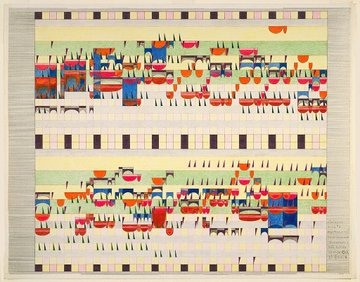
<em>Graphic scores by John De Cesare (1890–1972).</em></p>

<p>Welcome to the 203rd Carnival. For all the other carnivals future and past,
visit
<a href="https://www.blogger.com/blog/post/edit/4227811469912372962/6398802341507033330#">The Aperiodical </a>where you can also submit future posts.  This is my fifth go around
hosting a carnival and the first time I’ve done so during March. So hold onto
your hats and prepare to be inundated with Pi Day material.  For those
jaded souls among you, there will be plenty of interesting math and  no
digit reciting contests. (If you’re in the other camp I found this 
<a href="https://www.youtube.com/watch?v=3HRkKznJoZA">Pi Day Digit Song</a> quite amusing this year)</p>

<p>Before we really get going via
 <a href="http://wikipedia.org">wikipedia.org</a> here are few facts
 about the number 203.  (We’re getting higher up the ordinals and sadly
 the list of references is getting shorter)</p>

<p>203 is the seventh
 <a href="https://en.wikipedia.org/wiki/Bell_number">Bell number</a>, giving
 the number of
 <a href="https://en.wikipedia.org/wiki/Partition_of_a_set">partitions of a set</a>
 of size 6, 203 different triangles can be made from three rods with integer
 lengths of at most 12, and 203 integer squares (not necessarily of unit size)
 can be found in a staircase-shaped
 <a href="https://en.wikipedia.org/wiki/Polyomino">polyomino</a> formed by
 stacks of unit squares of heights ranging from 1 to 12.</p>

<p>## 
 All things π</p>

<p><img src="/assets/img/carnival-of-mathematics-203/blogger_ea2cc391.gif" alt="" /></p>

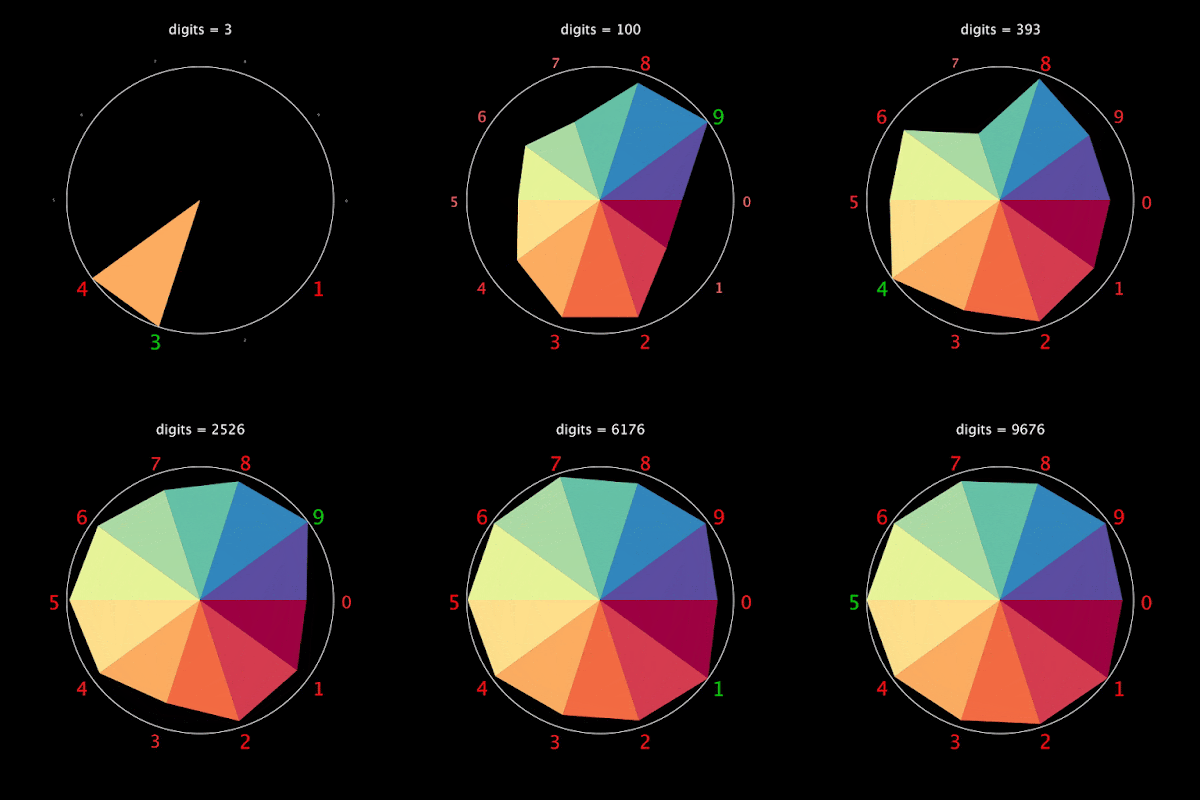
<p><strong>David Berardo - Pi Digit Distribution</strong></p>

<p>I really enjoyed the set of *mostly *new pi videos I watched this
 year.  We’re going to start with @TedG’s well done animated
 presentation using Gregory’s theorem to approximate the value of Pi. The idea is similar to Archimedes approximation but uses area instead of
 perimeters The video is based on an article he wrote with a collaborator
 about 3-4 years ago.  I never tire of another way to find pi. </p>

<p><a href="https://youtu.be/-LVpjnaqtwU">https://youtu.be/-LVpjnaqtwU</a></p>

<p>Speaking of folks attempting to calculate pi, Matt Parker continued his
 longstanding series of pi approximations this year with a stab at using
 Shank’s method.  The project involved human computers and watching how
 they self organized to maximize efficiency and accuracy was thought
 provoking.  In the end, as per tradition, the attempt was heartbreakingly
 derailed by calculation error but I feel that’s half the fun of these
 videos.     For another background piece on what’s going on I
 found  this writeup on  Mancin’s formula <a href="http://personalpages.to.infn.it/~zaninett/pdf/machin.pdf">http://personalpages.to.infn.it/~zaninett/pdf/machin.pdf</a> quite useful.</p>

<p>On a more artistic theme, Vi Hart had a new video up as well where she worked
 with mapping the digits of pi onto the musical scale and translated it into
 music. I enjoyed the composition process and hearing her thinking as she went
 along and the end result was more musical than I would have ever dreamt given
 the source material.</p>

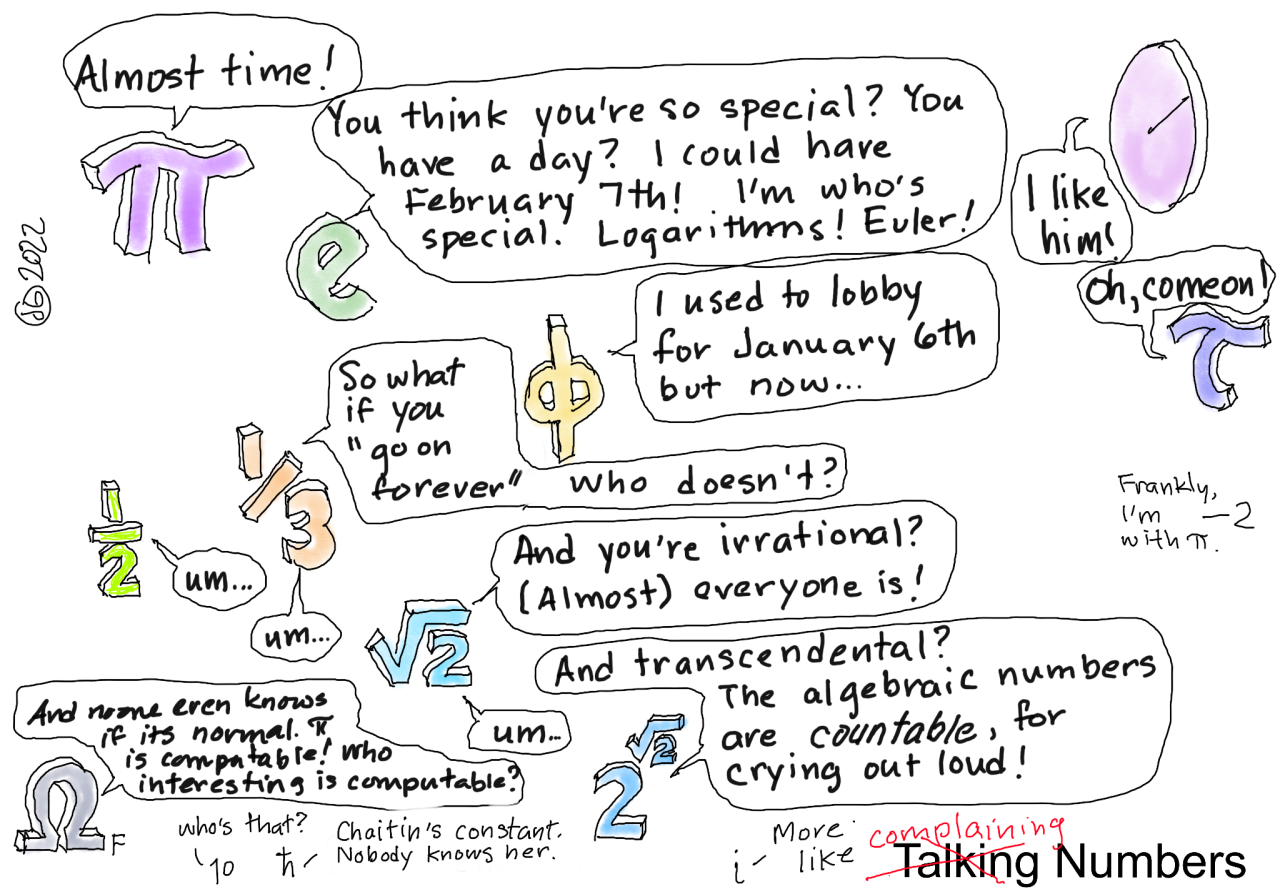
<p>Somewhere in the middle of all this serious and/or beautiful material  I
 also found the   Talking Numbers blog a welcome bit of light humor:</p>

<p><img src="/assets/img/carnival-of-mathematics-203/blogger_bacc4b97.png" alt="" /></p>

<p><a href="https://talkingnumbers.tumblr.com/post/677995936069320704/pi-me-a-river">https://talkingnumbers.tumblr.com/post/677995936069320704/pi-me-a-river</a></p>

<p>We have another blog up next  from  Gianluigi Filippelli on the various infinite series that lead to pi . This
 time it examines the historical development of expressions for $
 \dfrac{\pi}{2}$  and $\dfrac{2}{\pi} $  Not surprisingly
 infinite series again are at the heart of all this.  (Series are
 fundamental would be my personal take away this year)</p>

<p><a href="http://docmadhattan.fieldofscience.com/2022/03/pi-day-viete-infinite-series.html">http://docmadhattan.fieldofscience.com/2022/03/pi-day-viete-infinite-series.html</a>   </p>

<p>Penultimately, I’m including one slightly older video that I also watched
 that ties back into the previous one on Shank’s method.  Here the
 Mathologer, Burkard Polster, goes through another well animated proof of
 pi’s irrationality. And once again the arctangent plays a prominent
 role.  The background material led me to a long digression down the
 derivation of the  <a href="https://proofwiki.org/wiki/Power_Series_Expansion_for_Real_Arctangent_Function">Arctangent Taylor Series</a> and then trying out converting it by hand into a <a href="https://functions.wolfram.com/ElementaryFunctions/ArcTan/10/">continued fraction</a>.    Watch this one in a pair with Matt Parker’s one.</p>

<p>Rounding things out is this performance piece / poem from Harry Baker. </p>

<blockquote>

</blockquote>

<p>I wrote a poem about circles for
 <a href="https://twitter.com/hashtag/PiDay?src=hash&amp;ref_src=twsrc%5Etfw">#PiDay</a>
 then I put on my fave circle t-shirt and filmed it walking around in a big
 circle. Enjoy x
 <a href="https://t.co/jzxwEOBZKv">pic.twitter.com/jzxwEOBZKv</a></p>

<p>— Harry Baker (@harrybakerpoet)
 <a href="https://twitter.com/harrybakerpoet/status/1503296176917041153?ref_src=twsrc%5Etfw">March 14, 2022</a></p>

<p><img src="/assets/img/carnival-of-mathematics-203/blogger_3094f043.png" alt="" /></p>

<p><strong>Prime Number of the Day -
 <a href="https://twitter.com/dforouhari">Danesh Forouhari</a></strong></p>

<h2 id="all-the-rest-of-mathematics">All the Rest Of Mathematics</h2>

<p><img src="/assets/img/carnival-of-mathematics-203/blogger_869f595b.jpg" alt="" /></p>

<p>And now for something completely different … First up is a lovely post
on Noether’s Therorem by  Gianluigi Filippelli:  <a href="https://www.blogger.com/blog/post/edit/4227811469912372962/6256346026660681186#">http://docmadhattan.fieldofscience.com/2022/03/noethers-theorem.html</a>  On my bucket list is to someday go back and really understand Lie
groups.</p>

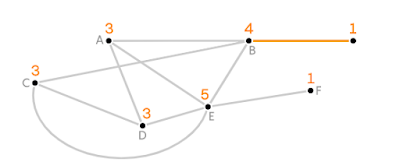
<p><img src="/assets/img/carnival-of-mathematics-203/blogger_15ed87f9.png" alt="" /></p>

<p>Patrick Honner has a new article up on Quanta Magazine:</p>

<p><a href="https://www.quantamagazine.org/what-a-math-party-game-tells-us-about-graph-theory-20220324/">https://www.quantamagazine.org/what-a-math-party-game-tells-us-about-graph-theory-20220324/</a></p>

<p>Exploring the hand shaking problem and graph theory.  This is one is
 accessible and comes with some great exercises at the end to play around with.</p>

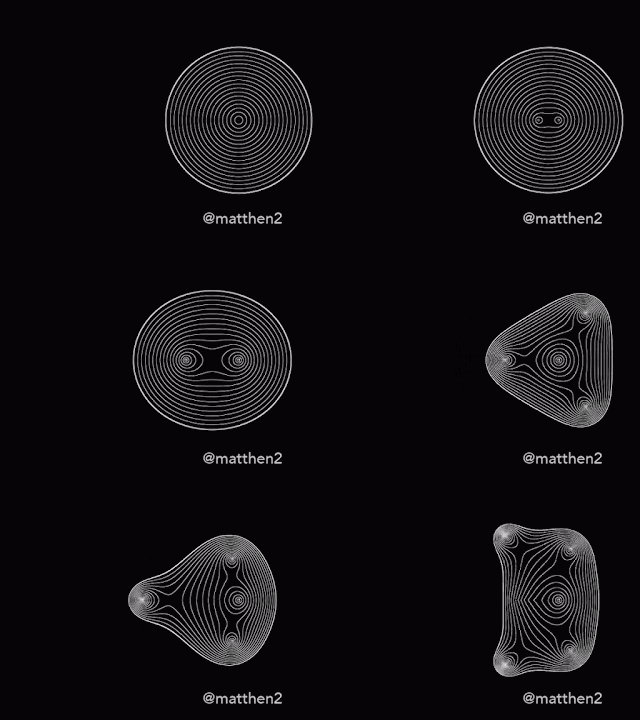
<p><img src="/assets/img/carnival-of-mathematics-203/blogger_52590148.gif" alt="" /></p>

<p><strong>Daniel Piker - Cubes</strong></p>

<p>On a related topic Tivadar Danka offered this fascinating thread on Twitter
 on the intesection between graph theory and linear algebra which I had never
 seen before and found really cool.</p>

<blockquote>

</blockquote>

<p>The single most undervalued fact of linear algebra: matrices are graphs,
 and graphs are matrices.</p>

<p>Encoding matrices as graphs is a cheat
 code, making complex behavior simple to study.</p>

<p>Let me show you
 how! <a href="https://t.co/8rBIkA8ZbZ">pic.twitter.com/8rBIkA8ZbZ</a></p>

<p>— Tivadar Danka 🇺🇦 (@TivadarDanka) <a href="https://twitter.com/TivadarDanka/status/1502215264544296962?ref_src=twsrc%5Etfw">March 11, 2022</a></p>

<p>Here’s another more metaphysical podcast from Tattva Deep  from one of
their podcasts recently:</p>

<p>” In this short video, we share some common and some not-so-common questions
 that each of them answered. All our guests seemed to possess a unique way of
 looking at maths and understanding what it might be about. And it changed the
 way we looked at maths and broadened our perception of it. We hope you derived
 pleasure and insights from these conversations as well. We’d love to hear what
 you have to say. together several interesting answers from their conversations
 about maths.”</p>

<p>Link: <a href="https://www.youtube.com/watch?v=OYp-HXEFsdg">https://www.youtube.com/watch?v=OYp-HXEFsdg</a></p>

<p><img src="/assets/img/carnival-of-mathematics-203/blogger_b39e8462.gif" alt="" /></p>

<p><strong>Matt Henderson - Mandelbrot Set</strong></p>

<p>Cameron Son writes this contemplative piece about his numeric visualization
 process:</p>

<p>“When doing any sort of mental arithmetic or
 visualization of quantities, I picture numbers as shapes. In my head,
 operations like addition and subtraction manifest themselves as physical
 interaction between these shapes, and are complete with sounds and tactile
 feelings.”</p>

<p><a href="https://www.blogger.com/#">http://www.csun.io/2022/03/03/how-i-see-numbers.html</a></p>

<p>And in our final entry for the month we have another well done video
 this time on Artificial Intelligence and pure mathematics.</p>

<p>“The
 usefulness of machine learning (ML) in pure mathematics is still the subject
 of much scepticism. However, a collaboration between representation theorist
 Geordie Williamson (University of Sydney) and AI lab DeepMind shows that ML
 algorithms can do more than just analyse large data sets. Geordie used
 DeepMind’s AI to suggest a possible line of attack on a 40-year-old
 conjecture about Kazhdan-Lusztig polynomials (the results were published in
 Nature in November 2021). In this video by the Sydney Mathematical Research
 Institute (SMRI), Geordie explains how AI can help 
with the intuitive
 elements of pure mathematics.”</p>

<p>Thanks again for reading. As usual the process of preparing this write
 up led me down so many interesting mathematical rabbit holes.</p>

<p><img src="/assets/img/carnival-of-mathematics-203/blogger_4134a633.png" alt="" /></p>

<p>  </p>]]></content><author><name>Benjamin Leis</name></author><category term="carnival of math" /><summary type="html"><![CDATA[Graphic scores by John De Cesare (1890–1972).]]></summary><media:thumbnail xmlns:media="http://search.yahoo.com/mrss/" url="https://mathoffthegrid.net/%7B%7B%20site.baseurl%20%7D%7D/assets/img/carnival-of-mathematics-203/blogger_8df3e4ba.png" /><media:content medium="image" url="https://mathoffthegrid.net/%7B%7B%20site.baseurl%20%7D%7D/assets/img/carnival-of-mathematics-203/blogger_8df3e4ba.png" xmlns:media="http://search.yahoo.com/mrss/" /></entry><entry><title type="html">15-75-90 on the quarter circle</title><link href="https://mathoffthegrid.net/2022/03/30/15-75-90-on-the-quarter-circle.html" rel="alternate" type="text/html" title="15-75-90 on the quarter circle" /><published>2022-03-30T11:44:00-04:00</published><updated>2022-03-30T11:44:00-04:00</updated><id>https://mathoffthegrid.net/2022/03/30/15-75-90-on-the-quarter-circle</id><content type="html" xml:base="https://mathoffthegrid.net/2022/03/30/15-75-90-on-the-quarter-circle.html"><![CDATA[<p><img src="/assets/img/15-75-90-on-the-quarter-circle/blogger_8bb6a461.png" alt="" /></p>

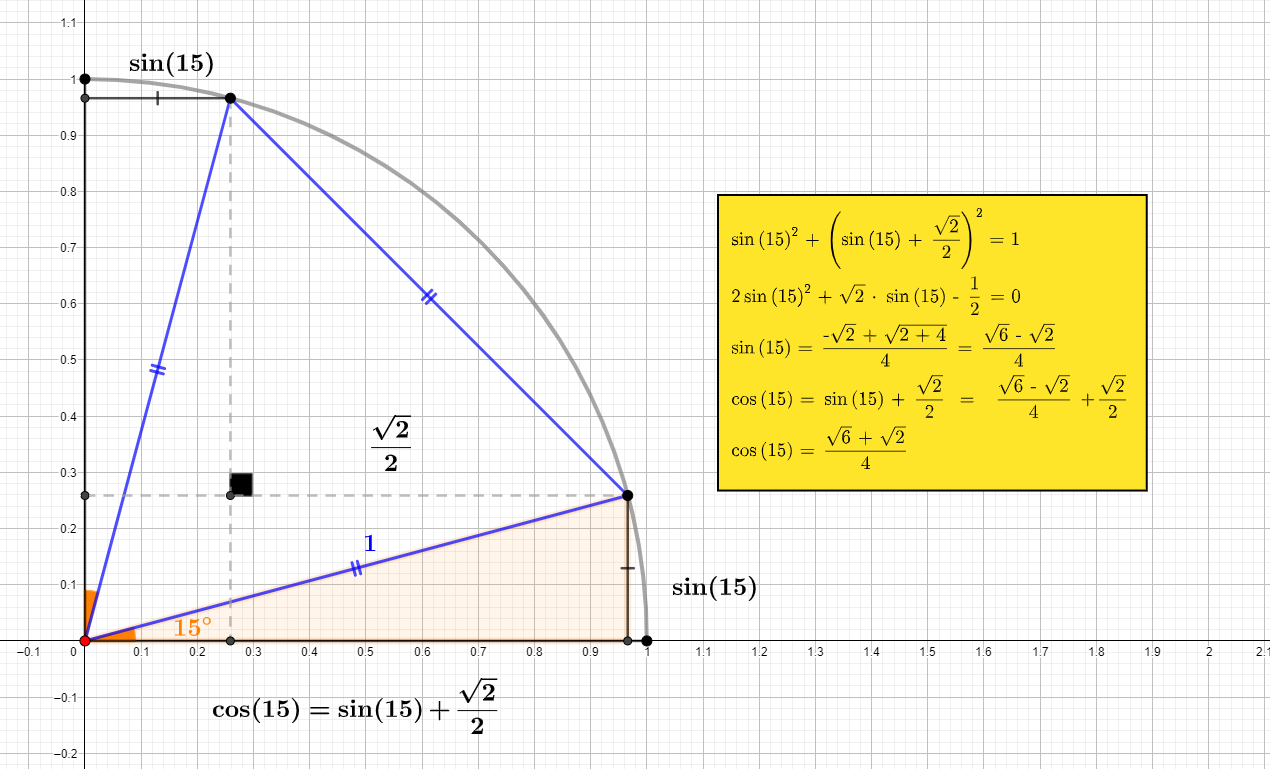
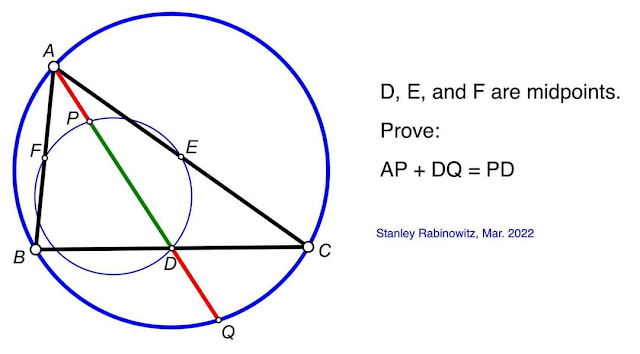
<p>I just saw a nice visual proof of the ratios for the 15-75-90 on the internet via @ilarrosac.   This one works via symmetry and the Pythagorean theorem. </p>]]></content><author><name>Benjamin Leis</name></author><category term="15-75-90" /><category term="geometry" /><summary type="html"><![CDATA[I just saw a nice visual proof of the ratios for the 15-75-90 on the internet via @ilarrosac.   This one works via symmetry and the Pythagorean theorem. ]]></summary><media:thumbnail xmlns:media="http://search.yahoo.com/mrss/" url="https://mathoffthegrid.net/%7B%7B%20site.baseurl%20%7D%7D/assets/img/15-75-90-on-the-quarter-circle/blogger_8bb6a461.png" /><media:content medium="image" url="https://mathoffthegrid.net/%7B%7B%20site.baseurl%20%7D%7D/assets/img/15-75-90-on-the-quarter-circle/blogger_8bb6a461.png" xmlns:media="http://search.yahoo.com/mrss/" /></entry><entry><title type="html">Two Circumcircles Walkthrough</title><link href="https://mathoffthegrid.net/2022/03/04/two-circumcircles-walkthrough.html" rel="alternate" type="text/html" title="Two Circumcircles Walkthrough" /><published>2022-03-04T15:45:00-05:00</published><updated>2022-03-04T15:45:00-05:00</updated><id>https://mathoffthegrid.net/2022/03/04/two-circumcircles-walkthrough</id><content type="html" xml:base="https://mathoffthegrid.net/2022/03/04/two-circumcircles-walkthrough.html"><![CDATA[<p><img src="/assets/img/two-circumcircles-walkthrough/blogger_cc5cf0c4.png" alt="" /></p>

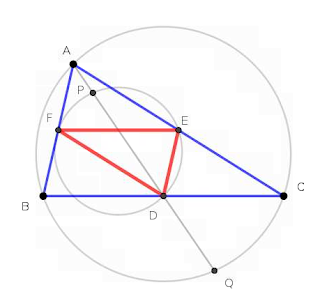
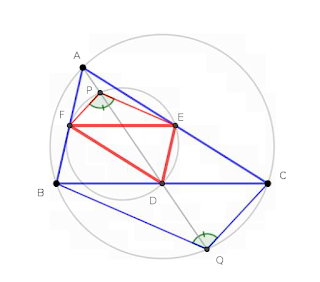
<p>I really enjoyed working through this problem from Stanley Rabinowitz I saw recently on Twitter. This was one of those problems where I circled around it and after finding the first solution realized I could improve it a lot and simplify the algebra fairly drastically.
One first impression,  I saw two things. First there was power of the point at D which could be used to give expressions for DQ and AD.  On the other hand AP looked like  it would be hardest segment to get a purchase on.
My second thought was around the midpoints and filling in the similar triangle DEF looking important as well finding all the congruent and parallel segments it created.
I started also filling in the cycle quadrilaterals as well at this point but didn’t immediately see to do with all of this.
Next I fired up geogebra and modelled a few thing.  One I was curious about the circumcenters and if they could help.  That didn’t immediately feel promising. The alignment in particular didn’t give me anything.   However, I did notice the centroids completely aligned as expected but I hadn’t though about that yet. (Others online went from there to homothety)
At this point I went back to a combination of a few of my initial experiments with the cyclic quadrilaterals and similar triangles and started just working out the ratios.
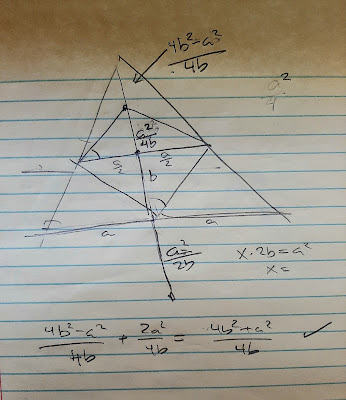
<img src="/assets/img/two-circumcircles-walkthrough/blogger_8bb053a9.png" alt="" /></p>

<p>You can see the basic algebra I worked out with the similar triangles and power of the point around the 2 intersections solved the proof.  But it wasn’t entirely satisfying.  Yes the calculation for the two parts were equal but why? It didn’t really feel like it was elucidating the structure. 
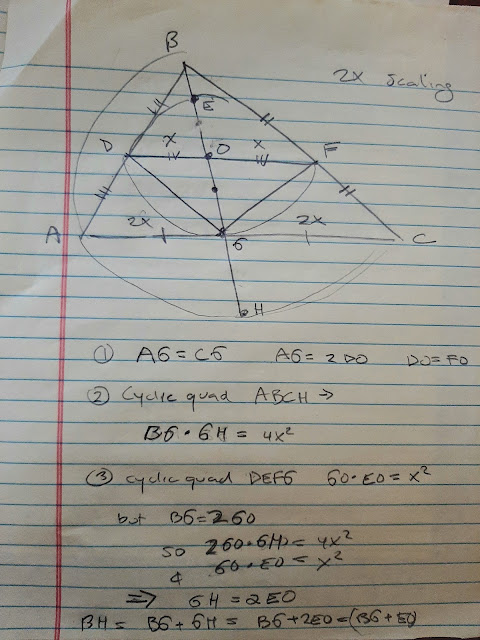
At this point I  could see that the 2x scaling for a and b above was key but I wondering what would happen if I started from that point. What I found below was  I  could drop all the ratios and just rely on the cyclic quads.</p>

<p><img src="/assets/img/two-circumcircles-walkthrough/blogger_e83cb180.png" alt="" /></p>

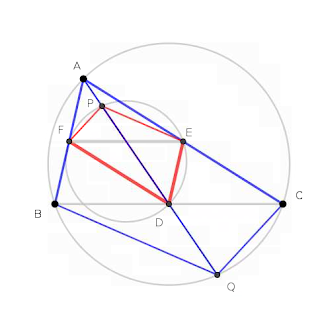
<p>But I kept thinking about the problem some more and had my final conceptual breakthrough. Above I ended up proving GH = 2EO at which point I could just do segment addition and subtraction but what did that imply?   Everything I kept looking at was 2x scaled. So what about the whole cyclic quads and their diagonals? As soon as I adjusted my mental model the final version fell out which is almost completely algebra free and focuses directly on scaling throughout.</p>

<p><img src="/assets/img/two-circumcircles-walkthrough/blogger_cc985a59.png" alt="" /></p>

<p><img src="/assets/img/two-circumcircles-walkthrough/blogger_f3e102ca.png" alt="" /></p>

<ul>
  <li>
    <p>The midpoints create an inner triangle DEF that is scaled 1:2 and
 rotated 180 degrees</p>
  </li>
  <li>
    <p>When circumscribed we then get 2 cyclic quadrilateral   DEPF
 and ABQC that are also scaled 1:2  and rotated 180 degrees</p>
  </li>
</ul>

<p><img src="/assets/img/two-circumcircles-walkthrough/blogger_3da51d62.png" alt="" /></p>

<ul>
  <li>
    <p>That means the central diagonals AQ and PD are also scaled 1:2</p>
  </li>
  <li>
    <p>If AQ = 2PD then AQ - PD = PD or recasting  AP + DQ  = PD</p>
  </li>
</ul>]]></content><author><name>Benjamin Leis</name></author><category term="cyclic quadrilateral" /><category term="geometry" /><category term="walkthrough" /><summary type="html"><![CDATA[I really enjoyed working through this problem from Stanley Rabinowitz I saw recently on Twitter. This was one of those problems where I circled around it and after finding the first solution realized I could improve it a lot and simplify the algebra fairly drastically. One first impression,  I saw two things. First there was power of the point at D which could be used to give expressions for DQ and AD.  On the other hand AP looked like  it would be hardest segment to get a purchase on. My second thought was around the midpoints and filling in the similar triangle DEF looking important as well finding all the congruent and parallel segments it created. I started also filling in the cycle quadrilaterals as well at this point but didn’t immediately see to do with all of this. Next I fired up geogebra and modelled a few thing.  One I was curious about the circumcenters and if they could help.  That didn’t immediately feel promising. The alignment in particular didn’t give me anything.   However, I did notice the centroids completely aligned as expected but I hadn’t though about that yet. (Others online went from there to homothety) At this point I went back to a combination of a few of my initial experiments with the cyclic quadrilaterals and similar triangles and started just working out the ratios.]]></summary><media:thumbnail xmlns:media="http://search.yahoo.com/mrss/" url="https://mathoffthegrid.net/%7B%7B%20site.baseurl%20%7D%7D/assets/img/two-circumcircles-walkthrough/blogger_cc5cf0c4.png" /><media:content medium="image" url="https://mathoffthegrid.net/%7B%7B%20site.baseurl%20%7D%7D/assets/img/two-circumcircles-walkthrough/blogger_cc5cf0c4.png" xmlns:media="http://search.yahoo.com/mrss/" /></entry></feed>