6/7 Hinged Polygons
I was pleased that this week ran much more smoothly than last time.
- First I didn’t serve candy which probably helped.
- I decided to give a little talk to start off about working on listening to each other when working on the whiteboard. This was similar to the one I did at the start of the club.
- I swapped the warmup activity in front of the problem of the week. The theory was this would let everyone transition back to math after the bell. I don’t really want to do this permanently since kids work at different paces and that means I have to stop some in the middle after most of them are done.
- The problem of the week was less procedural and easier to explain in a shorter period of time.
- I also changed my tack a bit and instead of asking for people to demonstrate solutions, I asked them to talk about what strategies they used without necessarily showing and writing all the details. I think this is something I’m going to return to next year.
Some combination of all this made everyone’s focus improve. For the warm up I picked an nrich.maths.org worksheet: shape times shape worksheet that I’ve had my eye on. Many kids finished it a bit quicker than I expected (under 5min vs my guess of 10) . This was the first discussion where I tried out asking for strategies explicitly. The general results were fairly positive. I had lots of hands up and each one went fairly quickly and I think although I’ll have to watch more that it was easier to digest for the group.
We then talked over the 5 pirate puzzle from last week. http://www.mathsisfun.com/puzzles/5-pirates.html The kids almost immediately jumped to the recursive solution so I only had to pick different students to go over each subcase one by one as we built to 5. Along the way we hit a snag at 4 pirates where there were 2 different solutions offered. So I had each presenter each explain why there was correct and then had the group talk about which one was better. This was also a productive conversation.
For the main activity I was fascinated by this particular hinged polygon transformation:!
I found the following worksheet: http://think-maths.co.uk/downloads/hinged-triangle to have everyone try the triangle to square transform. During the start I mentioned that this was a general property of polygons but I did not go any farther. It would be possible to build on this a bit more next year if I redo.
!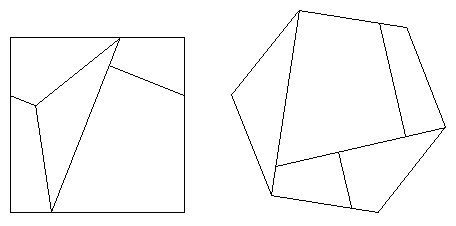
I also copied another non-hinged dissection square to hexagon for the kids to cutout and try if they finished the first:
https://books.google.com/books?id=pW_0EisSP4IC&pg=PA120&lpg=PA120&dq=hinged+dissection+octagon&source=bl&ots=9C0Pj4jPt2&sig=bVccQxe6KvtTSWdHr8F9ihZvPjQ&hl=en&sa=X&ved=0ahUKEwj_4P7ZnZTNAhUI9GMKHRtjDRYQ6AEIJjAB#v=onepage&q=hinged%20dissection%20octagon&f=false
Then to round things out I brought a huge box of crayons to use for another set of matchstick puzzles:
http://www.aimsedu.org/category/puzzle/toothpick-puzzles/
Both activities were well received but I’d like to buildup the polygon dissections a bit more so they are a full session’s worth of material and they go a bit deeper. I plan to brainstorm more about this.
P.O.T.W What is the smallest whole number that has a remainder of 1 when divided by 4, a remainder of 1 when divided by 3, and a remainder of 2 when divided by 5?
Leave a comment