Carnival of Maths 255
Intro
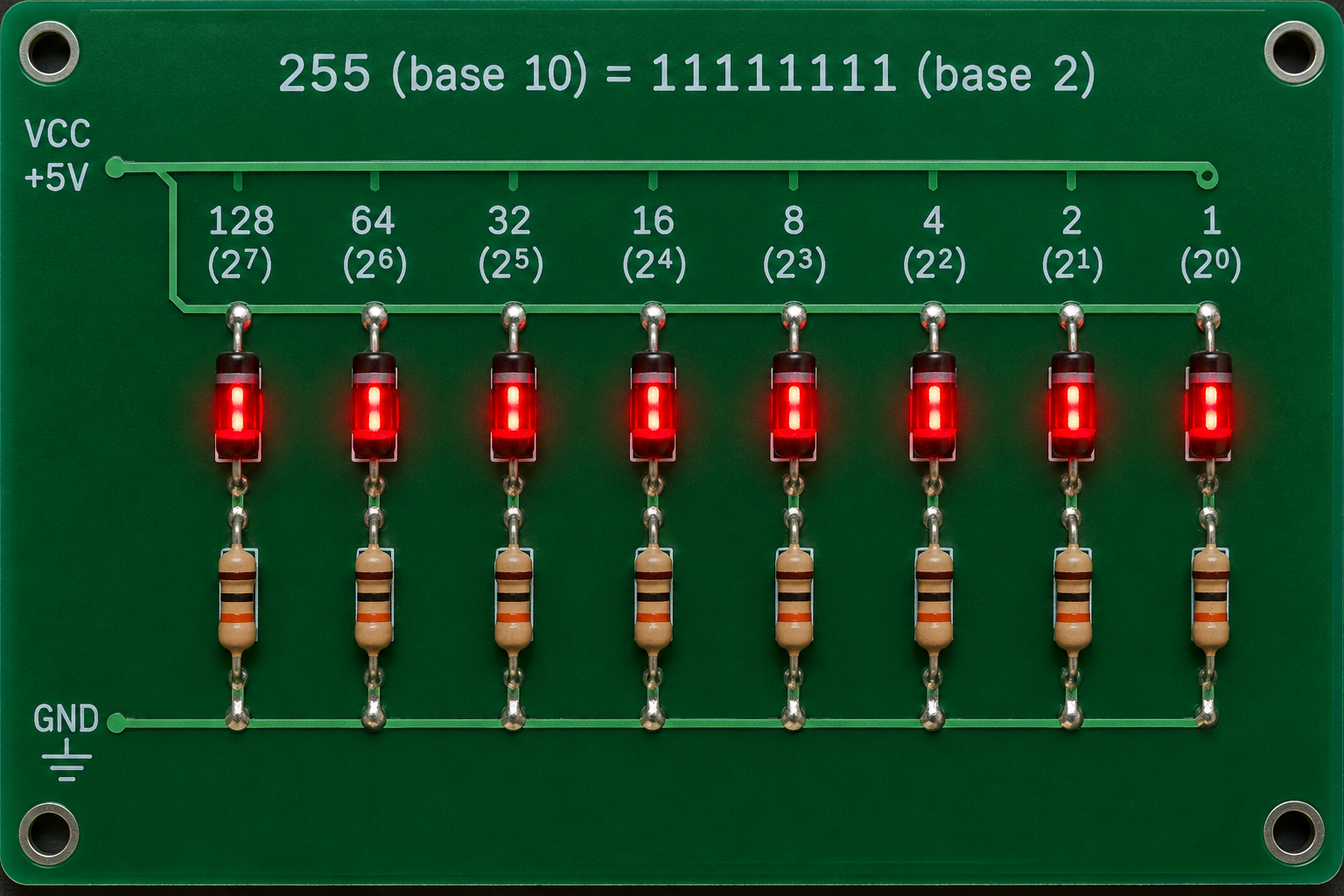
Welcome to the 255th Carnival of Mathematics For all the other carnivals future and past, visit The Aperiodical where you can also submit future posts. . I’m really excited to be hosting again after a several year gap on my newly re-platformed blog. As is traditional, let’s start with a few facts about 255 courtesy of the Wikipedia.
- Its factorization makes it a sphenic number .
- Since \(255 = 2^8 – 1\), it is a Mersenne number (though not a pernicious one), and the fifth such number not to be a prime number.
- It is a perfect totient number, the smallest such number to be neither a power of three nor thrice a prime.
- Since 255 is the product of the first three Fermat primes, the regular 255-gon is constructible.
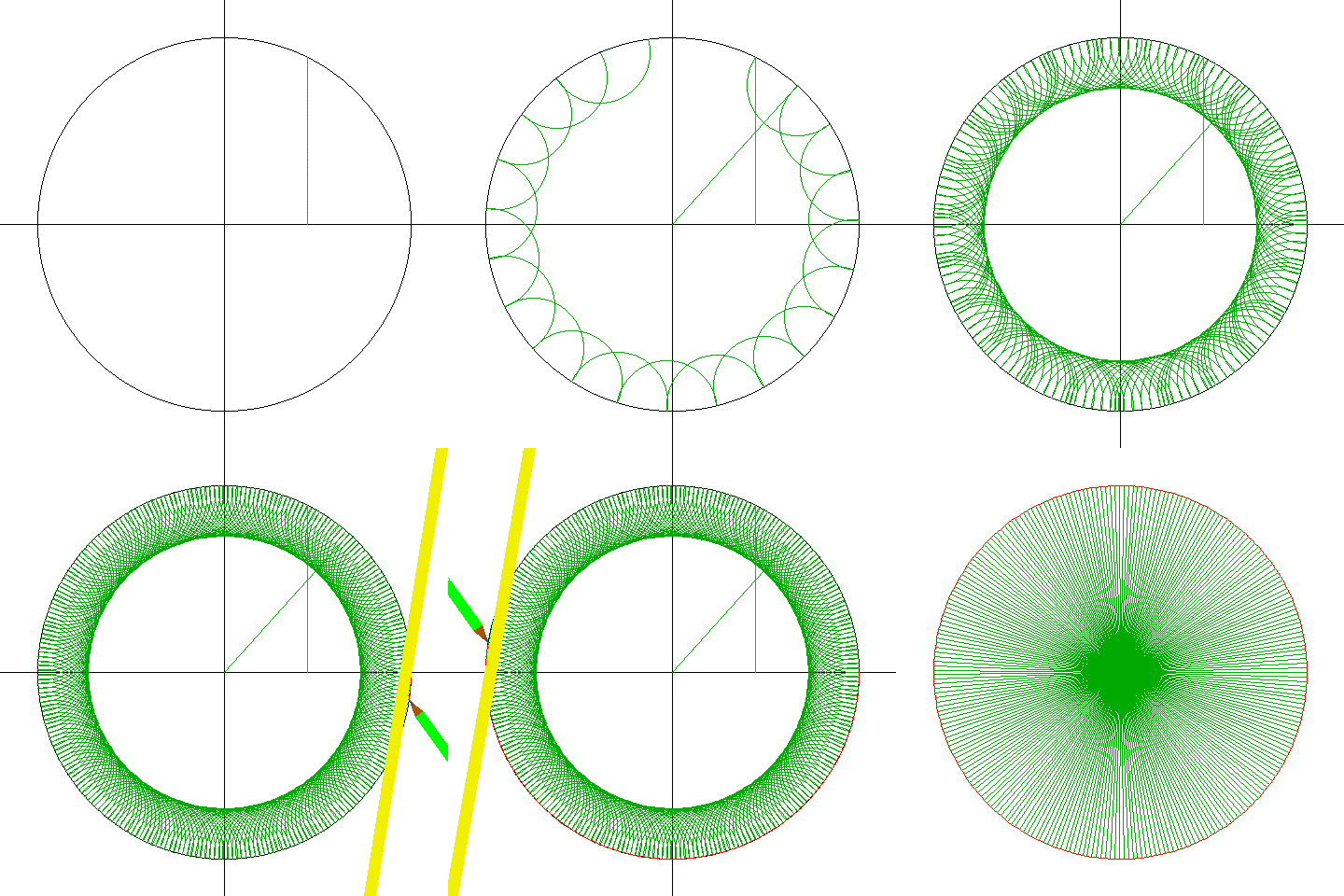
diacosiapentacontapentagon
Personally 255 resonates with me because its 0xff in hexadecimal a fairly common occurrence in coding often use as a bit mask. And long ago when I was in middle school I actually built my own digital adder out of circuits that was capable of adding up to it. (Although next month’s lucky carnival editor will have 256 which is even more evocative in computing.)
Submissions
There were a huge number of submissions this month and while a bit daunting is was a lot of fun working through all of them.
Four Triangle in a Box
I ran into an old problem I’ve seen multiple times but apparently never wrote a blog entry on.
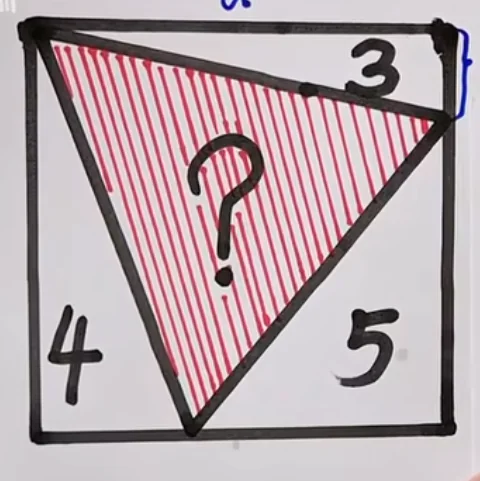
So today, I’m going to finally delve into it. I’ve seen a lot of variants on this in terms of orientation, the triangle areas and whether the outer rectangle is a square. Spoiler it doesn’t matter. The areas by themselves uniquely constrain the area of the remaining triangle tot he same value regardless of the rectangles proportions as long as they fit.
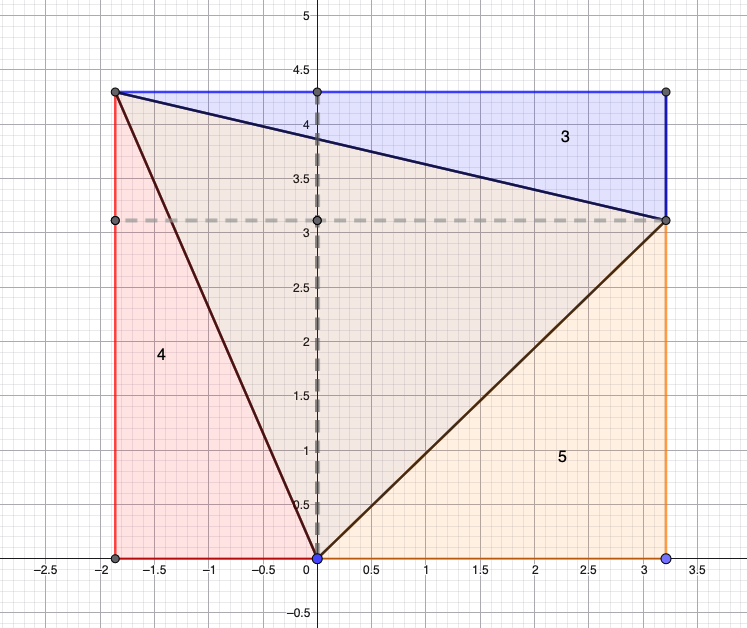
There are several approaches you can take but the simplest and most direct one since you’re given areas is to try to work in terms of areas and not drop down to segment lengths. (That will work but can be much more complicated)
Focal chords in a parabola
Intro
The following problem came up on reddit:
Show that the lines tangent to the parabola at the ends of a focal chord intersect at right angles on the directrix.
This has a nice proof based on the groundwork from post
Setup
Everything that follows will build on the fact the tangents to a point on a parabola lie on the perpendicular bisector of the segment from the focus to the perpendicular with the directrix shown in the previous post.
So to start let’s graph out the basic layout.
Last day of the semester
Another year draws to a close
Today was the last day of Husky Math Academy for the year and like all such closures its bittersweet for me. By the end of the year the weekly preparation starts to wear a bit thin. (I really should keep my workings somewhere so I can reuse them in future years rather than deriving from scratch again.) But also typically within about two weeks I start to miss the weekly interactions with the students. This year, the main section I was leading (6 girls and 5 boys) had really good flow most of the time. With a minimum of guidance, everyone in the room, worked really hard and often surprised me with interesting analyses. On the flip side, they were quiet enough that I often found myself cold calling on kids or surveying the room one by one more often as the months went by to encourage more talking. By contrast, the second section was more typical and you would enter the room and it would be quite noisy at first and take a few moments to really settle in.
What did the kids remember?
For the last day I decided to go around and ask everyone what they enjoyed the most during the Spring and two main themes emerged.
- Examining parabolas from the perspective of the Directrix and Focus
- Deriving the Cubic Equation via Cardano’s Method.
There were a lot of comments how everyone enjoyed when I went off the book and looked for extensions of the material.

Looking at a parabola and going off on 4 tangents
As the curriculum sequence is normally presented, we don’t usually consider tangent lines to curves until Calculus. As a result, taking a derivative might seem like the only way to find a tangent. Interestingly, that’s very far from the case. So here I’ll demonstrate 3 other ways to do it without Calculus
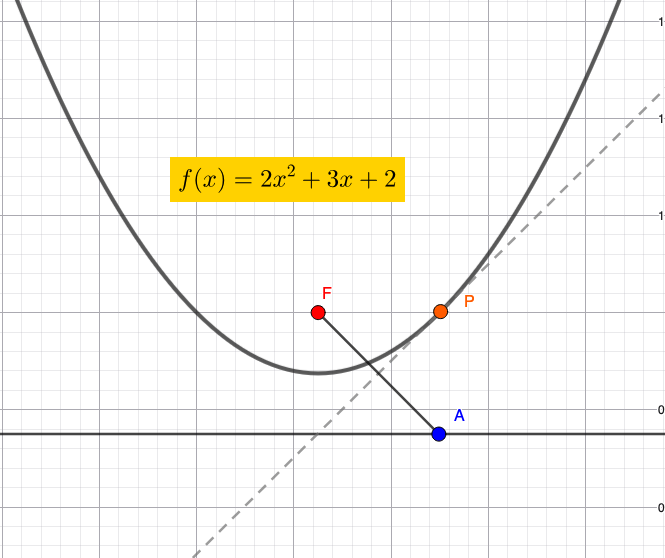
Our test parabola $ 2x^2 + 3x + 2$ and the point P at $(-\frac{1}{2},1)$
Algebra
With only the tools from Algebra I, we can already attack this problem.
-
First let’s assume there is some tangent line $y = mx + b$ that goes through b. In this case its more convenient to use point slope notation. $ m = \frac{y - 1}{x + \frac{1}{2}}$
Reflective Property of a Parabola
Reflective Property of a Parabola
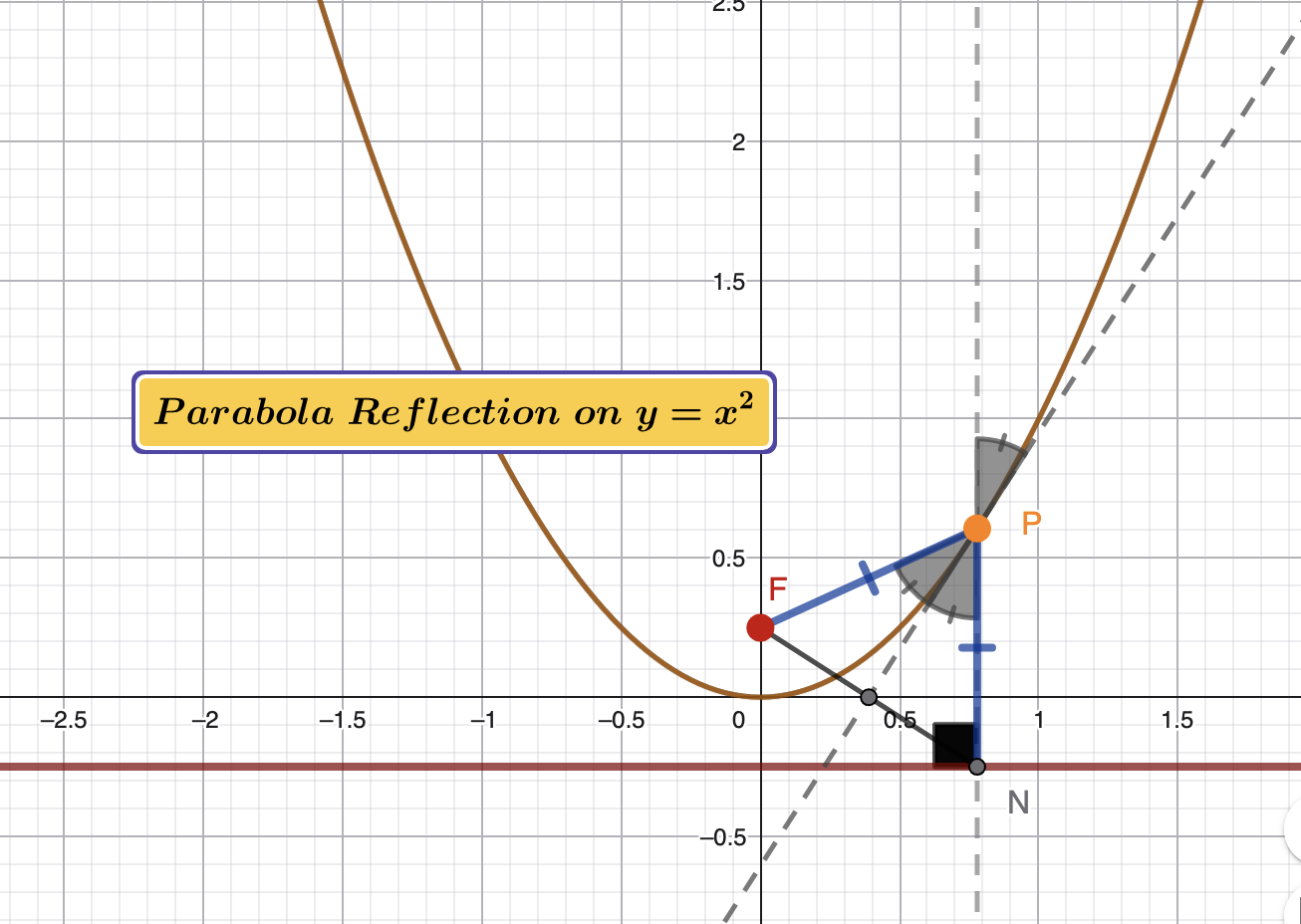
We’ve been going the reflective property for a parabola in class and I wanted to make my own diagram to illustrate a few nice points (and all without calculus).
First without loss of generality I’m going to use the simplest quadratic equation $y=x^2$ but remember “There is only true parabola”
That said to set the context, for this parabola the directrix is at $y=-\frac{1}{4}$ and the focus F is at $(0,\frac{1}{4})$
-
By definition every point P on the parabola is equidistant from the focus F and a perpendicular line down to the directrix $\overline{\rm PN}$
Two Boxes in a Circle
The March MathsJam had an interesting geometry puzzle.
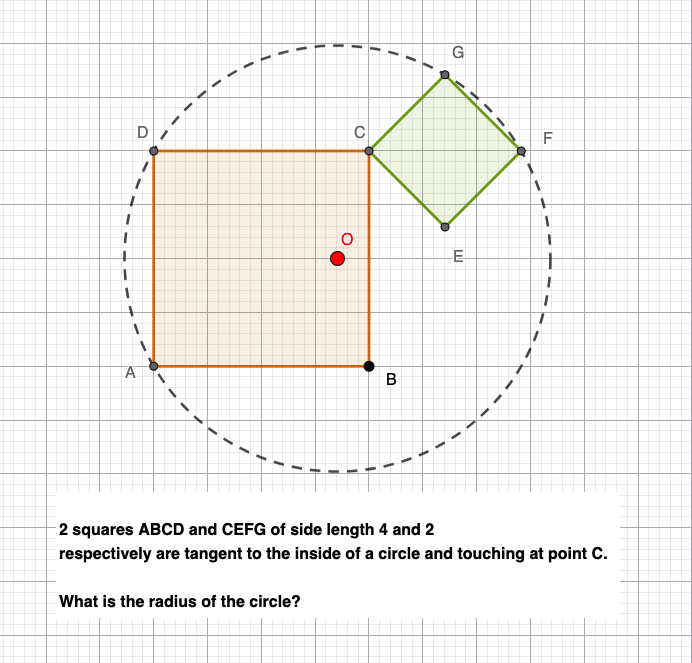
In the course of the evening, we noodled on this for a while and initially made no progress. So I decided to model it in geogebra to confirm whether there was a unique solution. What I found visually was that there appeared to be one when the smaller box was tilted 45 degrees. And that was in fact not hard to confirm because the triangle DFA inscribes the diameter in that case, along with the triangle FGA. You can then solve with the Pythagorean theorem and verify that they give the same result in this configuration.
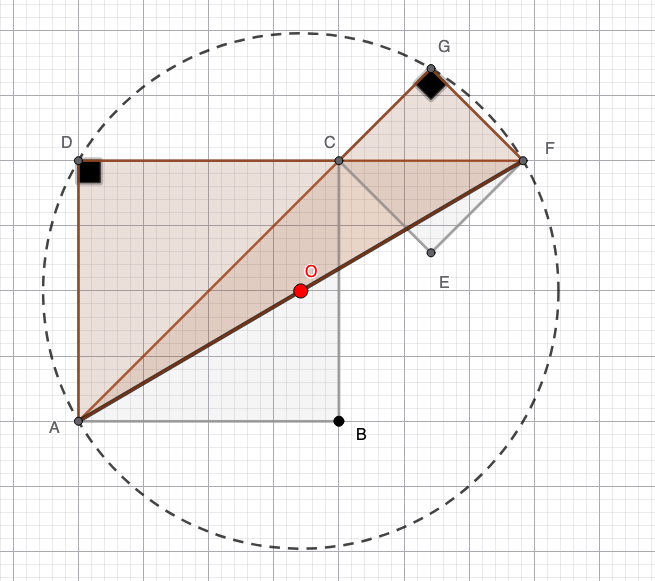
\(\text{the diameter: } AF^2 = AD^2 + DF^2 = 16 + (4 + 2\sqrt{2})^2 = 40 + 16 \sqrt{2}\) \(\text{and also the diameter: } AF^2 = FG^2 + AG^2 = 4 + (2 + 4 \sqrt{2})^2 = 40 + 16 \sqrt{2}\)
But this isn’t entirely satisfying because it basically presumes that answer and confirms it works and it doesn’t settle whether this is the only answer.
New Beginnings
I’m back

It’s been a long 3 years. In the course of Covid and life changes, I took a hiatus from my the old blog site and in the interim it broke down. But the itch to post math related posts has been growing along with the desire to migrate off of blogger and onto to a more open source platform.
Two Hinged Triangle Geometry Walk Through
Setup
It’s time for another geometry walkthrough motivated this week by this interesting problem from James Tanton.
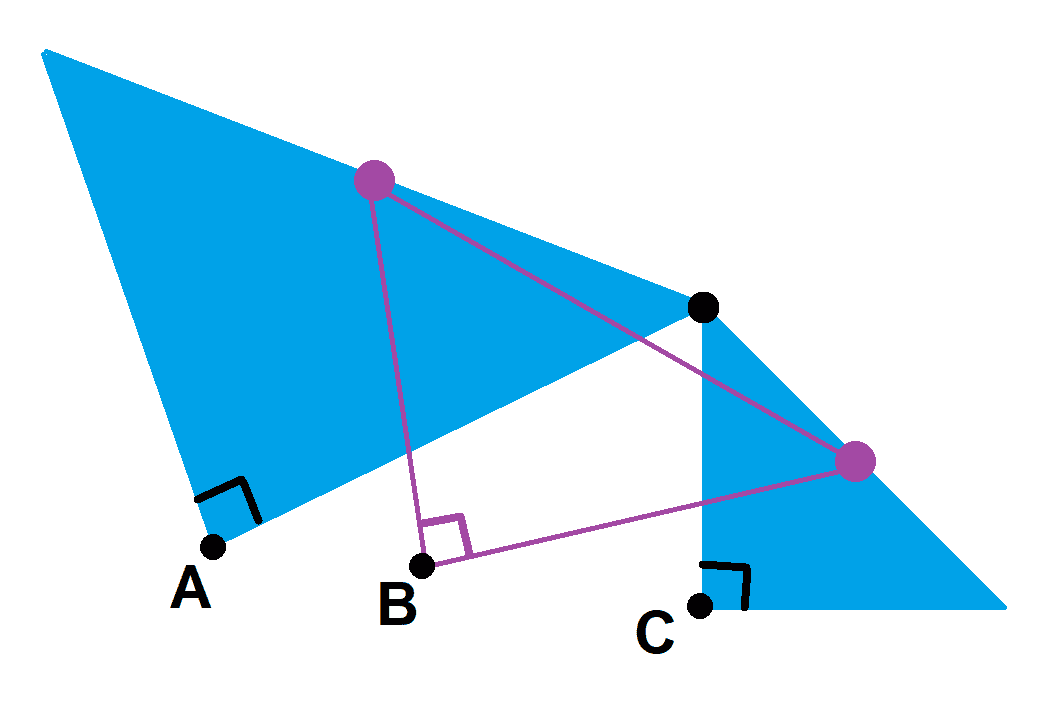
“Two isosceles right triangles are hinged at corners as shown. Line segment connecting midpoints of their hypotenuses is used as the hypotenuse of yet another isosceles right triangle.
Prove A, B, C lie on a straight line. Can anything be said about where B sits on segment AC?”
Trig identity Three Ways (at least)
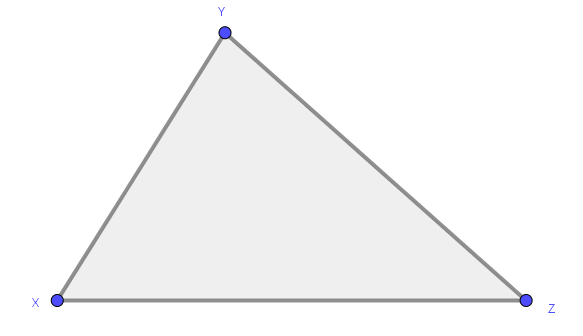
This post starts with reading elsewhere about someone struggling with the following trig identity given a triangle with three angles x, y, z show: