11/28 Egyptian Fractions
!
Brainstorming this week I became interested in Egyptian Fractions because they dovetail nicely with the math history from last time. Here’s a topic that is both historical and mathematically interesting. I was going to originally title this week Funny Fractions and do a unit on both Egyptian Fractions and Farey Sequences but on consideration I decided there was enough to deal with just focusing on the first idea. That was right decision to make based on actual time management. As I discovered also over the hour, these provide a great platform for practicing other more basic skills,
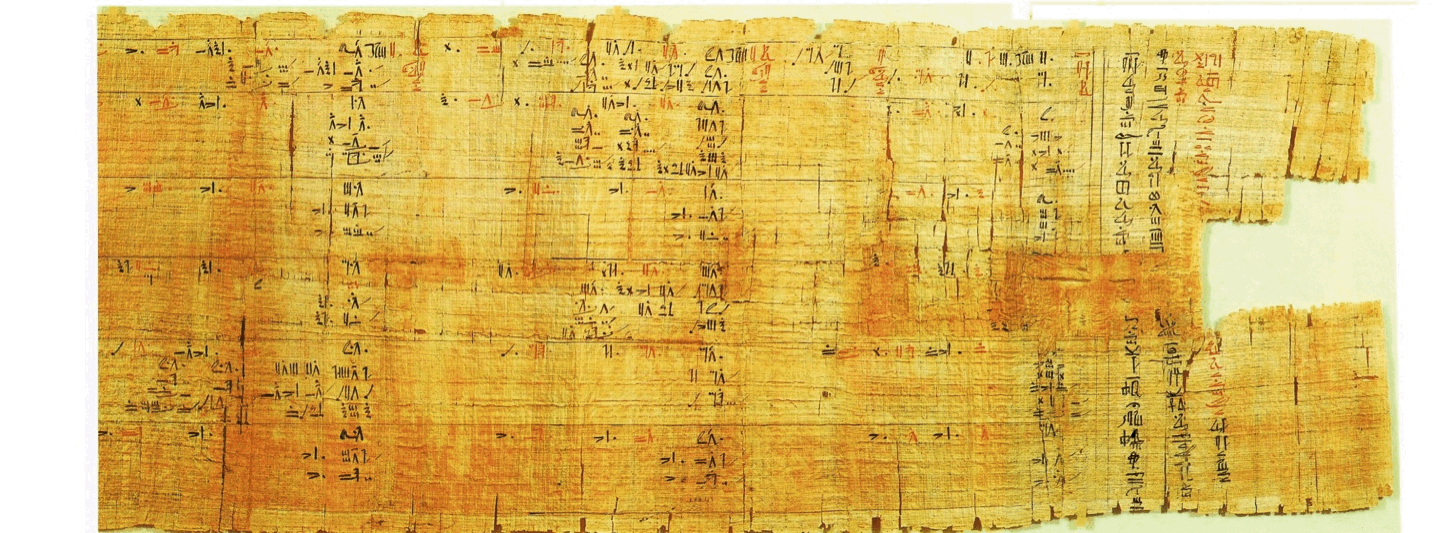
To start off I had everyone guess when fractions were first documented as being used. I mentioned the late entry of decimals as a starting point. I was pleased someone remembered the Babylonian base 60 fractions from last week. I then did a quick read of the background of the Rhind papyrus with some information and a printout of the scroll from: http://www.maths.surrey.ac.uk/hosted-sites/R.Knott/Fractions/egyptian.html
I then used a modified version of the series of questions and activities from here:
https://nzmaths.co.nz/resource/egyptian-fractions I particularly focused on finding ways to break Egyptian fractions apart into sums of other Egyptian fractions and discovering algorithms to find an Egyptian fraction sum for a regular fraction. Once kids started to brainstorm on the whiteboard I started feeding further problems as different groups progressed:
Further Problems:
1. The Mullah’s horse: The former Grand Wizier, Mullah Nasrudin was approached by three men with 19 horses. The men asked him to adjudicate the will of their recently dead father which required that his horses be divided among his three sons so that the oldest son receives 1/2, the middle son gets 1/3, and the youngest son would get 1/7. With little hesitation Nasrudin added his own horse to the herd and said, “What is half of 20, 1/4 of 20, and 1/5 of 20” After some time the men replied, “10, 5, and 4”. The eldest son then took 10 of the horses, the middle son took 5 of the horses, and the youngest son took 4 of the horses. The Mullah Nasrudin, then took the remaining horse and rode home. Can you explain what occured?
- Find all the solutions (there are less than 10) to the problem (n-1)/n = 1/a + 1/b + 1/c, where a
Also during the time I noticed a lot of fluency issues while the kids worked on the math.
- Adding fractions like 1/4 + 1/5.
- Long division.
- Mental math for fairly easy computations like 84 divided by 4.
In each of these cases I ended up doing mini walk-throughs and I think the session acted as a way to review rusty skills. But overall, I’m toying with the idea of finding other activities that also stress these again.
P.O.T.W
https://drive.google.com/open?id=1HjGYSNp8ngQet1lsXf2jxA6jEYoQhpIIxlMb2_Ye2TM
Leave a comment