4/3 Spring is Sprung
The last few weeks I’ve been concentrating on arranging the topics up to the last MOEMS Olympiad. This week I looked forward enough to realize that first Spring Break was coming up and that immediately after it was our only window to do the Purple Comet Math Meet. So I tabled my original idea for a new game in favor of doing a practice problem day. To start things off, I had one new student join us so we went through introductions again. As usual I had everyone say their name, math class and favorite activity from the last few months (except for the new boy who I asked to say why he joined) There were a couple of trends in what was mentioned. Pi day was apparently quite memorable and a group favorite as well was the Math Counts competition itself. But my favorite comment from someone a bit unexpected was to the effect “I really like all the problems, they’re not like math class at all.”
Before we started I had the kids go over the problem of the week (from @solvemymaths) on the board:
I was happy to get both compute the inner area and compute the outer area demonstrated as approaches by two different students. (As I type this write-up I just notice the slanted 90 degree angle and wish we had talked about it.)
Since Purple Comet is a team event that you run in your own room I asked whether the kids wanted me to randomize the groupings or if they wanted to form them on their own. There was a very strong strong preference to choose teammates. As no one was left out I let them do so although every time this happens I wonder a bit about random groupings and if I should occasionally impose them on the kids. So far my feeling is that as a voluntary club its ok to honor their wishes and that regular class will cover some of this ground.
Once everyone was divided I used a structure that has worked well in the past. I wrote the problem numbers up on the whiteboard and had the teams record their answers there. If they noticed a difference, they then went and discussed their solutions between teams to come to a consensus (and I also could focus on the groups at that point too.)
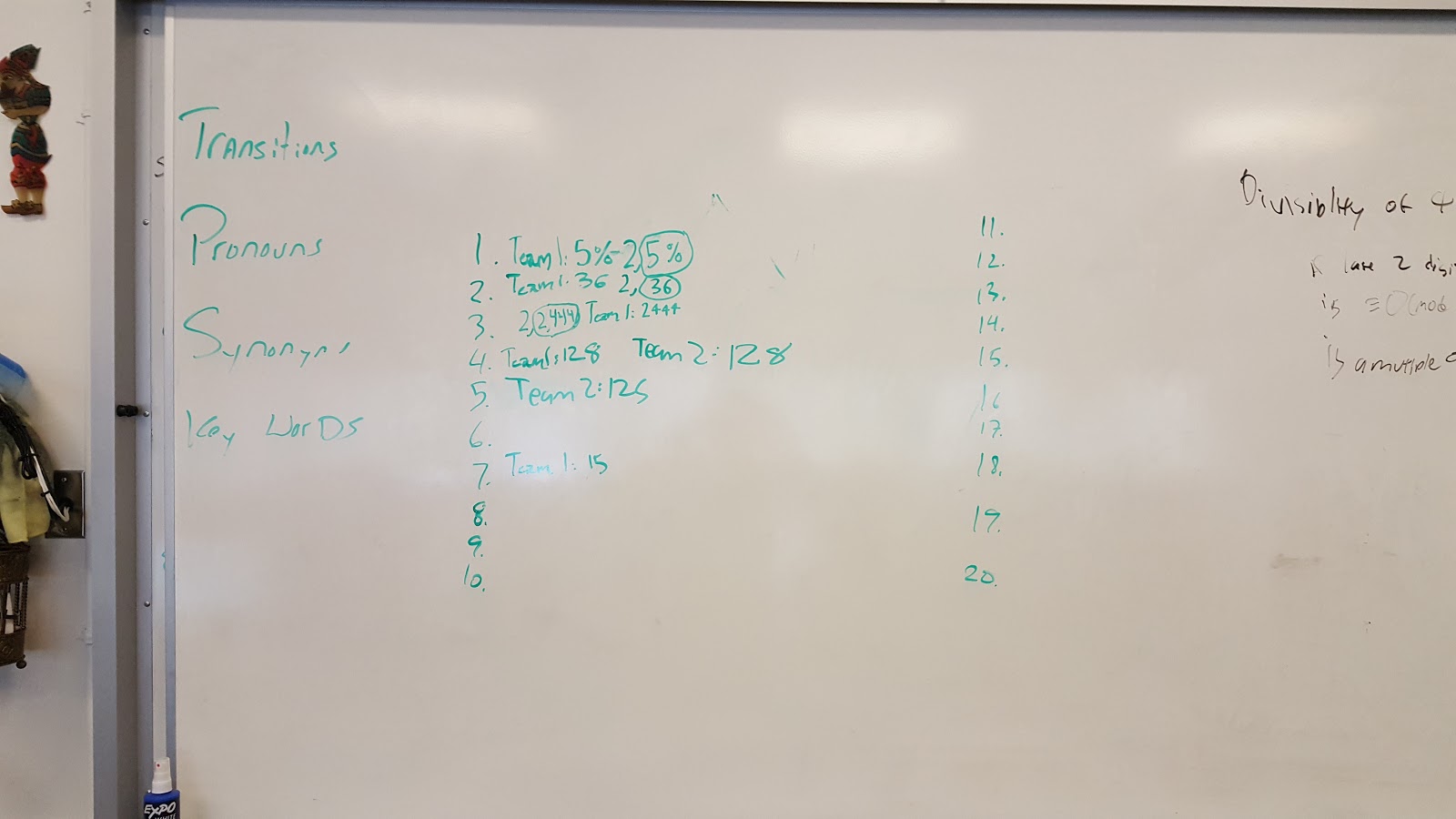
Even though its not really competitive this is just enough structure to hook a lot of the kids in and keep them going. I also brought some slant puzzles to hand out if I saw kids “burning out.”
https://mathequalslove.blogspot.com/2017/03/slants-puzzles-from-brainbasherscom.html but I really only used them with 2 kids at the very end. Engagement overall maintained itself.
I had the kids go over last year’s contest: 2017 MS Contest Based on yesterday it looks like everyone should be able to do at least 6-10 problems on the real event which for me means the levelling is pretty good this time.
During this whole process I then circulated and helped out with individual groups. Interestingly, the one problem I ended up focusing on the most with all the groups the was the tower of 7’s.
Find the remainder when $ 7^{7^7} $ is divided by 1000.
There’s not a lot of number theory or modular arithmetic exposure in school so this isn’t so surprising.
I emphasized a few ideas:
- Find the pattern/cycle in the last 3 digits of the powers of 7 i.e. make a table and see what happens.
- You don’t need all the digits to keep calculating only the last 3 (and why?)
- Once you know the cycle length you just need to find where you are in the cycle i.e. what’s the remainder of 7^7 divided by 20.
- That can also be done by the just looking at the remainder (mod 20) after each multiplication of 7 and there is a simple pattern there as well.
I’m almost completely decided we will do something with modular arithmetic before the end of the year based on this experience.
Leave a comment