Seattle MathJam or Pints and Polynomials
Last night I launched a small project I’ve been thinking about for a while. I’m now officially the host for the Seattle MathJam. https://mathsjam.com/what-is-mathsjam/
“MathsJam is a monthly opportunity for like-minded self-confessed maths enthusiasts to get together in a pub and share stuff they like. Puzzles, games, problems, or just anything they think is cool or interesting. We don’t have organised talks, planned activities or even strict timings - just turn up and join in.”
The events were started by a group of Brits whom I admire, Colin Wright, Katie Steckles, Matt Parker et al. and have spread fairly far. There’s actually a group down in Tacoma but traffic being what it is, I’ve never been able to get down there. So as they say “If the mountain will not come to Muhammad, then Muhammad must go to the mountain” After thinking about hosting a Seattle version for several months I finally jumped in.
I’m still figuring out ways to draw people to the events but with the places I tried, I already have a small mailing list and 4 people showed up at the inaugural night:
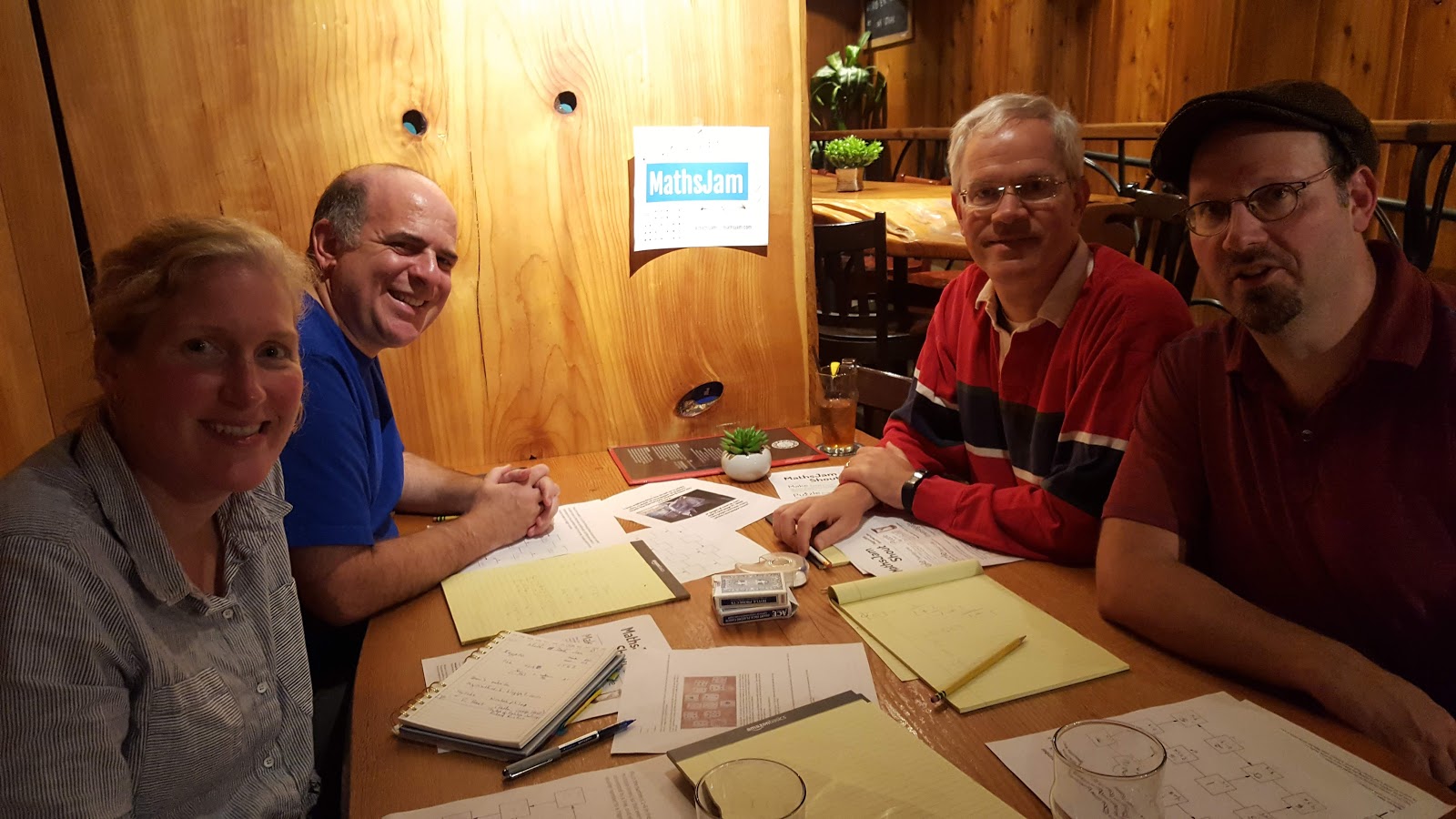
To give a flavor of what a MathJam is like (or at least our version) here’s some of what happened. First, each site takes turns providing a starter set of puzzles and problems for all the groups. Last night’s set was from Bristol, UK. Because its my default instinct, I also brought a few things I had seen recently and thought would be interesting.
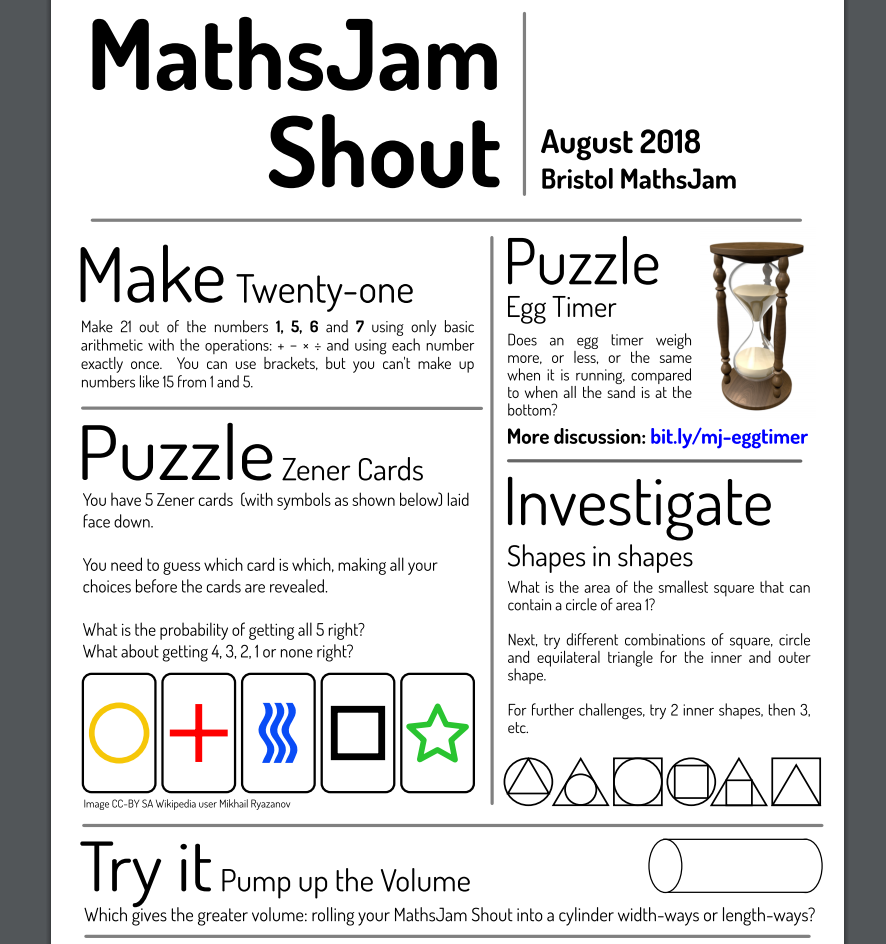
We started with the make 21 puzzle which took us quite a while to crack. Hint: you need to use fractions.
I then suggested we work this puzzle I found from @mpershan:
I actually had done this one a few weeks ago but conveniently forgotten my solution and it was still pleasant to rework out with a group. I will definitely use this one again with kids.
We then had conversation about the egg timer puzzle. I’m still not sure which answer is correct but after considering some of the factors (suspended sand vs the force of the particles hitting the bottom vs a closed system for mass) it seems like a great science project.
Next for a change of pace, we discussed Colin Wright’s Polynomial puzzle:
“Think of a polynomial with positive integer coefficients then pick an integer greater than any of coefficients and give me its value. With only that, I will tell you the original polynomial: Example: p(5) = 413.”
I had thought about this algorithmically previously. If you use a greedy strategy, you will always generate a unique polynomial. i.e. 5^4 is > 413 so the largest exponent is 5^3 and we can 3*5^3 = 375 then check 5^2 and then 5 and finally 1 to get p(x) 3x^3 + x^2 + 2x + 3
Last night, one of the attendees immediately said isn’t this just about converting the number into the base N? And after thinking about it a bit I suddenly realized that was exactly what the greedy algorithm was doing (413 in base 5 is 3123) From there we had a lovely conversation riffing about exotic base systems like base 3/2 or Phinary: https://en.wikipedia.org/wiki/Golden_ratio_base
And that was the fun of the night, we socialized a bit, talked about math in our lives, did some puzzles and went off on mathematical tangents. I’m expectantly looking forward to the second gathering next month. My goal is to attract a few more folks.
Leave a comment