3/4 A series of interludes
As I previously mentioned I’ve been collecting a group of mathematical issues I want to discuss with the kids. So today rather than a large overarching theme we worked through a few concepts in a series of communal talks and then group work.
POTW
First we returned to the same problem from last week:
!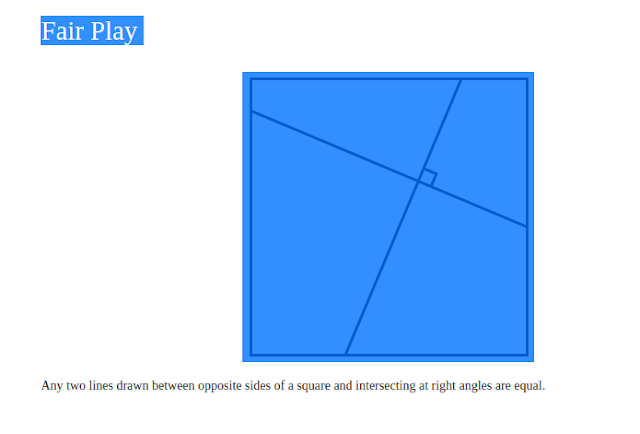
I had one student demo a partial solution by extending the lines to create triangles. So this time I gave my own idea on moving the lines until they hit the corners. That preserves their lengths but makes to easy to prove similar triangles that share a common side length and therefore are indeed congruent.
Divisibility
We spent the first piece of the day talking about why divisibility rules worked. I warmed up by talking about nines. After splitting each place value value into (9+1)^n I had the kids regroup numbers by table and then show what they had worked out. From there it was easy to get the divisibility rule.
Next we tackled 11’s. These are regrouped as (11-1)^n which is a bit trickier since like above all the terms except the last are powers of 11. But the last one alternates between 1 and -1 depending on whether n is even or odd. After regrouping this is the driver behind the alternating sum rule. Once again I used the same structure with the kids doing the algebra and looking for the patterns and then coming together as a group to demonstrate on the board.
Counting
We tackled the one MOEMS problem that everyone missed next. (There is no connection to divisibility so this made the day a bit more fragmented)
What percentage of the 3 digit numbers XYZ have repeating digits i.e. 101 or 994?
I started by talking as group about how many total 3 digit numbers there are and how to find this out with 2 main ideas coming out
- Combinatorics 9 x 10 x 10 (There can’t be a zero so one less choice for the first digit)
- Counting: 100 - 999 –> 1 - 900. By subtracting 99 we get an easy to calculate sequence.
Then I mentioned that you could solve this 2 ways either looking for the positive case or its inverse: how many non repeating numbers are there.
Again I had the various group spend some time working things out. When enough solutions had been found 10-15 minutes we regathered to share. I think the inverse case is a bit easier and I was lucky to have both solutions presented.
Super Permutations
Finally although I didn’t have enough time we discussed the recent super permutation discoveries. To motivate everything I had the kids find the easiest case. The super permutation for n = 3. That worked well but we ran out of time so we didn’t move onto n = 4 which would have been fun. This need at least 30 minutes to do properly.
P.O.T.W.
https://drive.google.com/open?id=10VOd1OBtadTKjLPyXrMmxpXtSnaltGgrsE8DayK9Jek
Leave a comment