Carnival of Math 181
Welcome
Welcome to the 181st Carnival of Mathematics If your appetite is only whetted here and you are interested in previous carnivals visit The Aperiodical where you can also submit future posts. This is my third time hosting and I’m very excited for a distraction from the realities of a global pandemic. This serves in a way as bridge between my recently shrunken world and the wider one that’s still out there and full of mathematical mysteries.
[Julia Set animation by Matt Henderson]
As is traditional here are some facts about 181 courtesy of the Wikipedia:
181 is a centered number 181 is a centered pentagonal number 181 is a centered 12-gonal number 181 is a centered 18-gonal number[ 181 is a centered 30-gonal number 181 is a centered square number 181 is a star number that represents a centered hexagram (as in the game of Chinese checkers)
181 is a deficient number, as 1 is less than 181 181 is an odious number 181 is a prime number 181 is a Chen prime 181 is a dihedral prime 181 is a full reptend prime 181 is a palindromic prime 181 is a strobogrammatic prime, the same when viewed upside down 181 is a twin prime with 179
181 is a square-free number 181 is an undulating number, if written in the ternary, the negaternary, or the nonary numeral systems 181 is the difference of 2 square numbers: 912 – 902 181 is the sum of 2 consecutive square numbers: 92 + 102 181 is the sum of 5 consecutive prime numbers: 29 + 31 + 37 + 41 + 43
On a personal note I’ve been unable to see my students from Math Club in person which has been hard. But I’ve been doing a bunch of Zoom based virtual events with them which while not really the same has at least meant I haven’t completely lost touch. As part of this process each week I’ve picked the most interesting internet resource I happened to have seen to send out in my email update. So here’s my personal list of curated approximately middle school level links for the last six weeks that I used. Hopefully its of use to some of the readers as well.
Posts
-
From Andrew Jeffey’s Mathematics newsletter some fun Match Stick logic puzzles: Link
-
The always excellent Grant Sanderson aka 3Blue1Brown has been doing a live YouTube broadcast biweekly on his channel: Channel Link on various H.S. level math. The current ones have focused on complex numbers. This is highly recommended.
-
Numberphile has continued to pump out great material. I linked this video from Ben Sparks: Numberphile Link on impossible squares and what numbers can be formed as a sum of two squares. If you’re tantalized, checkout Mathologer’s brilliant video on the same subject: Mathologer Video Link which explores a geometric proof of Fermat’s 2 square theorem.
-
Matt Enlow provided an entertaining set of “Snake Puzzles” here
-
The Julia Robinson Festival has been hosting a series of weekly. webinars See: https://jrmf.org. This is one of my favorite math organizations and although the physical festival was cancelled here in Seattle, the spirit of the event lives on in these events.
-
James Tanton, one of the great math teaching reframers of the day, has also been putting on webinars as well as his regular videos and newsletters: Facebook Link
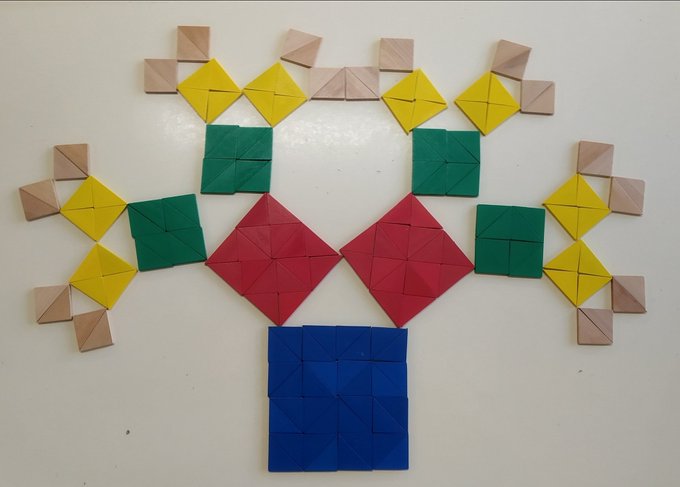
[Fractal Tesselation by @asitnof]
Blogs
Onto the blogs! Henri Picciotto has put together a compilation of a bunch of patterns both his own and others presented online at his website: https://www.mathed.page/manipulatives/pattern-blocks/dodecagons/index.html
Even if you don’t own a set yourself, like me, you can explore the tessellations just via drawings.
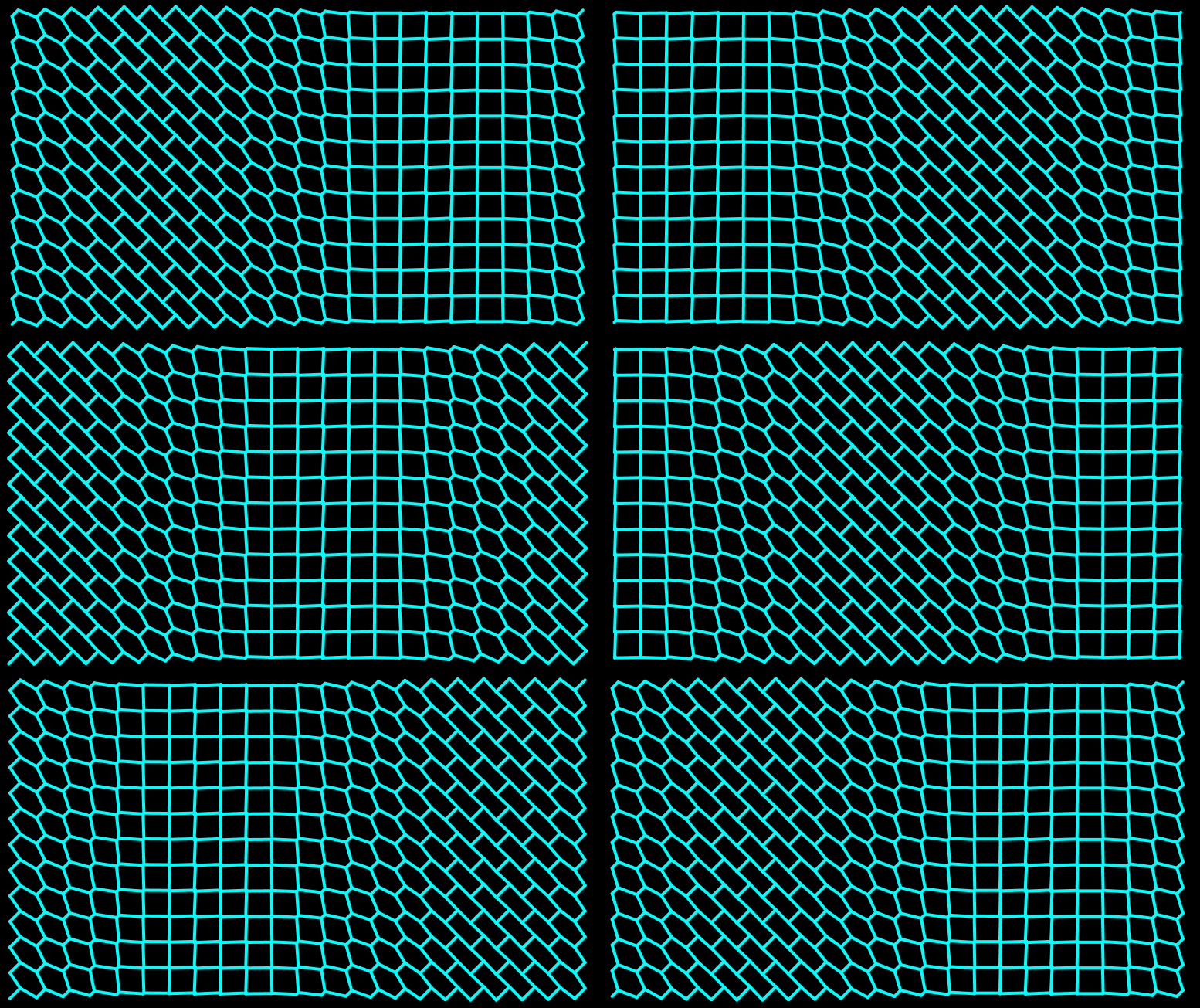
[Vincent Pantaloni - Parquet Tesselation]
Then for something math adjacent, Evelyn Lamb has a lovely mathematical poem in the Roots of Unity column: https://blogs.scientificamerican.com/roots-of-unity/prime-factorization-as-verse/
13 January 2009
12=22×3 Anuk is dying for Anuk is dying in the white of winter
11 The coldest month
10=2×5 Anuk is dying in the falling snow
9=32 The white of winter for Anuk is dying
8=23 Anuk is dying for the white of winter
7 The drift of time
6=2×3 Anuk is dying in the white of winter
5 The falling snow
4=22 Anuk is dying for Anuk is dying
3 The white of winter
2 Anuk is dying
1 .
This is also a good place to show my recent memento from one of Evelyn’s other projects: the My Favorite Theorem podcast: https://kpknudson.com/my-favorite-theorem (As you can see I’m collecting math postcards - if you’re interested in exchanging any mail respond in the comments)
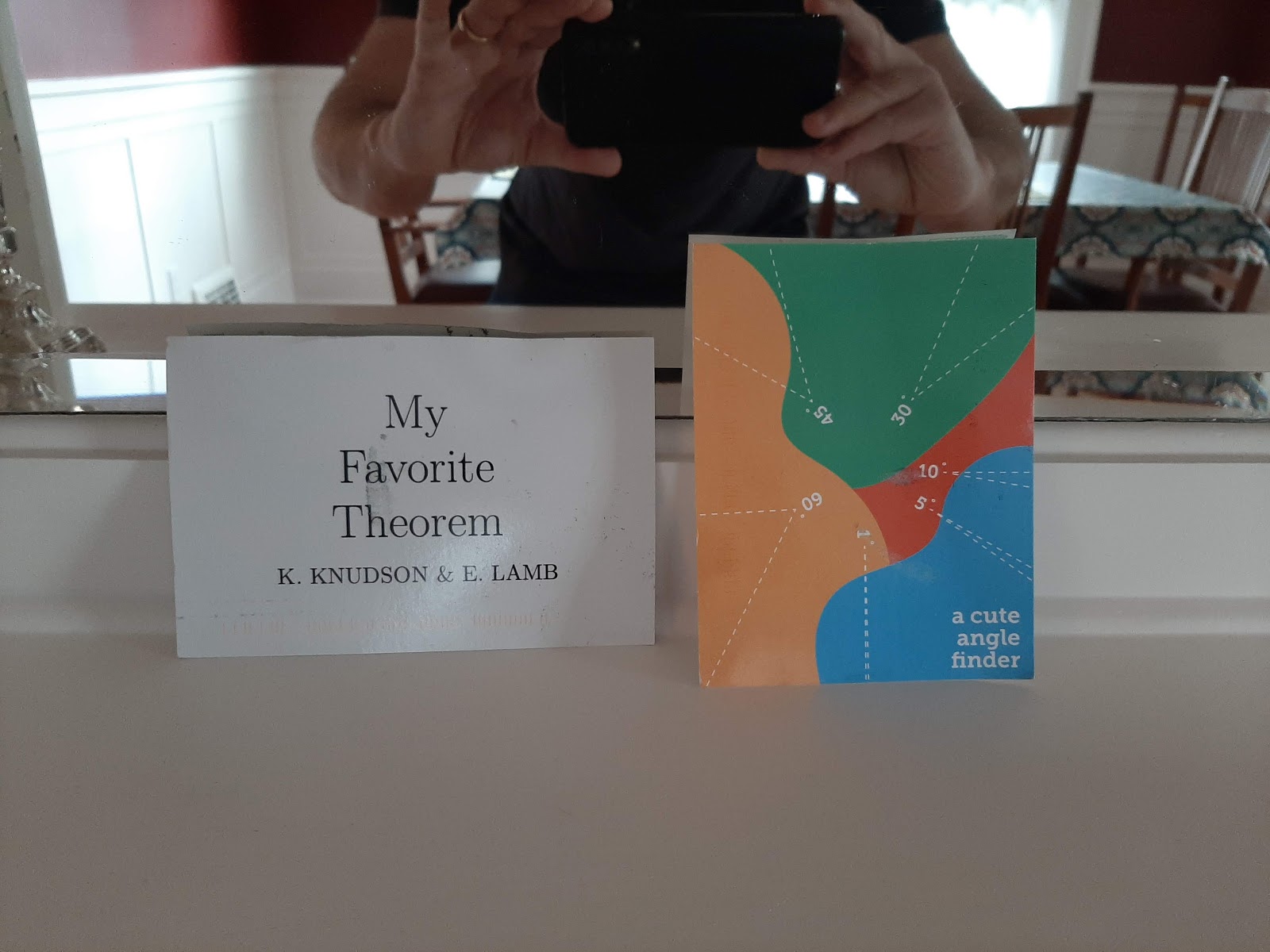
[Personal postcard from Kevin Knudson]
Peter Wolt has an update on the recently published Shinichi Mochizuki ABC Conjecture proof: Link
““I think it is safe to say that there has not been much change in the community opinion since 2018,” says Kiran Kedlaya, a number theorist at the University of California, San Diego, who was among the experts who put considerable effort over several years trying to verify the proof.”
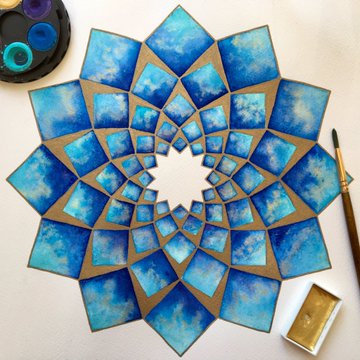
Clarissa Grandi
GarnitCharcha, another Carnival Host, shares a quiz in honor of International Mathematics Day which I believe was technically in March (3/14) but don’t let that stop you from a fun diversion:

Next up two posts in honor of the late John Conway
Gianluigi Filippelli writes a lovely remembrance at http://mathematics-in-europe.eu/?p=1713
“The most famous mathematical invention by John Conway was undoubtedly the Game of life, that was popolirized by Martin Gardner on his column published on Scientific American [1], but today I want to tell you something about the free will theorem.
The theorem was proposed by Conway with Simon Kochen, inspired by the question about the interpretation of quantum mechanics. The statement is:
If the choice of directions in which to perform spin 1 experiments is not a function of the information accessible to the experimenters, then the responsesof the particles are equally not functions of the information accessible to them.”
Scott Aaronson also posted an expansive tribute: https://www.scottaaronson.com/blog/?p=4732 https:// Don’t
Don’t miss the comments section.
Finally: Card Colm posted some recollections as well as a summary of Conway’s Circle Theorem: http://www.cardcolm.org/JHC.html
Next up, Marilyn Burns writes about an enticing online game from nrich.org on here own blog:
http://www.marilynburnsmathblog.com/whats-the-longest-number-string-possible
I’m hooked on the Factors and Multiples Game. Here’s why.
It provides practice with factors and multiples. It supports thinking strategically and problem solving. It works for solitaire or as a two-person game. It’s interesting and challenging both for students and adults
I’ve always really liked the material nrich produces as well. Definitely recommended especially for elementary students.
Winding down the blogs Kartik over at Comfortably Numbered has a cool post: http://hardmath123.github.io/spaghetti-shadows.html ”Spaghetti’s Shadows are Spirali-Shaped” that explores some 3-d geometry including the python code to explore it yourself.
Assorted Tweets
-
Bourbaki’s final perfected definition of the number 1, printed out on paper, would be 200,000 as massive as the Milky Way!
At least that’s what a calculation by the logician Robert Solovay showed. But the details of that calculation are lost. So I asked around….
(1/n) pic.twitter.com/HhDI7jqH7y — John Carlos Baez (@johncarlosbaez) April 16, 2020
-
OBSCENELY ENJOYABLE ALGEBRA ACTIVITY 👇
Plain old graph of y=x^2
Pick a point either side of y-axis
Join them with a straight line
y-intercept is always the product of the x-values
Why? How? What??
-
This is gorgeous fun to prove, I think I first saw it in an @alexbellos book pic.twitter.com/2Hci5kcFuW — Kyle D Evans (@kyledevans) April 28, 2020
-
Back to rectangular biscuits this morning. What do you notice? What do you wonder? pic.twitter.com/NY1jqswhES — Alison Kiddle (@ajk_44) May 2, 2020
-
Everything @Ayliean’s said 👇 https://t.co/6eTSRkPgju — Tamás Görbe (@TamasGorbe) March 31, 2020
Finally one last plug for the entire series of recent posts by Matt Henderson (1 more sample)
- a Sierpinski triangle in spherical geometry pic.twitter.com/kVWx2HxeTG — Matt Henderson (@matthen2) April 30, 2020
Leave a comment