Tilted Ellipse Problem Walkthrough
This problem from Matt Enlow is quite fun and as a bonus a chance to show off some geogebra formatting:
The number of integer solutions (x,y) to x²+xy+y²=a (for some integer a>0) appears to always be a multiple of 6. What might explain this?
First observation I made was that it was a tilted conic section and based on the coefficients the tilt was 45 degrees. But which one? You could easily test but I just like to graph things first:
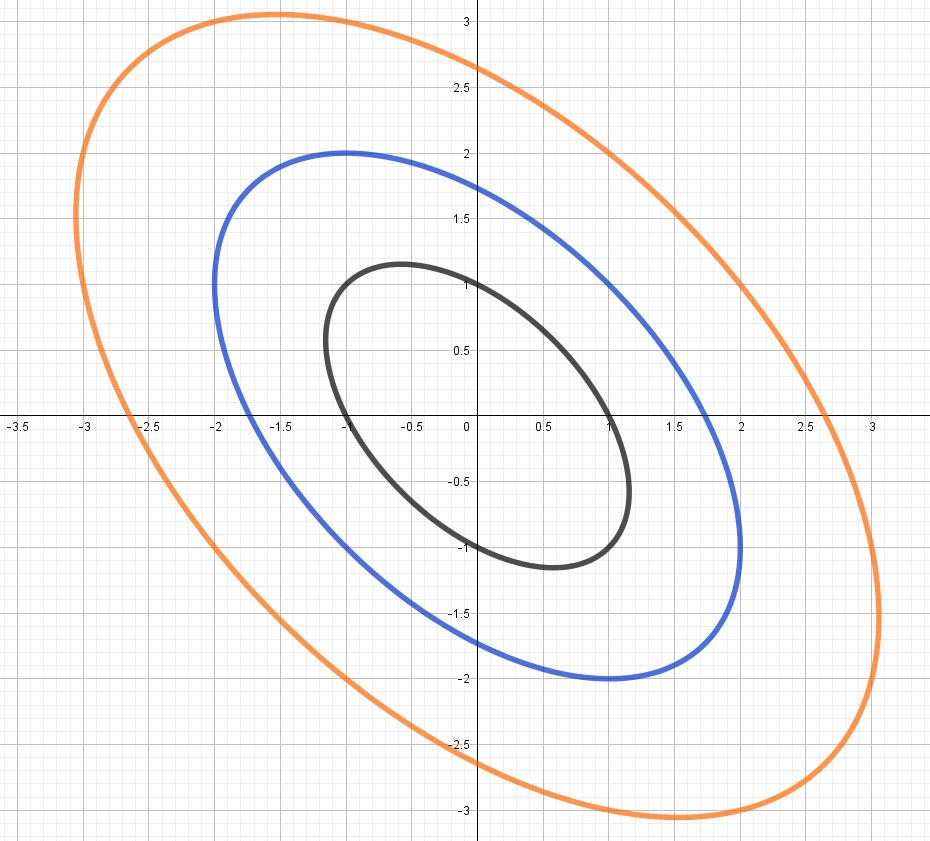
As the picture and title of this post suggest, we’re dealing with an ellipse. From here my first thought was to un-tilt the ellipse and take a look at the
simpler version. But that also rotates all the lattice points too onto non integer coordinates and so it
doesn’t necessarily help.
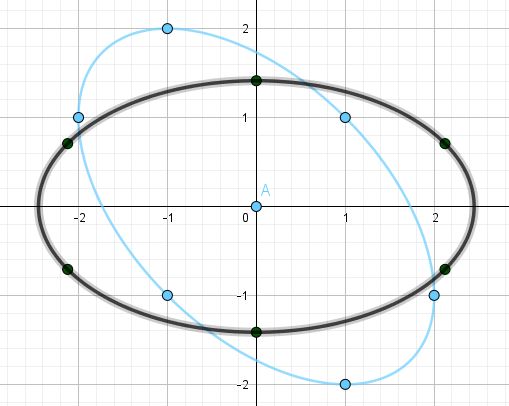 $ \dfrac{x^2}{2} + \dfrac{3 y^2}{2} = 3 $
I couldn’t quite see a path with factoring that would work here. I also started to notice a lot of symmetries
in the ellipses. For any given solution (a,b) there is at least 1 other solution pair (-a,-b) and potentially two other ones (b,a) and (-b,-a) if a !=
a. That’s a 4 four fold factor not a 3 fold one so I spent some time
looking for why its not always true. Sadly, there isn’t a 120 degree angle
difference between lattice points like I was hoping for.
At this point I happened to see response to Matt:
$ \dfrac{x^2}{2} + \dfrac{3 y^2}{2} = 3 $
I couldn’t quite see a path with factoring that would work here. I also started to notice a lot of symmetries
in the ellipses. For any given solution (a,b) there is at least 1 other solution pair (-a,-b) and potentially two other ones (b,a) and (-b,-a) if a !=
a. That’s a 4 four fold factor not a 3 fold one so I spent some time
looking for why its not always true. Sadly, there isn’t a 120 degree angle
difference between lattice points like I was hoping for.
At this point I happened to see response to Matt:
Consider a grid of unit equilateral triangles. You get travel to any point
on the grid by moving x units right/left, and y units Southeast/Northwest
(x=0 and y=-1 corresponds to a move by "omega" in the diagram here.) The
distance to (x,y) is x^2+xy+y^2. Now use symmetry.
[pic.twitter.com/cuXDvZBz0h](https://t.co/cuXDvZBz0h)
— Marty Weissman (@marty__weissman) September 21, 2020
This mapping onto the Eisenstein integers is quite clever but I still thought there was some else directly embedded in the ellipse. At this point I brought the problem to the MathJam I host and as a group after studying it for a while we came up with a partial breakthrough that I will expand below to a full explanation.
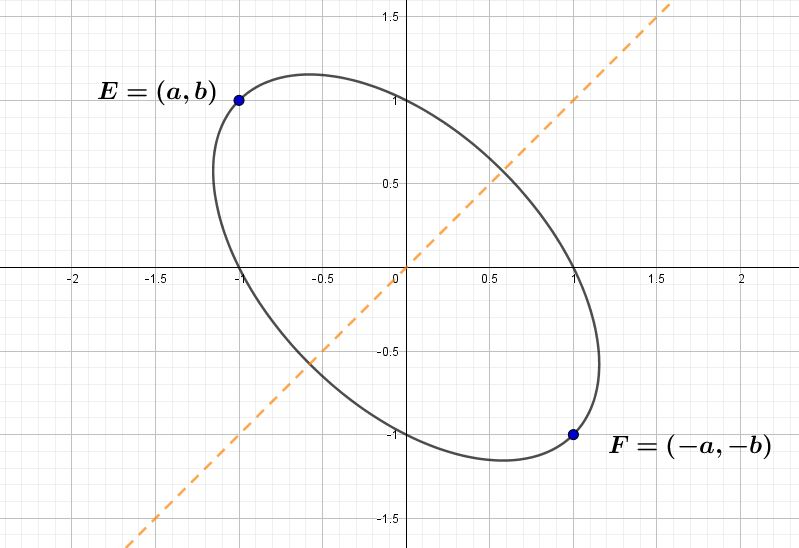
First off the basic symmetry that always holds:
If (u,v) is a solution to $ x^2 + xy + y^2 = a$ then (-u,-v) is as well because: $u^2 + uv = v^2 = (-u)^2 + (-u)(-v) + (-v)^2$. This means that the number of solutions is definitely an even number.
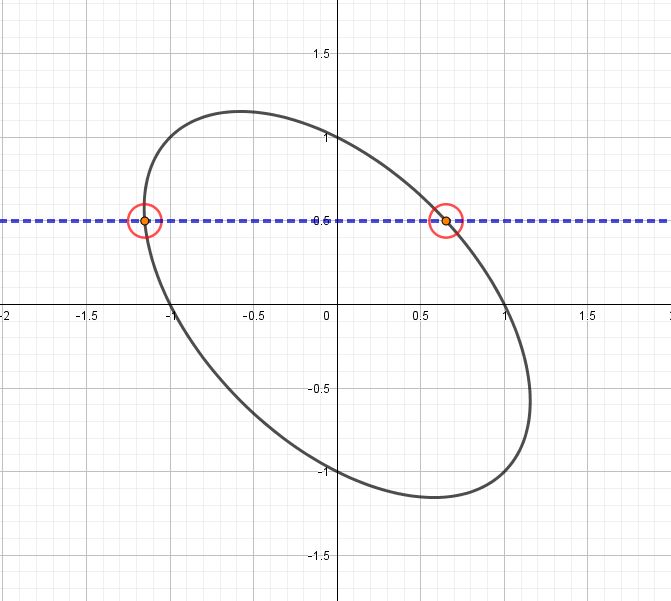
Secondly as show above any line either doesn’t intersect the ellipse, is tangent to it or intersects it at 2 points. Its this final case we’re most interested in.
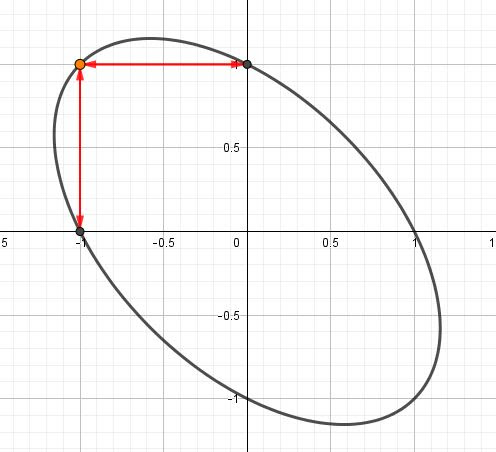
Third, what’s interesting and the key group observation that we made during the MathJam is that if (u,v) is an integer solution, if you draw a vertical or horizontal line so are the other intersections. This follows because if we fix one of the coordinates a monic quadratic equation is left where we already know one solution. $x^2 + bx + b^2 = k \rightarrow x^2 + bx + b^2 - k = 0$ This has two roots a and something else. But via the Vieta formulas the sum of the two roots is b so that means the other one is -a - b also an integer. This same logic can be repeated on the other axis.
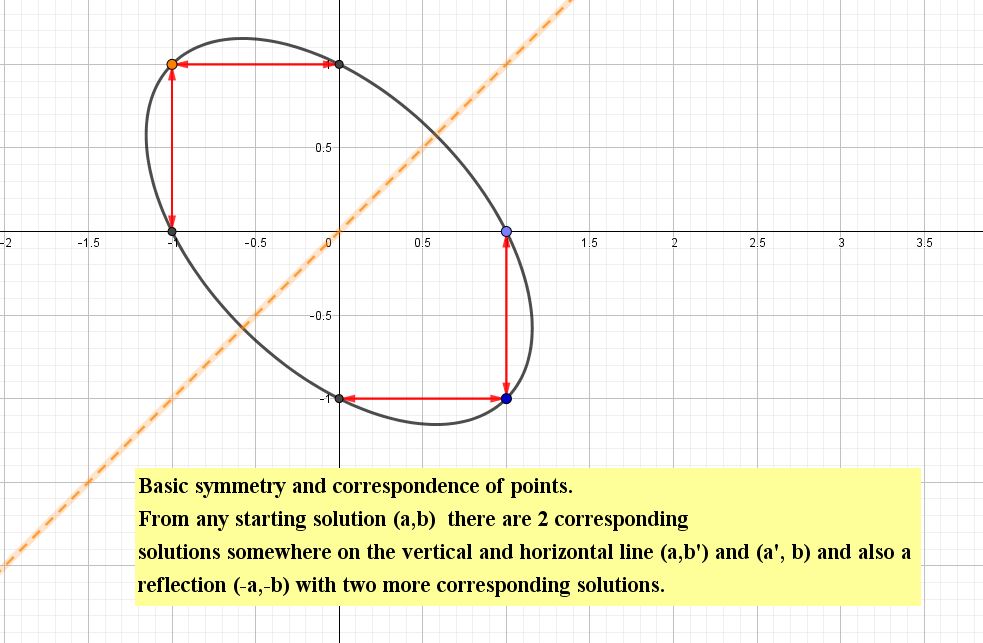
- $ (a,b) \rightarrow a^2 + ab + b^2 $- $ (a,-a - b) \rightarrow a^2 + a(-a -b) + (-a -b)^2 = a^2 -a^2 -ab + a^2 + 2ab + b^2 = a^2 + ab + b^2 $- $ (-a - b, b) \rightarrow (-a -b)^2 + b(-a -b) + b^2 = a^2 + 2ab + b^2 -ab - b^2 + b^2 = a^2 + ab + b^2 $
Slight complication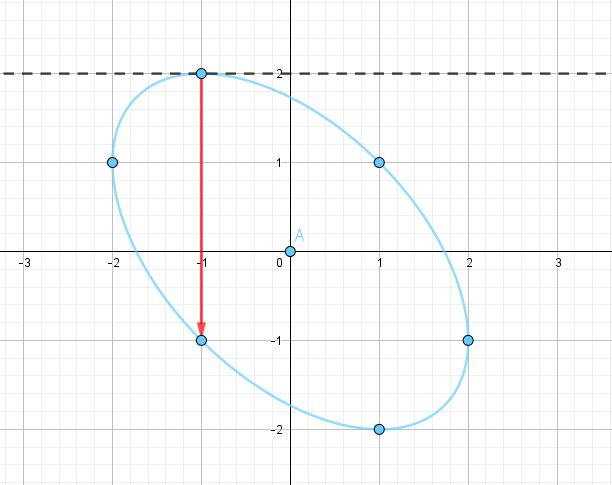
Everything works well if the initial point is normal and not on a vertical or horizontal tangent to the ellipse. If it is on the tangent then we need to make a slight adjustment and move over to its pair integer solution as the starting point. The corresponding pair will not be a tangent due to the tilt of the parabola.
Finally putting everything together:
Leave a comment