Justifying complex number exponential notation i.e. Euler’s Formula without Calculus
Background
I’m assuming that you are already familiar with polar coordinates and cis notation for complex numbers. If not look here: Link
We start with any complex number being represented in polar coordinates on the complex plane as: $ r ( \cos(\theta) + i \sin(\theta)) $
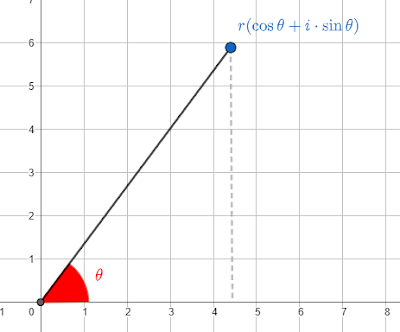
Looking at the basic properties
By directly evaluating the general expression above we can start off by showing the complex numbers have the all same properties as an exponential function
- $ f(0) = 1 $
- $ f(x + y) = f(x) \cdot f(y) $
- $ f(x - y) = \dfrac{f(x)}{f(y)} $
- $ f(-x) = \dfrac{1}{f(x)} $
- $ f(x)^n = f(n\cdot x) $
That’s very suggestive but what exponential expression is equivalent in this case? In fact Euler’s Formula says that $ r ( \cos(\theta) + i \sin(\theta)) = r \cdot e^{i \theta} $
Usually that’s justified via Calculus and Taylor Series but its possible to mostly ground with simpler techniques.
Justification
Lets start by looking at how e is defined: $ \displaystyle{e = \lim_{n \to -\infty} \left(1 + \dfrac{1}{n}\right)^n} $ or conceptually the result of infinitely compounding a value. That’s usually been introduced before in the context of interest or other proportional growth.
We’d also like to have an expression for $e^x $ so we raise both sides to the xth power. Then on the right hand side via the binomial theorem we get:
$ ( 1 + {x \choose 1} \cdot \frac{1}{n} + {x \choose 2} \cdot \frac{1}{n^2} … )^n $
But as x goes to infinity all of the smaller powers of n drop off and we’re only left with the first two terms giving us:
$ \displaystyle{e^x = \lim_{n \to -\infty} \left(1 + \dfrac{x}{n}\right)^n} $
Enter De Moivre’s Theorem
So how to connect these two seemingly unrelated concepts? We’re going to start with De Moivre’s Formula
\[(\cos(nx) + i \sin(nx)) = ((\cos(x) + i \sin(x))^n\]We’d like this to look similar in structure to the definition of e and the normal cis notation so first step is to scale everything down:
\[(\cos(x) + i \sin(x)) = \left((\cos(\dfrac{x}{n}) + i \sin(\dfrac{x}{n})\right)^n\]Now what happens as n heads towards infinity?
For the cosine value $\frac{x}{n}$ heads towards so 0 so in this case $ \cos(\frac{x}{n}) \approx \cos(0) = 1 $. Likewise as n goes to infinity $\frac{x}{n}$ is getting closer and closer to 0 and so is the sine value: $ \sin(\frac{x}{n}) \approx\ \sin(0) \approx \frac{x}{n} $
Combining things we get as $ \displaystyle{ \lim_{n \to -\infty}} (\cos(x) + i \sin(x)) \approx \left(1 + i \cdot \frac{x}{n} \right)^n $
We then look back and realize this is exactly the same as the definition for: $ e^{ix} $ !
Leave a comment