Looking for a more elegant approach
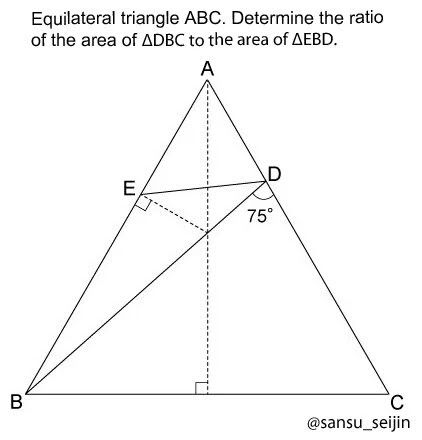
This is a continuation of my geometry problem solving posts. I spent the last few days thinking about the above problem from @five_triangles. This ends up serving as an example of a brute force approach versus a more elegant one.
My first step was to find that $\angle DBC$ is 45$^\circ$ and $\angle ABD$ is $15^\circ$ through a quick angle chase. That immediately made me think of trisecting $\angle DBC$ and reflecting the triangle $\triangle$ BED across the segment $\overline{BD}$. This can be reflected two more times to produce this:
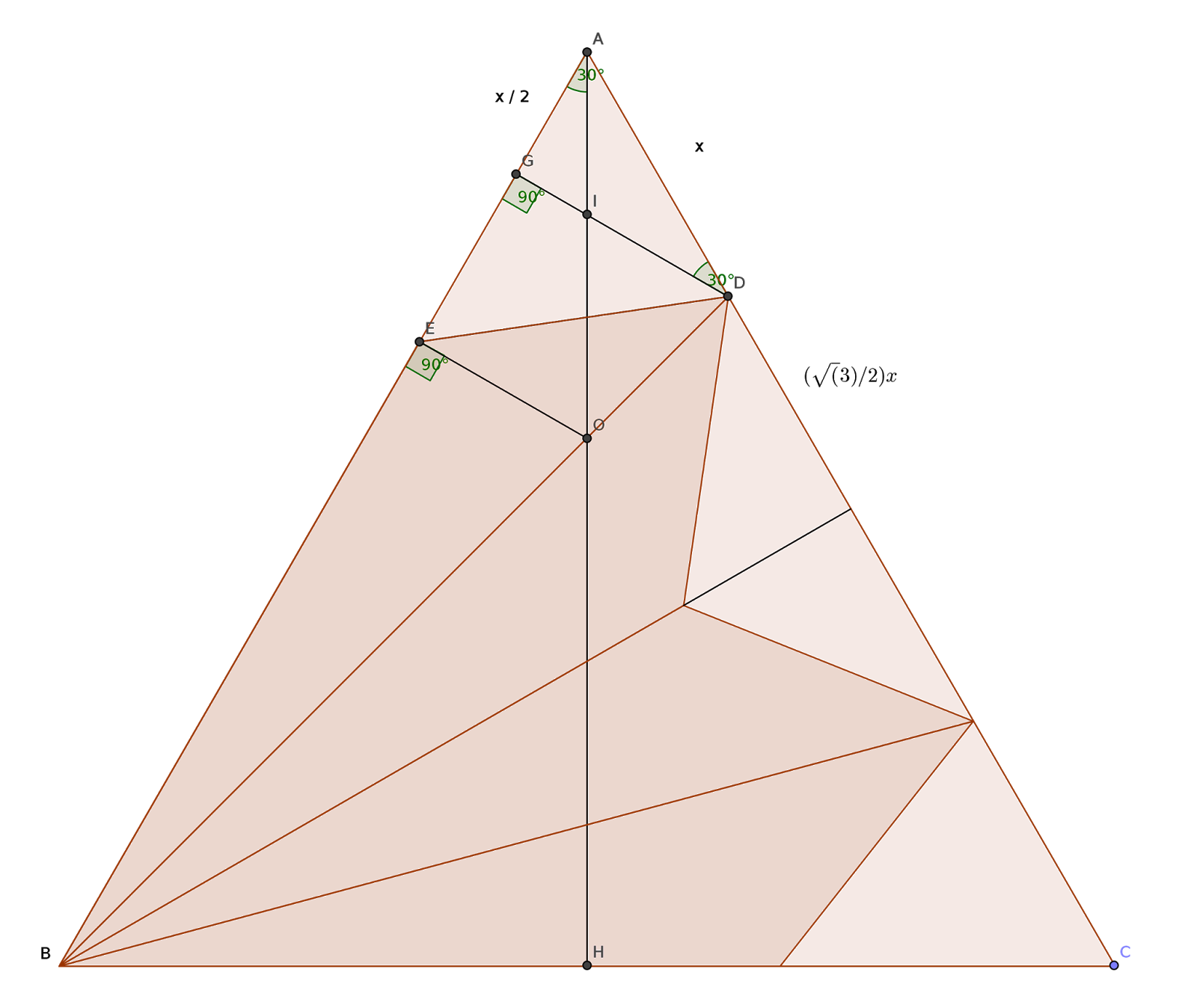
Note: $\triangle ABH$ is half of the big $\triangle ABC$ and the desired ratio is at least 3:1 since there are 3 reflections of $\triangle EBD$ within $\triangle DBC$ plus some other bits.
From here I added the parallel line GD to EO which makes a trapezoid and some similar triangles. I was hoping that the remaining similar triangles could be easily combined to form a multiple of EBD but while they all had the same altitude this wasn’t the case.
I then experimented with the similar triangles starting from $\triangle{BEO}$ That almost worked I could find BGD and BDC in terms of BEO. Using the ratio between GD and EO I could even break the trapezoid apart to find the remaining piece but was left with a ratio $\frac{\overline{GD}}{\overline{EO}}$ embedded in my expression.
So I went back to the drawing board and started with the top $\triangle{AGD}$ which is 30-60-90.
-
Let AD = x Its possible to then find DG, and ultimately the entire side AC in terms of x.
-
AHC is also 30-60-90 and since you have AC. You can find AH and HC in terms of x.
-
OH is in a 45-45-90 triangle so it has the same length as HC which is known.
-
The smallest triangle at the the top AGI is also 30-60-90 and similar to AEO. Its one edge AG is already expressed in terms of x as well and we know AO from the previous step (AO = AH - OH)
-
From that you can finally find GE using the similar triangles.
-
Putting all of that together you have altitudes and bases for the two triangles all in terms of AD and it simplifies down to 1:4.
This is mechanical but fairly messy and has a lot of expression with radicals.
Trig Approach
After looking at my first two ideas I didn’t like the complexity and I felt the ratio could be visualized more cleanly i.e. something should be quartered. So I actually asked my friend Dan to try the same problem. Here’s his clever idea which utilizes some trig to quickly find the altitudes and cleanly shows where 1/4 comes in.
Call the intersection point in the middle Q.
Draw QC.
BQC is a 45-degree right triangle.
So the height of DBC is QC which is also BQ.
Angle QBE is 15 degrees.
BE is BQ * cos 15.
Altitude from E to BD is BE * sin 15.
So altitude of triangle EBD is altitude of triangle DBC * cos 15 * sin 15 = altitude * ½ sin 30
Ratio of altitudes is 4, so ratio of areas is also 4.
Final Improved Version
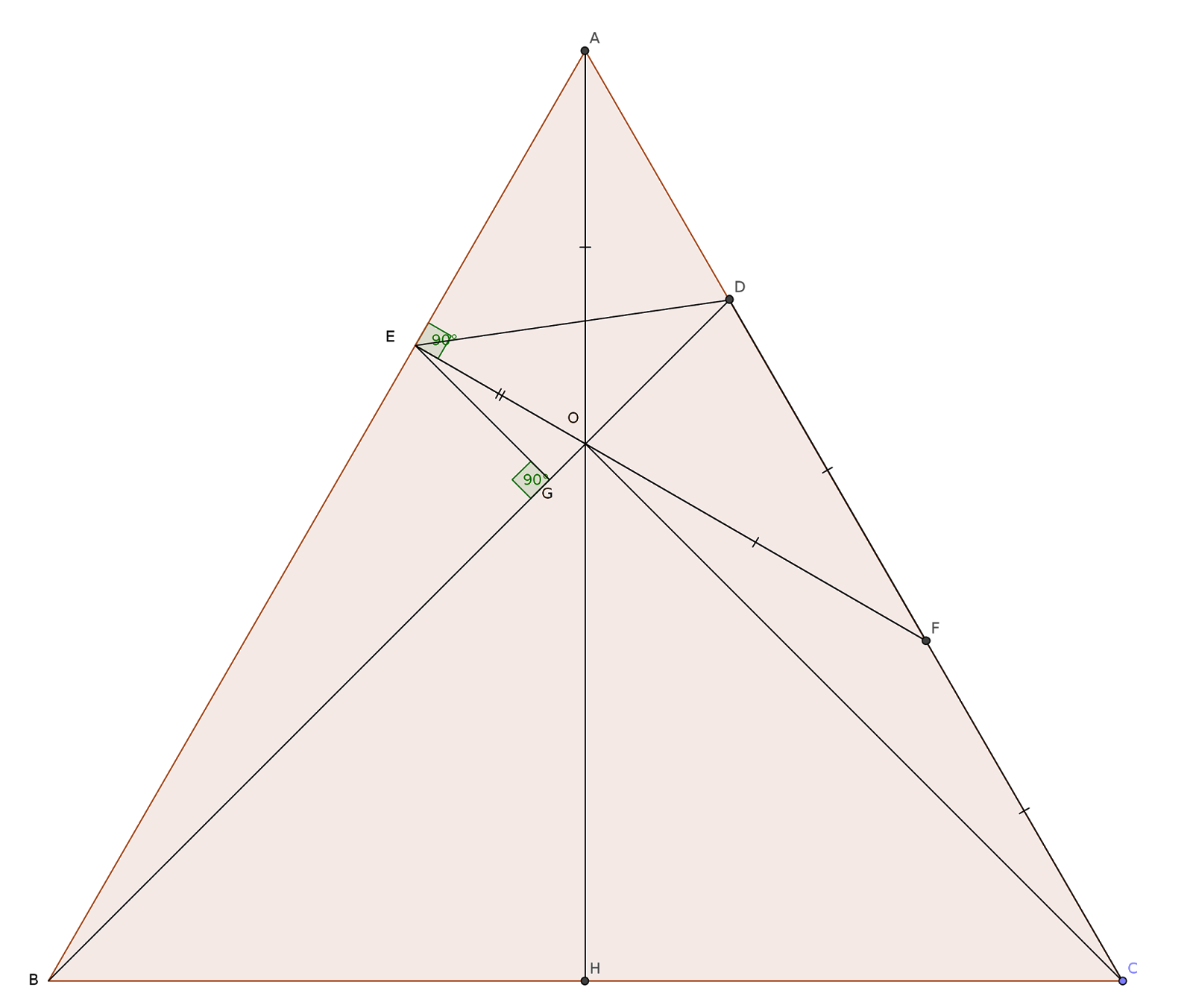
Playing with Dan’s idea a bit more you can remove the need for trig.
-
First note: $\triangle{EBD}$ and $\triangle{DBC}$ share a common base $\overline{BD}$.
-
Angle chase to find $\angle OBC$ is 45$^\circ$ and $\angle ABO$ is $15^\circ$.
-
Reflect $\overline{BO}$ and you get a right triangle BOC so $\overline{OC}$ is the altitude of $\triangle{DBC}$.
-
Drop another altitude $\overline{EG}$ for $\triangle{EBD}$
-
Now the trick is to find the ratio between the two altitudes. This is accomplished through following a series of isosceles triangles.
-
First extend $\overline{EO}$ to F. [I experimented with this auxiliary line because the 2 overlapping 30-60-90 triangles were so useful in my first try. I thought I would directly use its side ratios but as soon as it was there all of the following observations were visible one after another.] $\angle{EFC}$ is 150 so $\angle{FOC}$ is 15 and $\triangle{OFC}$ is isosceles. Therefore $\overline{FC}$ = $\overline{OF}$.
-
Next angle chase again $\angle{DOF}$ is also 75 so $\triangle{ODF}$ is isosceles and
$\overline{DF}$ = $\overline{OF}$.
-
Then look at $\triangle{AOF}$ which is also isoscleses. So $\overline{AO}=\overline{OF}$
-
$\triangle{AEO}$ is a 30-60-90 so $\overline{EO}$ is 1/2 $\overline{AO}$
-
Its easy to verify then that $\triangle{OEG}$ and $\triangle{ODC}$ are similar 15-75-90 triangles.
-
Since $\triangle{OEG}$ has a hypotenuse (EO) 1/4 of the hypotenuse of $\triangle{ODC}$ (DC). The altitudes must be in the same ratio, and also the areas.
Leave a comment