1:2 triangles and their link to Pythagorean triples
I’ve mentioned before how instinctively it feels like the 1:2 triangle ought to have a more natural angle measure. In fact its in a 90 - 26.57 - 63.43 degree triangle. However when combined with a 1:3 triangle more integral relationships appear.
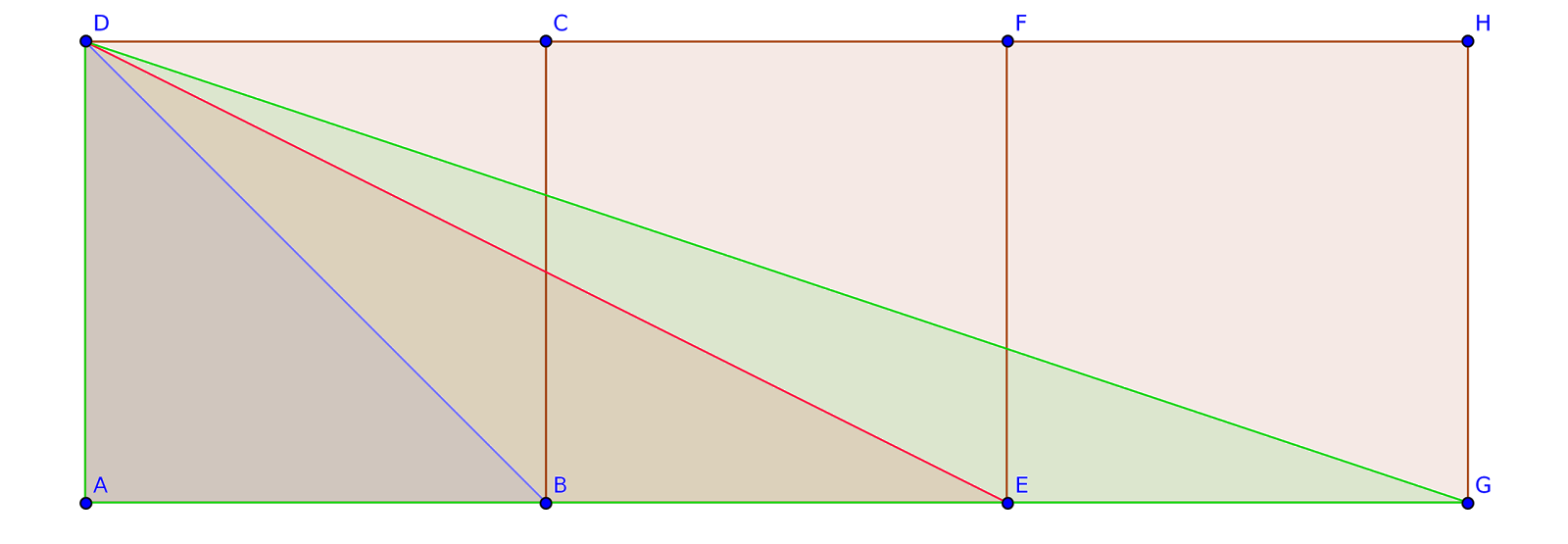 The 1:1 triangle ABD, 1:2 triangle AED and 1:3 triangle AGD all in a row.
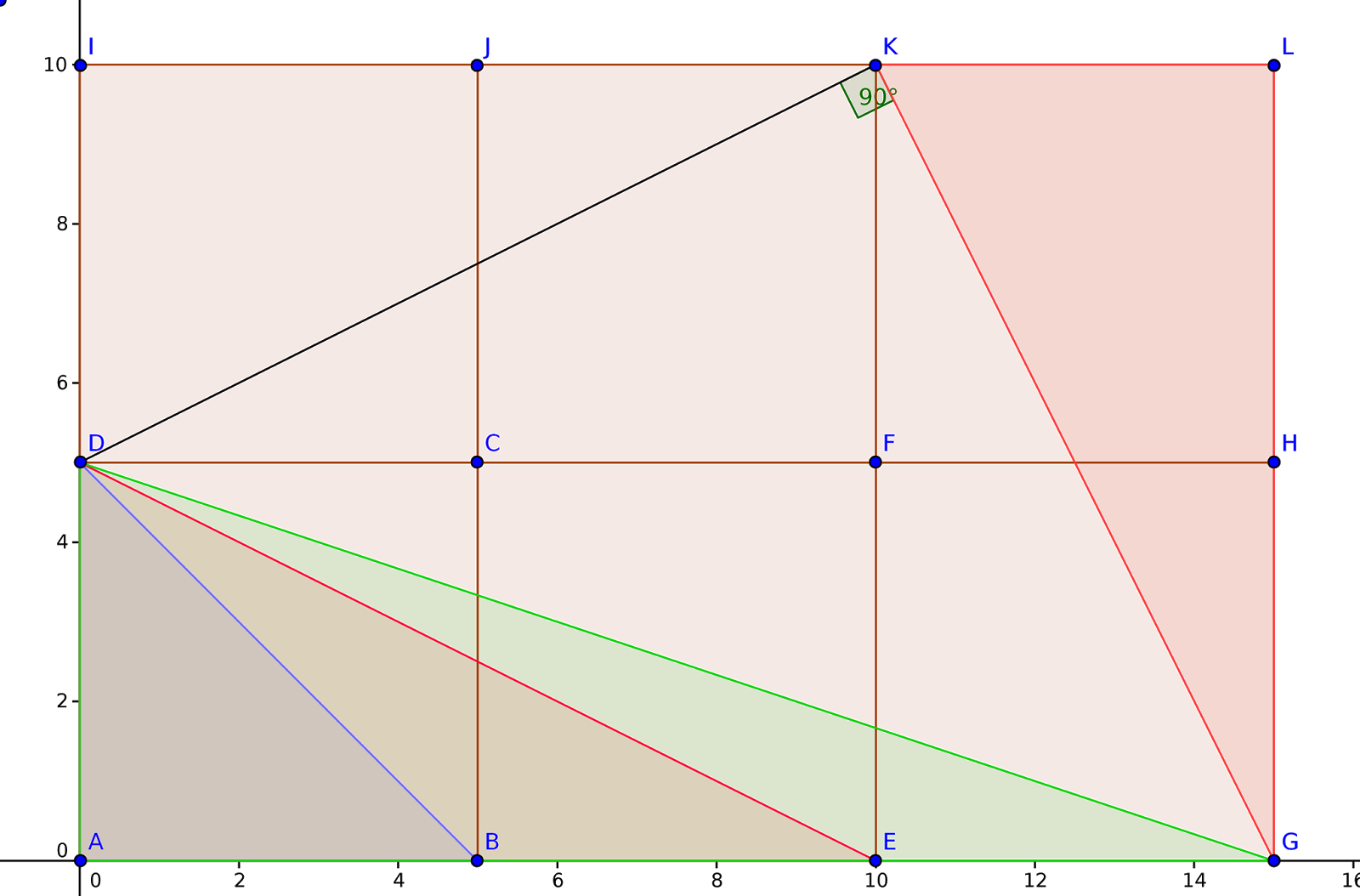
Demonstration that the 1:1 + 1:2 + 1:3 triangles create a 90 degree angle. in the corner G.
- First draw in a congruent 1:2 triangle GLK.
- The remaining angle between it and the 1:3 triangle forms a 45-45-90 triangle.
I just realized another extension today. Multiple the angles in the corner G by 2 and you get
90 degrees + 2 1:2 triangles + 2 1:3 triangles = 180 degrees.
Stated another way if you take 2 of each of the base triangles they will form another right triangle.
And here’s where it gets cool: out pops the 3-4-5 Pythagorean triple. (Its also another demonstration why the in-circle has radius 1)
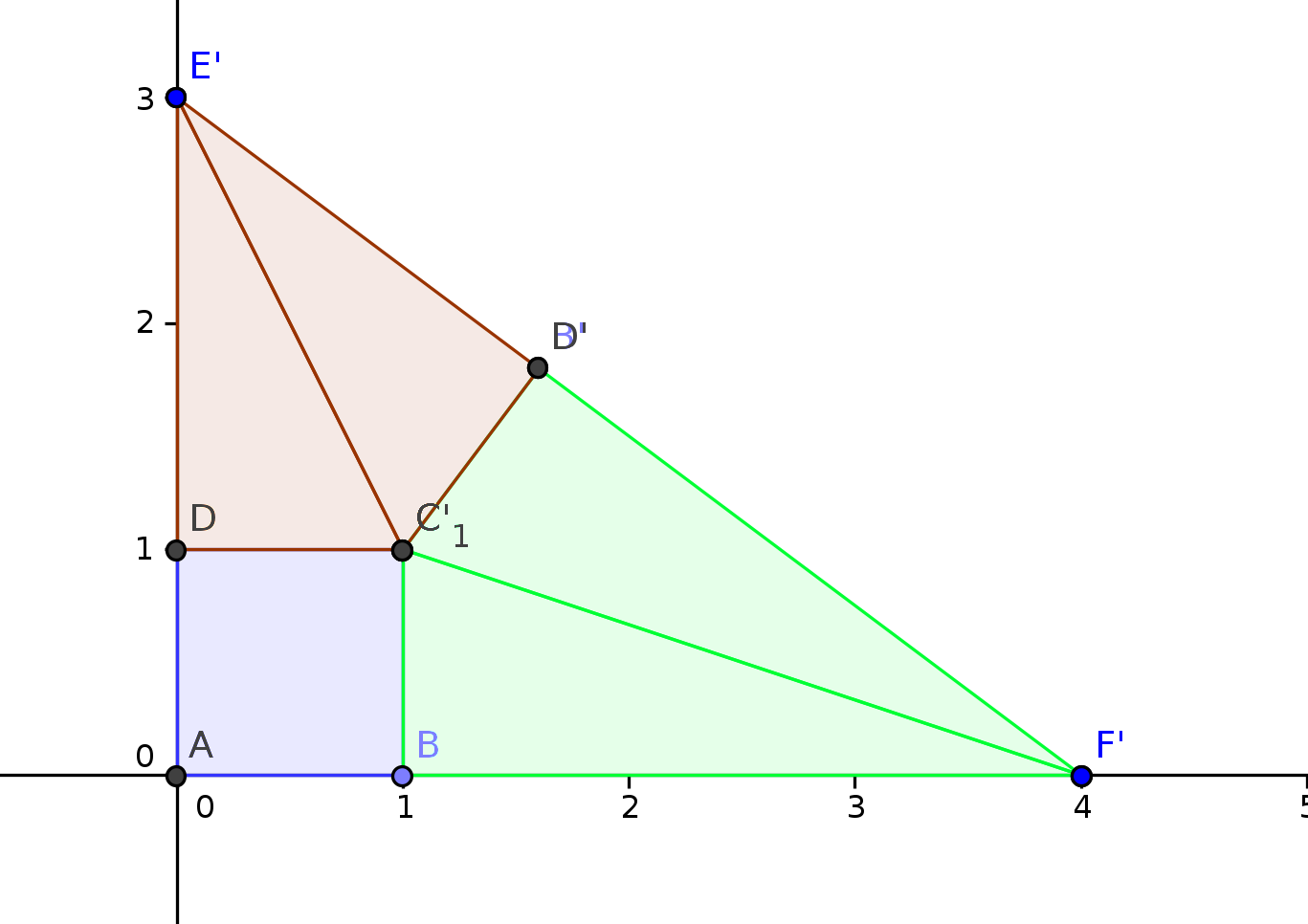
This meshes well with another 1:2 triangle exploration that led to a
3-4-5 triangle: another-fundamental-square-construction
Field Guide to spotting 3:4:5’s (examples) Example:
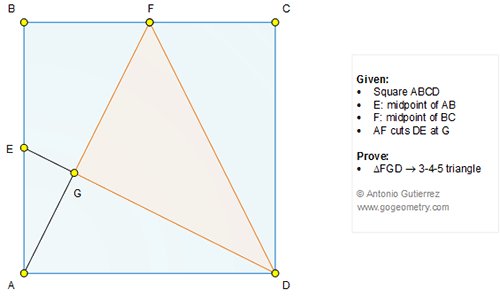
Once you have medians, like F and E you create 1:2 triangles like ABF, AED, CDF. So its fairly natural that a 3-4-5 is lurking. The normal approach would be to show AEG is similar to ABF and also a 2:1 and then find the length of EG, GD and then prove DFG is a 3-4-5 in proportion.
But we simplify by just noting FDG is 90 degrees - 2 arctan(1/2) angles and therefore is
2 arctan (1/3) i.e. one of the corners of the 3-4-5. We can either show FGD is 90 degrees using similar triangles or AFD is 180 - 2(90 - arctan (1/2)) = 2 arctan(1/2) and the 2nd of the 3 needed angles. And we’re done.
Second Example:
!
This doesn’t immediately appear the same but once you add the radii and center and remove the circle you’re left with:
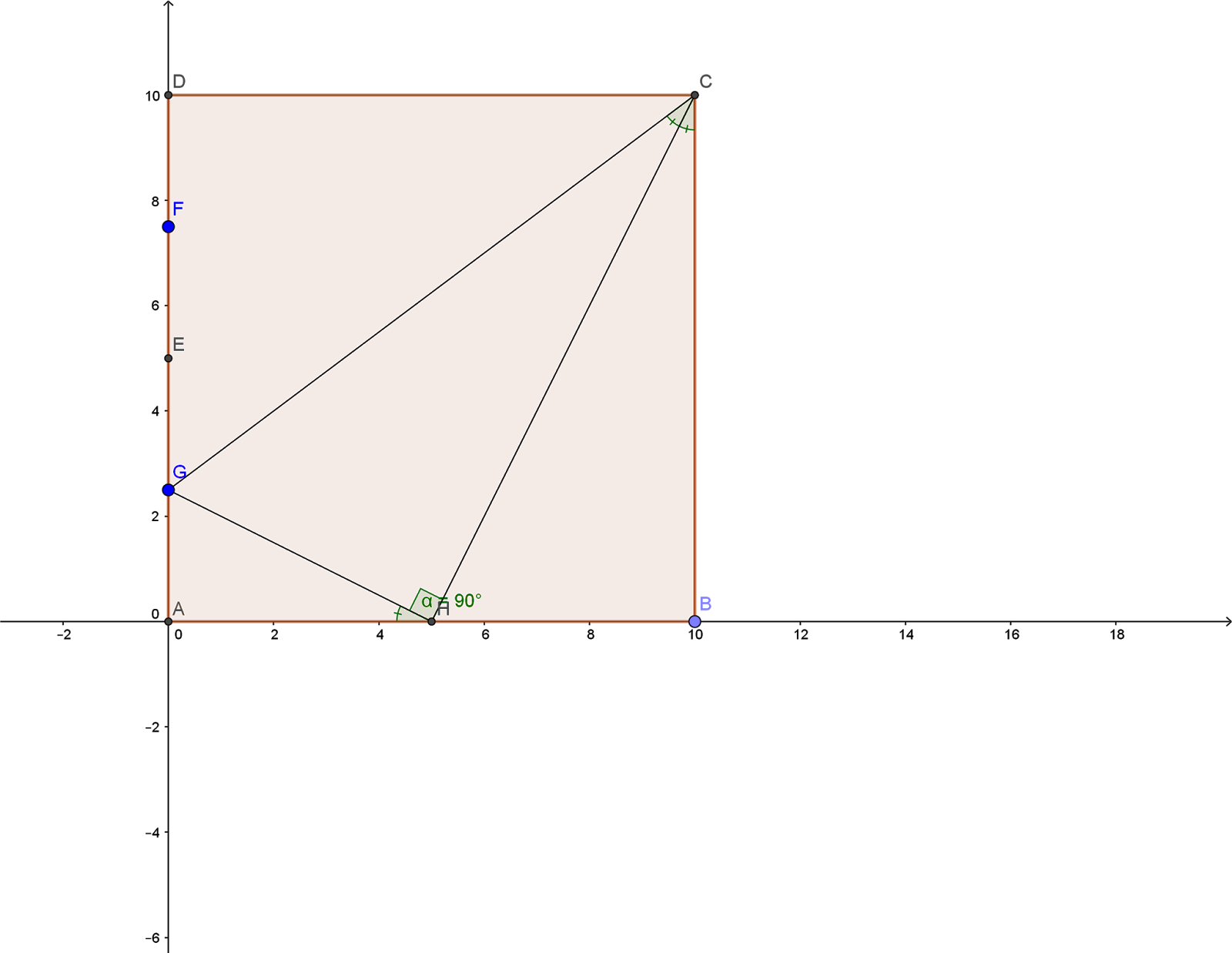
The median at the bottom has created a 1:2 triangle CBH which its then easy to show similar to first AGH and then CGH. You can then see angle DGC = 2 1:2 triangles angles from the parallel lines and it follows CDG is a 3-4-5.
Third Example:
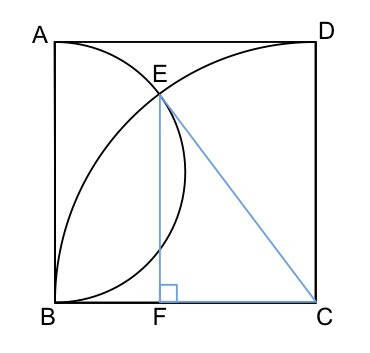 ABCD is a square containing a half and quarter circle and their intersection. What is the ration of CF:EF:CE?
After angle chasing one could apply the Pythagorean theorem (or similar triangle / ratios) and eventually find BF is 2/5 of the side BC and EF is 4/5. But there is again a quicker way
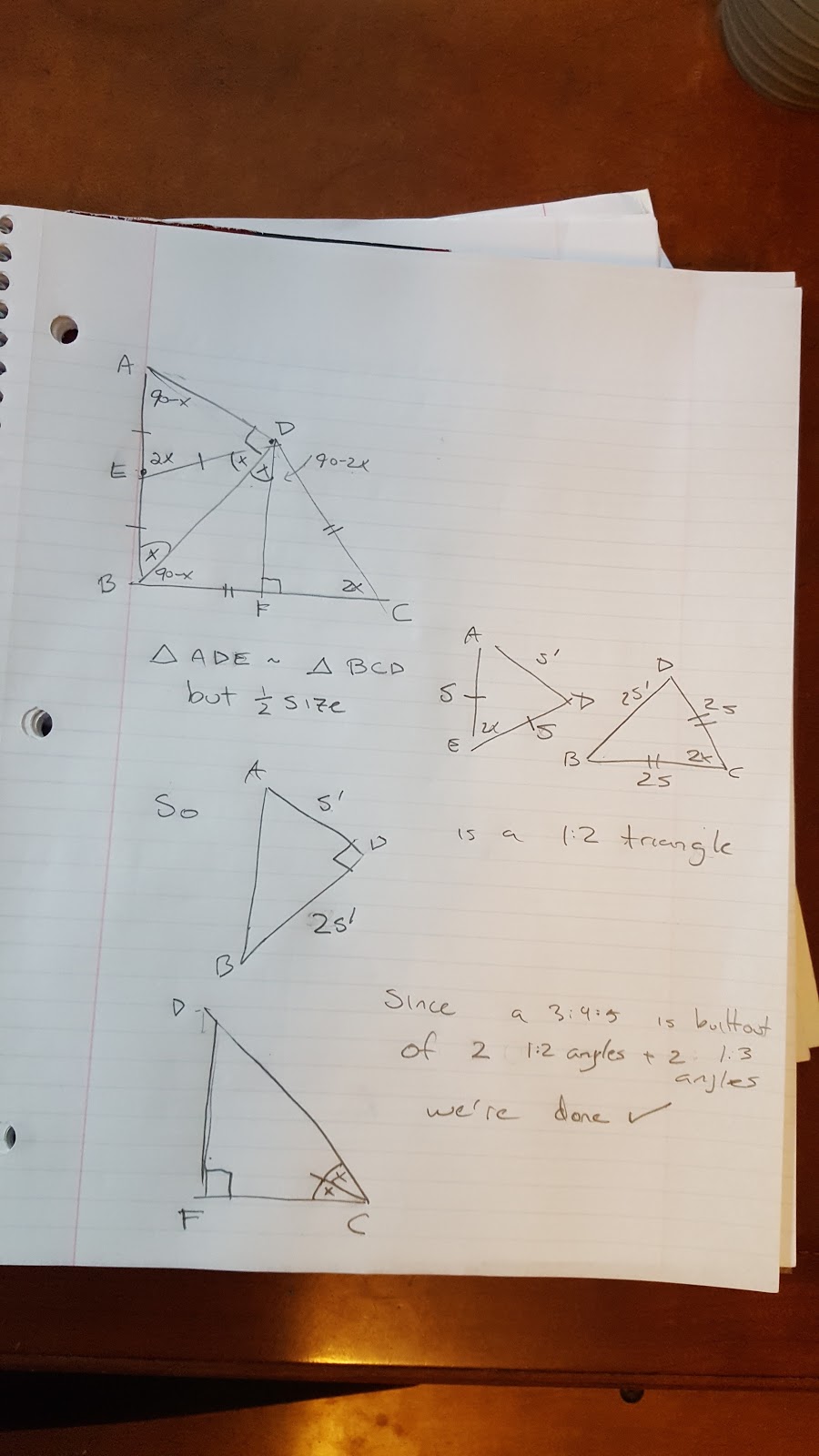
What to do with all these connections?
It seems like there is a really fun project for kids exploring all these relationships. I just have to figure how to structure them since the conceptual leaps are fairly big.
Leave a comment