Fun with Pentagons
I’m in the mood for a geometry walk-through. I’ll start out by saying this one has tons of solutions. I’ve thought of 3 or 4 and seen several additional ones (one of my favorite parts of geometry.) I tend in this case to prefer the synthetic to trigonometric solutions but if you add that $ cos(36) = \frac{\phi}{2} $ or any variant rather than blindly calculating a decimal I’m good.
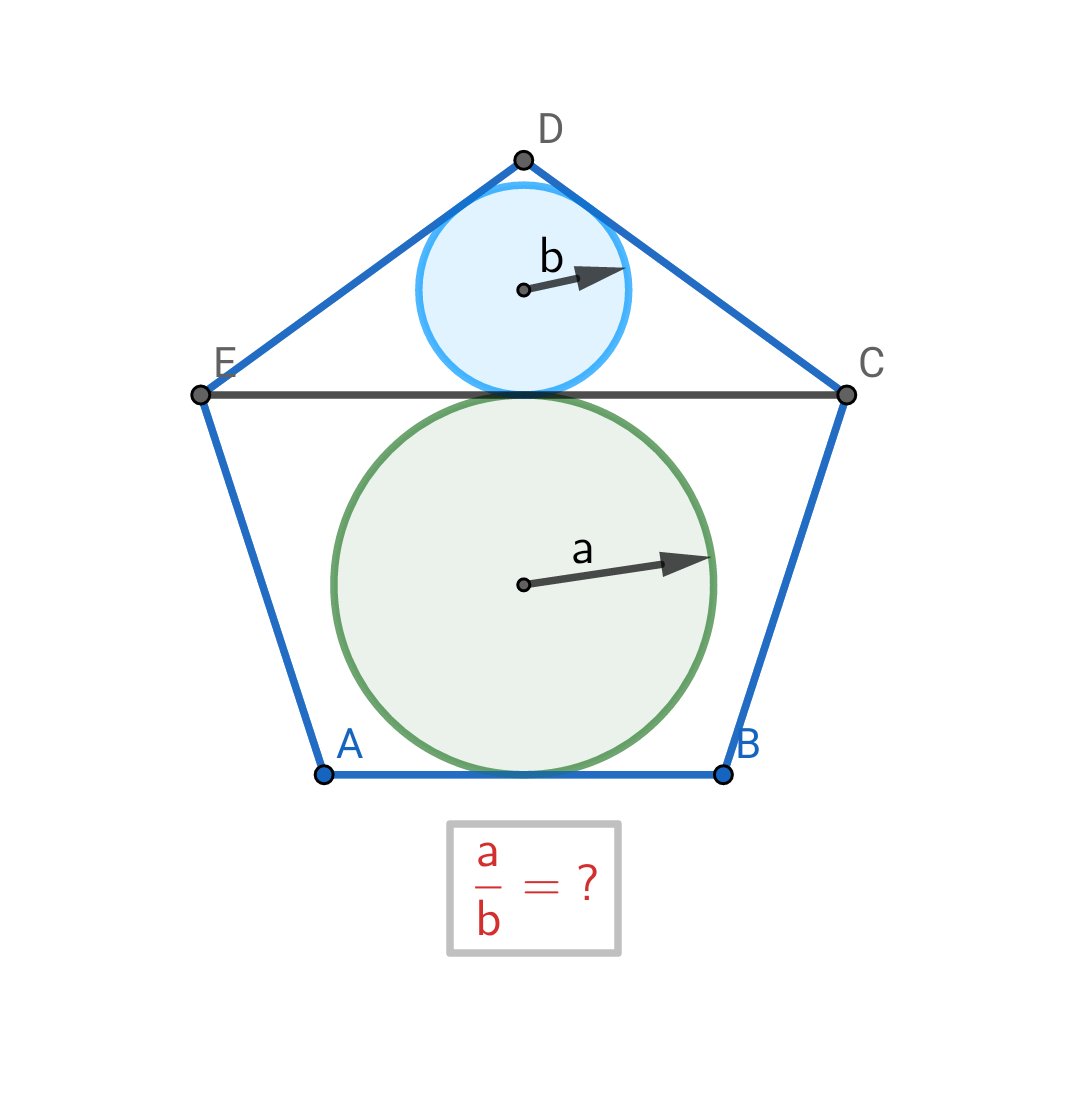
[@@jldavilaa01]
This is the second interesting pentagon problem I’ve seen in a week or so. With this one, I immediately thought I’ll be disappointed if the golden ratio is not embedded somewhere in the answer. When playing around I spent some time angle chasing and looking for similar triangles. This led to several different ways to find the ratio. I’ve included the simplest one below.
First I assume a regular pentagon of side length 1 for the rest of this discussion. Secondly, I’m going to briefly discuss how the golden ratio is found within the figure.
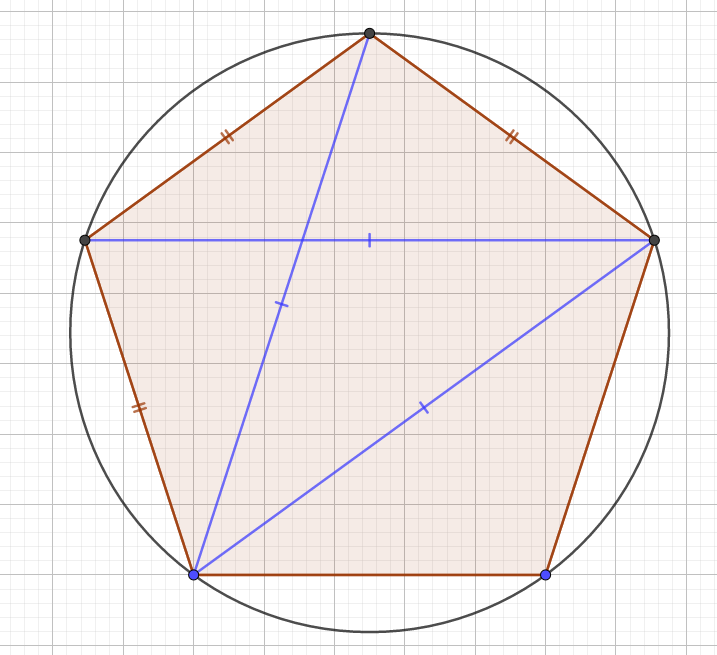
If you look at 4 points on the pentagon (A, C, D and E) its clear they form a cyclic quadrilateral with three sides of length 1. Further all the other sides and diagonals have the same length since they are all in congruent triangles.
Let $ d = \overline{CE} = \overline{AD} = \overline{AC} $
Using Ptolemy’s theorem: $1^2 + 1\cdot d = d^2$ Solving you get $d = \frac{1+\sqrt{5}}{2} = \phi$ also know as the golden ratio.
With that result in hand I now did some angle chasing:
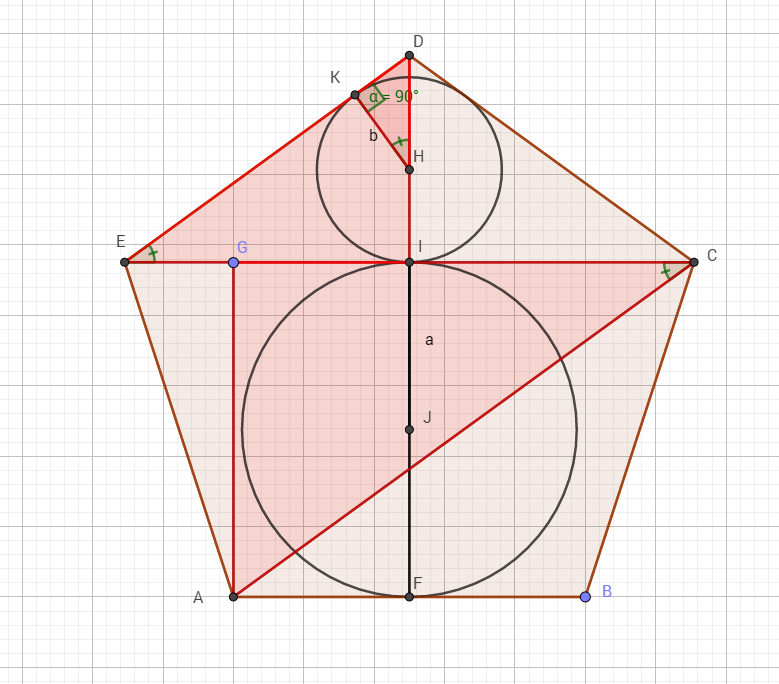
I found three 36-54-90 triangles: DHK, EDI and ACG (which are outlined in red above). In addition we already know that:
- $\overline{EI} = \frac{\phi}{2}$
- $\overline{AC} = \phi $
- $\overline{DE} = 1 $
- $\overline{HI} = \overline{HK} = b$
- $\overline{AG} = 2a $
So now we can apply the similar triangles:
From DHK and EDI:
\[\frac{\overline{DH}}{\overline{HK}} = \frac{\overline{DE}}{\overline{EI}}\] \[\frac{\overline{DH}}{b} = \frac{1}{\frac{\phi}{2}} \text{ or } \overline{DH} = \frac{2b}{\phi}\]Then $\overline{DI} = \overline{DH} + \overline{HI} = \frac{2b}{\phi} + b = b\cdot(\frac{2}{\phi} + 1) $
Now look at EDI and ACG:
\[\frac{\overline{DI}}{\overline{DE}} = \frac{\overline{AG}}{\overline{AC}}\] \[\frac{b\cdot(\frac{2}{\phi} + 1)}{1} = \frac{2a}{\overline{\phi}}\]Rearranging:
\[\frac{a}{b} = \frac{\phi}{2} \cdot (\frac{2}{\phi} + 1) = \frac{2 + \phi}{2}\]Note: there was a fun alternative presented online by @asitnof using areas rather than similar triangles:
!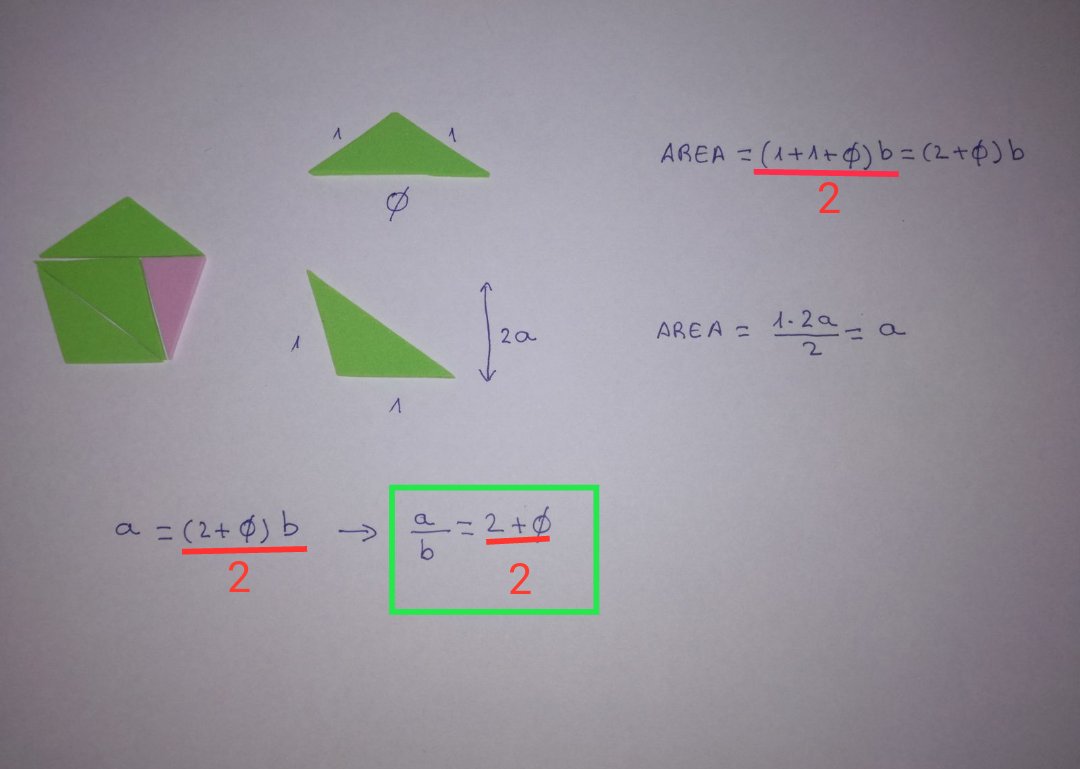
Again we start with the cross diagonals being phi in length but instead find 2 different expressions for the length of the triangles. One based on the incircle and the second on the base and height.
Leave a comment