Book Review: Introduction to Number Theory and An Illustrated Theory of Numbers
Over the last 5 months, I worked through both Introduction To Number Theory and parts of An Illustrated Theory of Numbers with my son at home so I thought while the experience is still fresh I would write down my impressions.
We started with the Art of Problem solving textbook. This is considerably shorter than some of their other volumes and its generally expected to take only half a year working through it. (Scale everything by how long it took you to do the Algebra book) In fact, this was the first AOPS textbook I ever purchased. A few years back, my neighbor’s son was working through a problem set for the online version of this book and needed some help on the problems. I spent a weekend going through the problem set and at the end thought to myself, “Wow these are really interesting problems.” The one below was my favorite.
There are unique integers $a_2, a_3, … a_7 $ such that
\[\frac{5}{7} = \frac{a_2}{2!} + \frac{a_3}{3!} + \frac{a_4}{4!} + \frac{a_5}{5!} + \frac{a_6}{6!} + \frac{a_7}{7!}\]where $ 0
So I ended up purchasing book then and reading and trying out some of the exercises over the winter in the ski lodge while my kids were taking lessons. Five years later, I’ve actually had experience with a few of the other books and I now wanted something to do with my son over the back half of the year.
The book itself informally divides into 3 major sections. The beginning sections on integers, divisibility and factorization which culminate in the Euclidean Algorithm for finding the greatest common divisor. There is a middle section which includes different base number systems and a review of some applications with decimals and fractions. Followed by the last section which deals with modular arithmetic and linear congruences.
Overall the pacing and material is a bit more uneven than some of the other textbooks in the series. I found portions of the earlier and middle chapters repeated topics from the pre-algebra book and some of the problem sets at the end felt a bit repetitive. So we tended to skim some of these chapters. In particular, if I were revising the book I would replace the decimal/fraction chapters and perhaps even some of the focus on different number bases with a dive into the Chinese Remainder Theorem and a discussion of Diophantine equations and how they relate to the linear congruences.
However, the payoff really was in the last 4 chapters starting with the introduction of modular arithmetic. These are all well done and have a nice ratio of practice to theory. If one were limited in time, I would focus on this section. I particularly like the work around exponent towers as a motivating problem.
Because there were a few weeks left in the school year when we finished the AoPS book and after seeing a favorable review by Mike Lawler I also purchased Weissman’s book. This is actually a very nice companion to the previous book. What’s most striking is the extremely strong conceptual/visual framework.
We ended up doing the introductory chapter and skipping ahead to modular arithmetic parts. My hope was to make it to the topograph sections but we ran out of time. The very strong narrative strands really make this book. There are interesting conceptual pieces and data visualizations almost every few pages along with illustrations to go with them. As Weissman notes “Most of our proofs are given with visual explanations; geometric and dynamical proofs are preferred” which makes the treatment fairly different from other texts.
For example, the early chapters have some lovely figurate number illustrations just with the number 100:
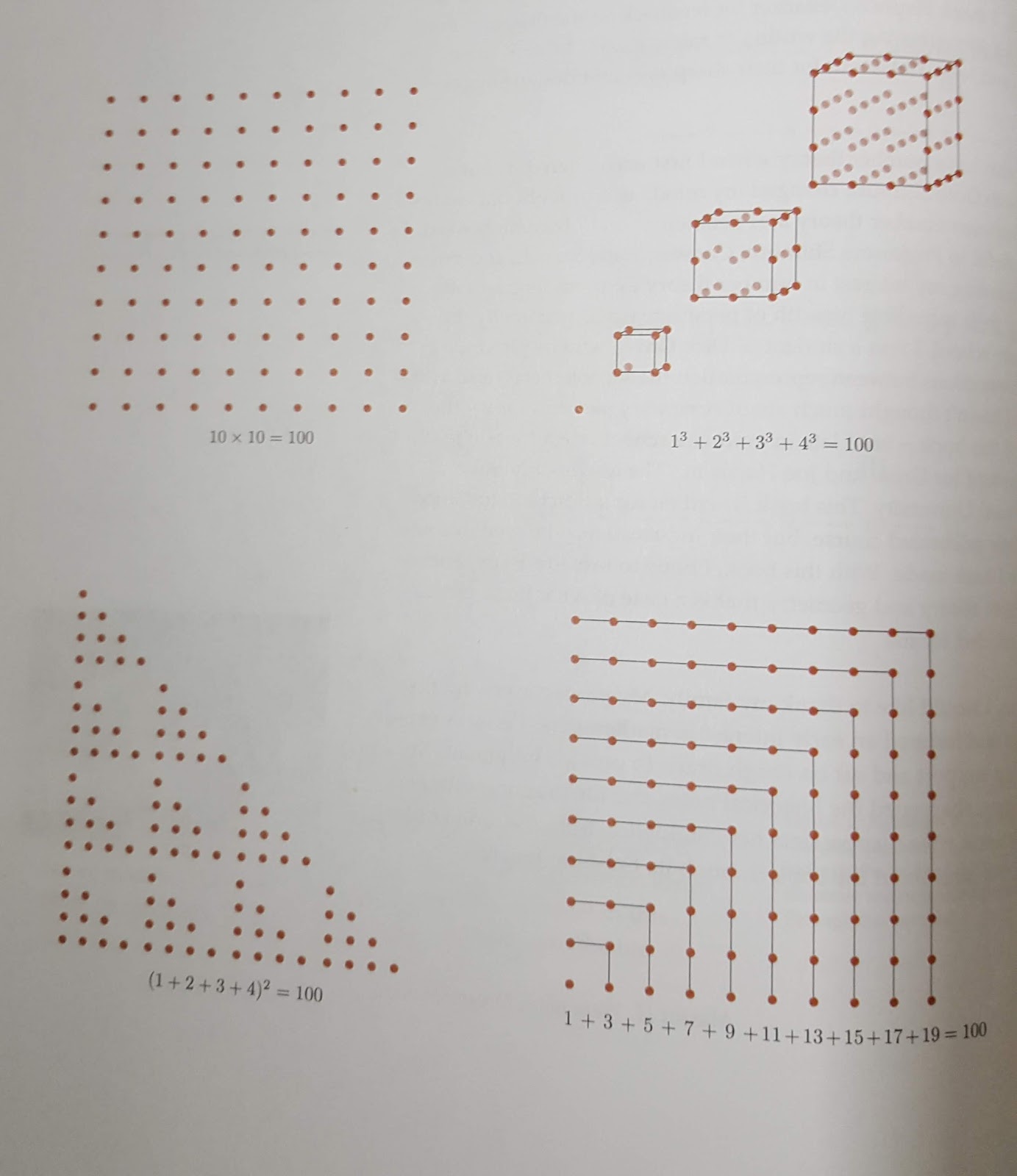
and then a section on using Hasse Diagrams to visualize factorization (rather than the more normal trees).
Where this really works well though is in the later chapters. I love conceiving of the “modular world” and having it bound horizontally via factorization and vertically via powers of prime.
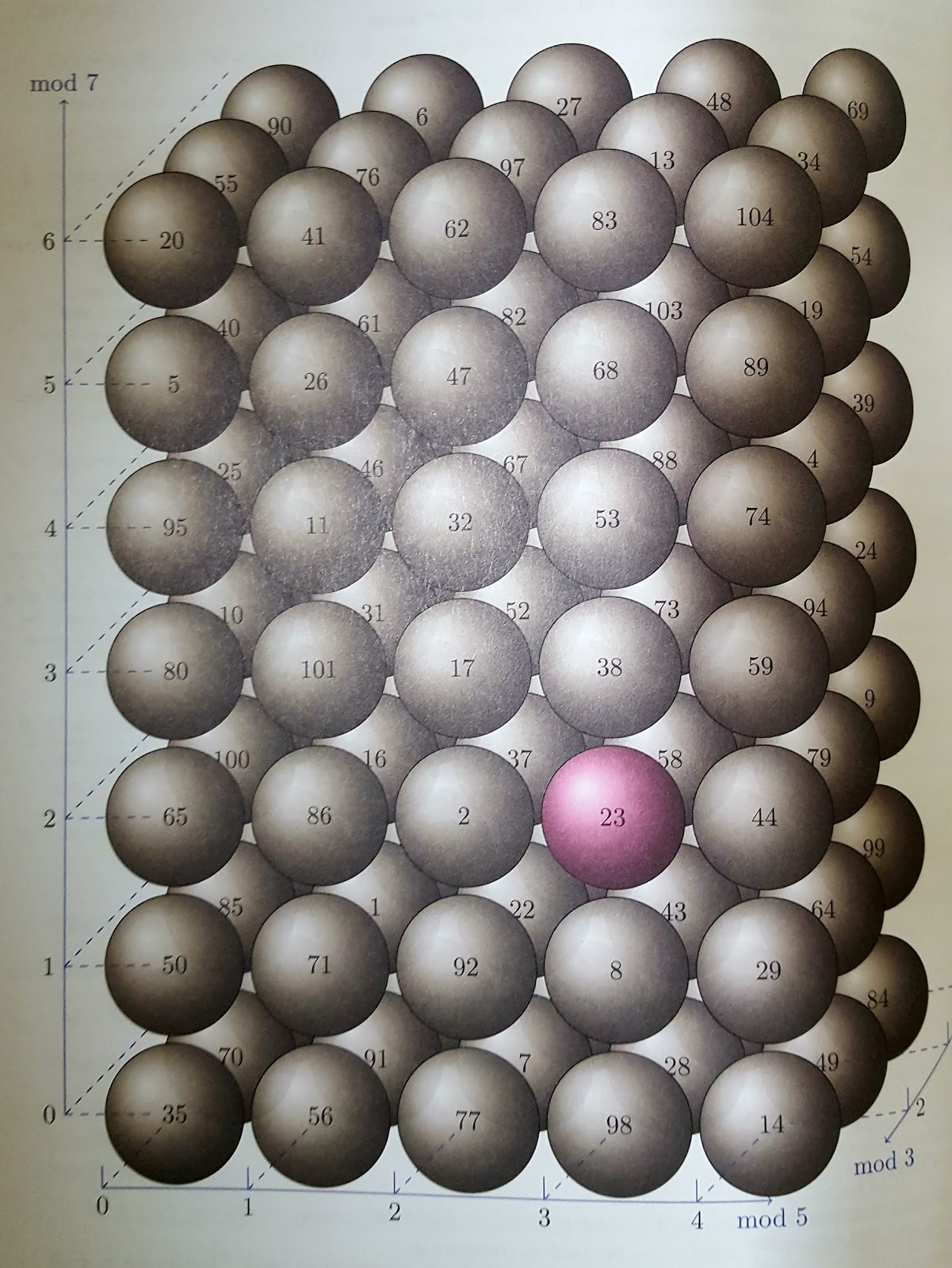
The final chapters which use John Conways topograph construct rather than more familiar approaches to discuss quadratic residues are particularly fun.
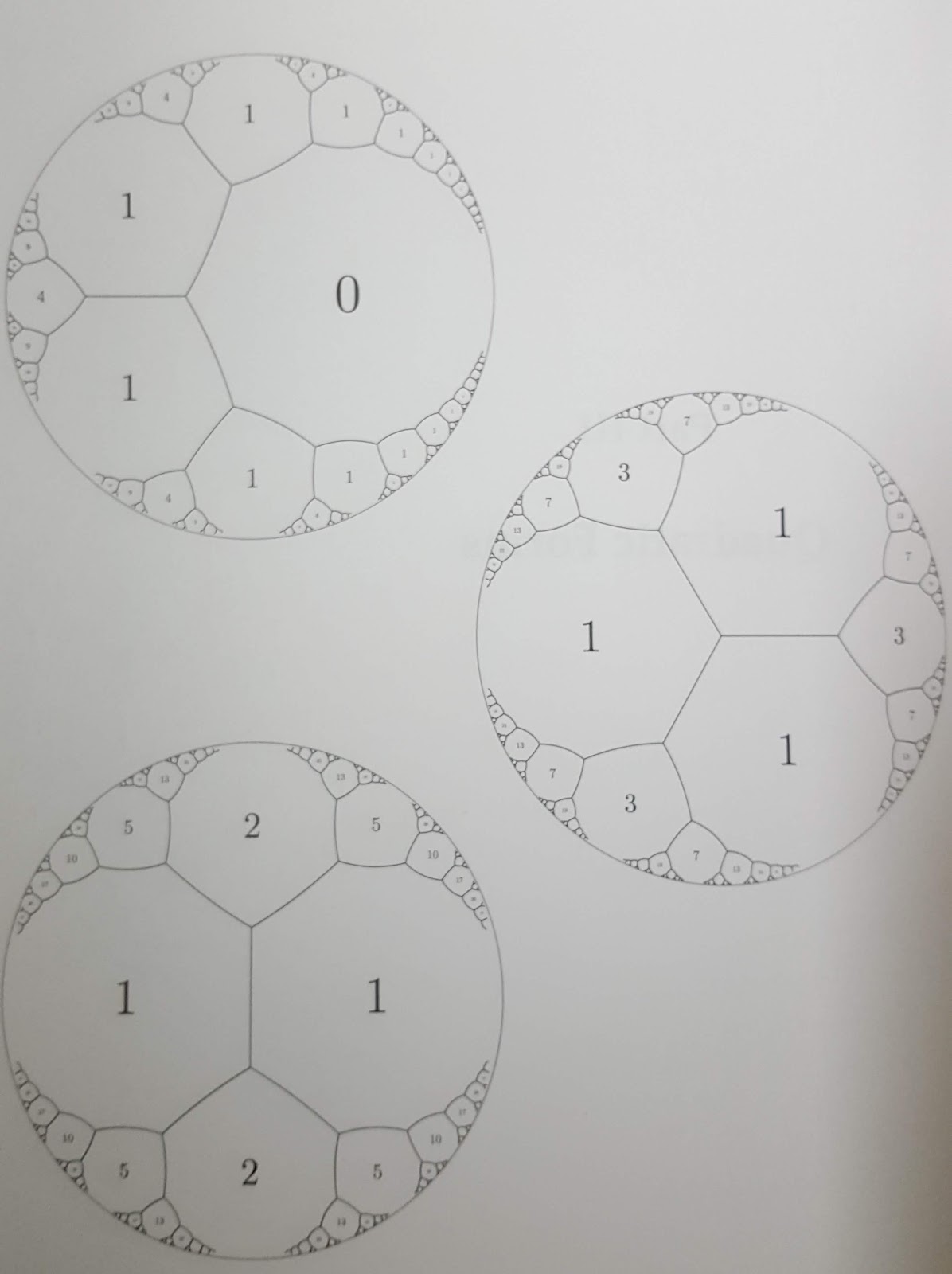
Overall, the only weakness I felt in the book was a need for more problems at the end of the chapter. From time to time I also found myself missing interleaved problems ala AOPS as well. For older more experienced students I might just use the Wiessman book alone but otherwise it made for a very nice complement to the AoPS text.
Leave a comment