Sometimes representation does matter
This is a small observation based on a post from @samjshah on the topic of the trig double angle formulas:
- $ \sin{2\theta} = 2 \sin{\theta} \cdot cos{\theta} $
- $ \cos{2\theta} = \cos^2{\theta} - \sin^2{\theta} $
Sam used the construction below to derive the formulas which is a bit different than how I usually think of doing it.
I immediately thought to myself, I can assign x to the base of one triangle and all the relationships must fallout from either the Pythagorean Theorem or similar triangles. This is certainly true and it looked like this:
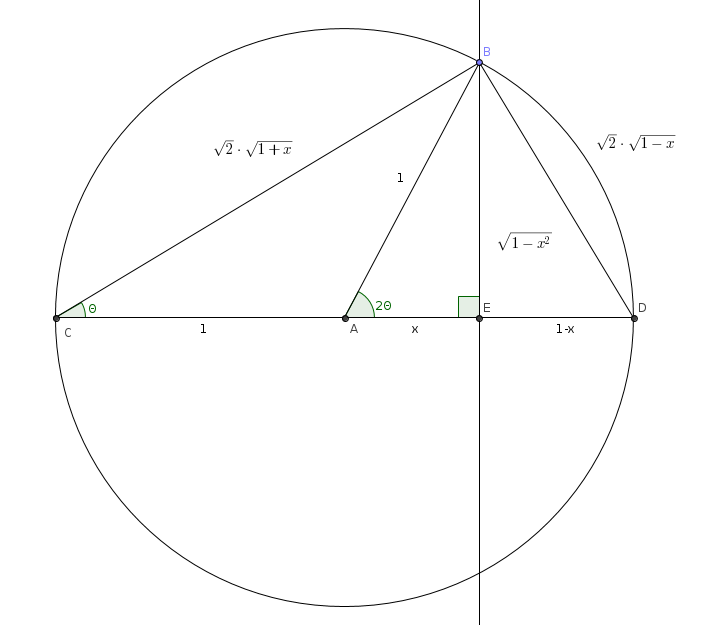
So for example using the direct definition of sin and cosine:
\[\sin{2\theta} = \frac{\sqrt{1-x^2}}{1} = \sqrt{1 - x^2}\]which you can compare to:
\[2 \cdot \sin{\theta} \cdot \cos{\theta} = 2 \cdot \frac{1+x}{\sqrt{2} \cdot \sqrt{1+x}} \cdot \frac{\sqrt{1-x^2}}{\sqrt{2} \cdot \sqrt{1+x}} = \frac{2 \cdot (1 + x) \sqrt{1 -x^2}}{2 \cdot ( 1 + x )} = \sqrt{1 - x^2}\]That was the expected result but didn’t really seem that exciting to me. But then I looked at how Sam had done it. Rather than assigning x to the missing piece he directly used the trig value and did this:
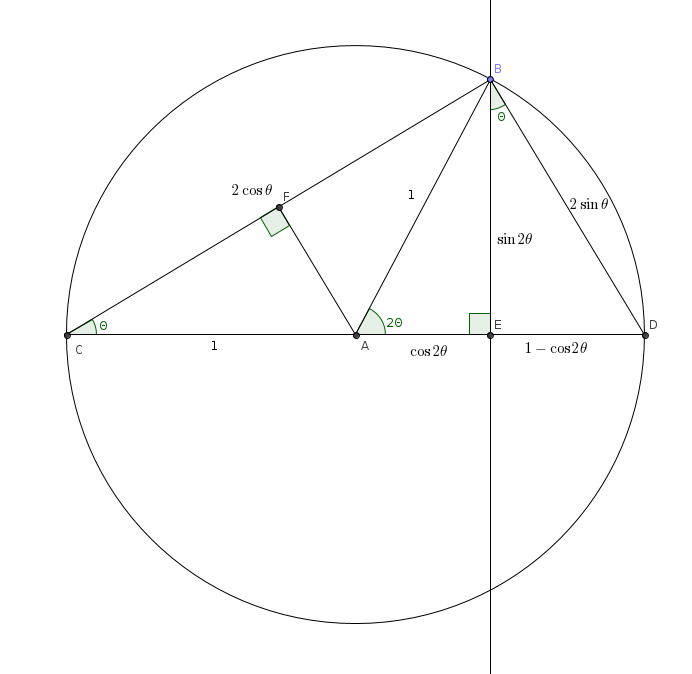
This time from the similar triangles BDE and ACF you get the following relationship:
\(\frac{BD}{BE} = \frac{AC}{CF}\) or
\(\frac{2\sin{\theta}}{\sin{2\theta}} = \frac{1}{\cos{\theta}}\) which after cross multiplication directly gives
\[\sin{2\theta} = 2 \sin{\theta} \cdot \cos{\theta}\]So with this representation something much more insightful for me falls out. Trig while offering a lot of power often has the ability to obscure geometric relationships. But as seen here sometimes with careful usage it can be quite interesting. And of course the importance of the problem setup towards simple vs complex solutions to the same problem is much more universal.
Leave a comment