Interesting Geometry Walkthrough: Inscribed trapezoids/hexagons
!
I really like this problem and spent several days experimenting with it.
Abbreviated Process:
Angle Chase
Trapezoid experiments
Extend to triangles
Notice 120 degree angle
Find an expression for r
Notice the equilateral triangles
Realize Ptolemy could be used
Simplify with Mustafa Eskici’s observation about similar triangles
Basically my process looks like this: I draw and redraw the figure and experiment with adding auxiliary lines/look for interesting observations. This time around I was particularly attracted to the trapezoids and almost immediately starting playing with diagonals. I also knew if I could find enough sides I could Ptolemy’s Formula to find a diagonal the trick was deriving all the other sides. Also I play around with geogebra models a bit so I knew several facts before I proved them: like the one diagonal being 21 which I didn’t rationalize until a day later. The whole exercise takes some time for me at least and I usually refrain from looking for solutions I’ve given it at least several days. Its amazing how much more productive thinking about a problem over several days can be vs a single attempt. I almost always find new things to explore even if they’re dead ends.
Step 1: Angle Chase
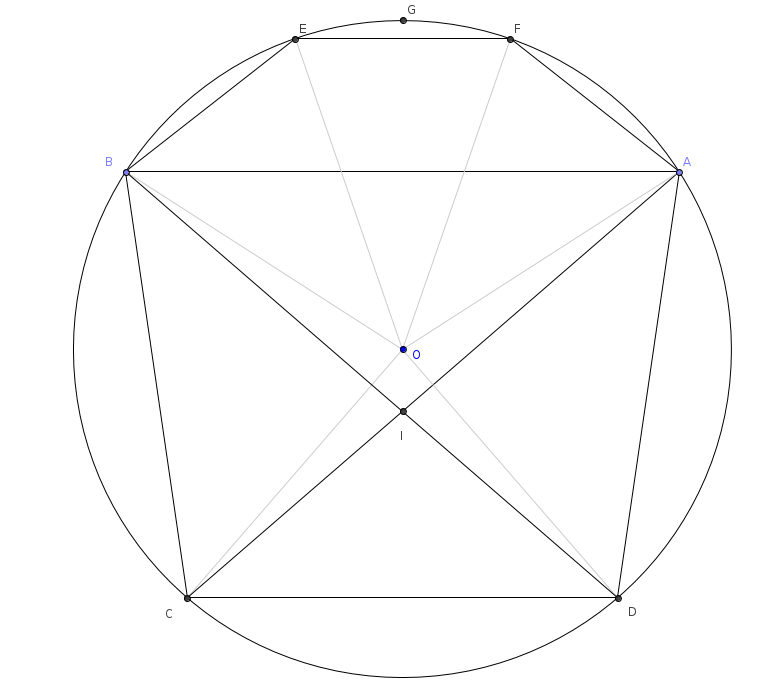
3 big arcs + 3 little arcs = 360 degrees so 1 big arc + 1 little arc = 120. This means that the interior angles like: $ \angle{EOC} = 120 $
Alternative:
Starting with the lower trapezoid ABCD which is also a cyclic quad. Let $ \angle{ACD} = x $
Then $ \angle{ACD} = \angle{CBD} = \angle{DBA} = x $ and you eventually arrive at $ \angle{BCA} = 180 - 3x $
This implies $ \angle{BOC} = 2x $ and $\angle{BOA} = 360 - 6x $
Since this is trisected each one one of the top angles for example $ \angle{BOE} = 120 -2x $
And finally that means adding the smaller to larger arcs you get an 120 degree angle i.e. $ \angle{EOC} = 120 $
Step 2: Diagonals
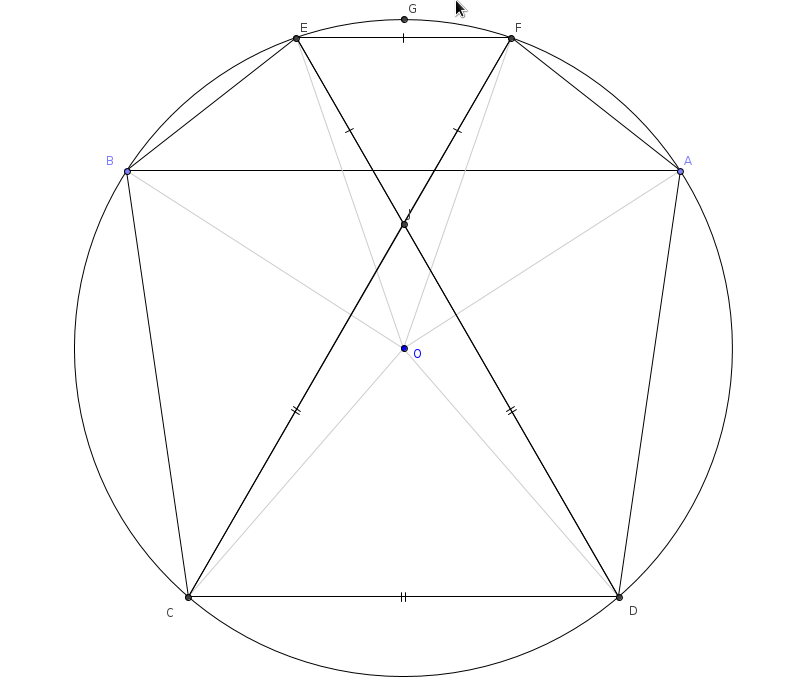
Now Connect CF and ED. Since angles EFC, FED, DCF and CDE all inscribe a pair of arcs from above they all are 60 degree angles and we have formed 2 equilateral triangles. The diagonals ED and CF must thus be 14 + 7 = 21.
Step 3: Similar triangles.
Note originally I used Ptolemy’s Law 3 times in a row here but the similar triangles are much nicer.
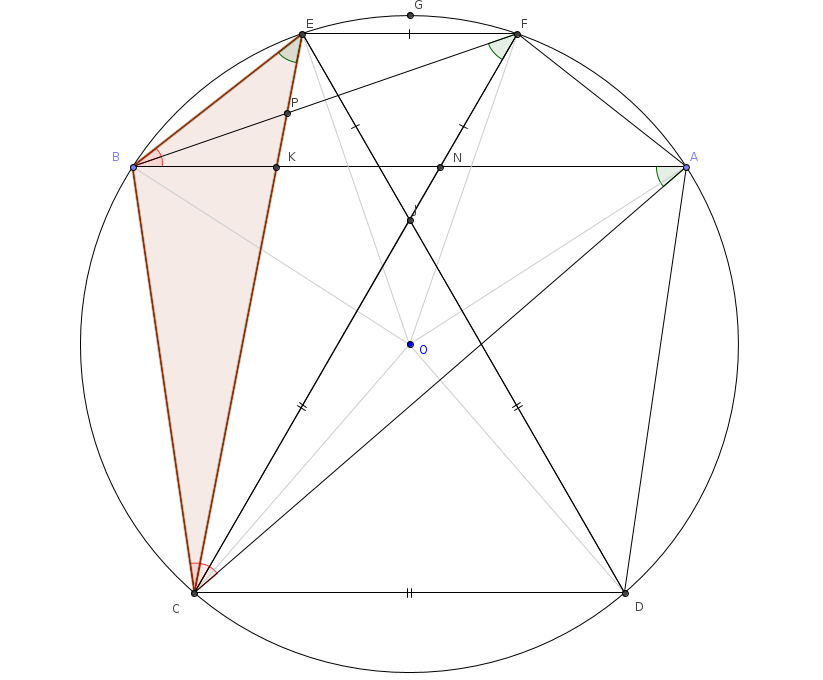
Now let’s look at triangle CBE which as has a 2:1 ratio for side CB:BE. It turns out looking at red/green angle pairs that its similar to triangle BEP, CPF, ACN and FBN.
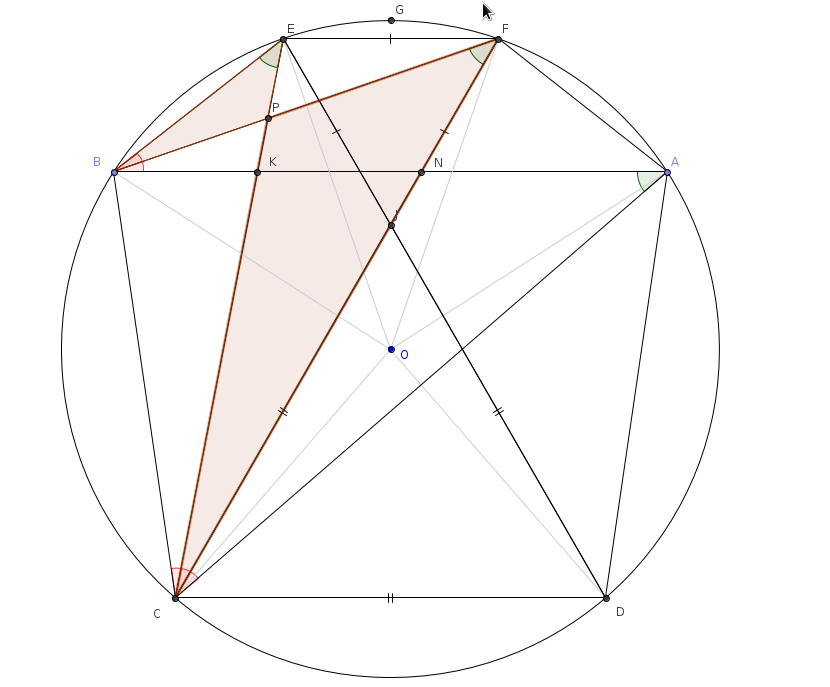
That’s convenient because we know the ratios of the triangle BEP and CPF are 3:1 since BE = 7 and CF = 21. So let a = EP then BP = 2a, CP = 6a and PF = 3a. That means CE in the original triangle is 7a and its ratios are 14:7:7a
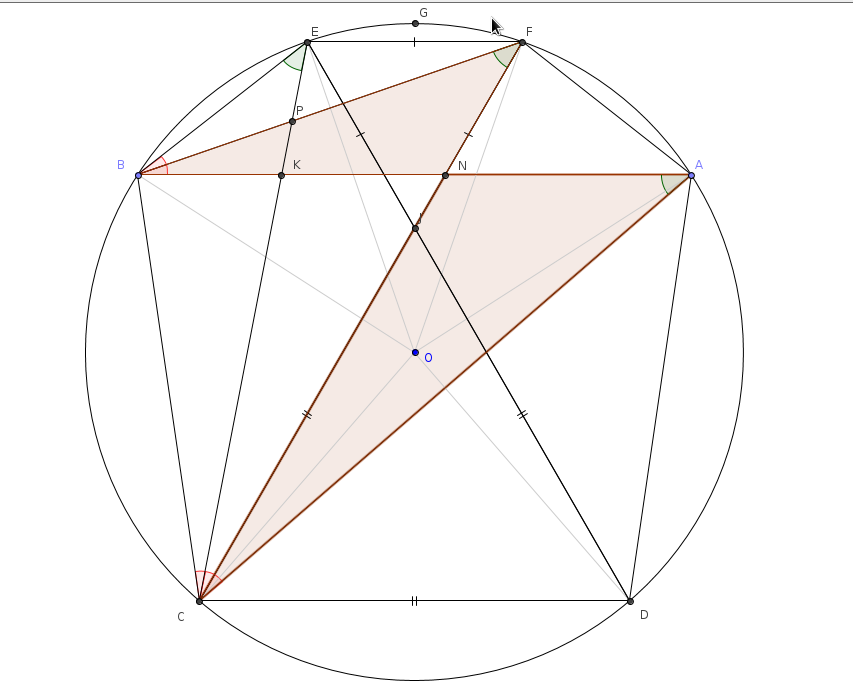
Now we can finally look at the other pair of similar triangles: FBN and ACN.
BF = 2a + 3a = 5a. So the whole triangle is scaled 5/7 to CBE and FN = 5, BN = 10
Then CN = 21 - FN = 16 and we again see it must be scaled 16/14 to CBE so AN = 8.
Adding the parts together AB = BN + AN = 10 + 8 = 18
Extras found along the way:
- Angle CBE is actually 120 degrees too since its half the remaining 240 degree arc it inscribes.
- That opens up the law of cosines for finding CE if you prefer.
- Its easy to show the diagonal CE is also $ r\sqrt{3} $ where r is the radius of the circle.
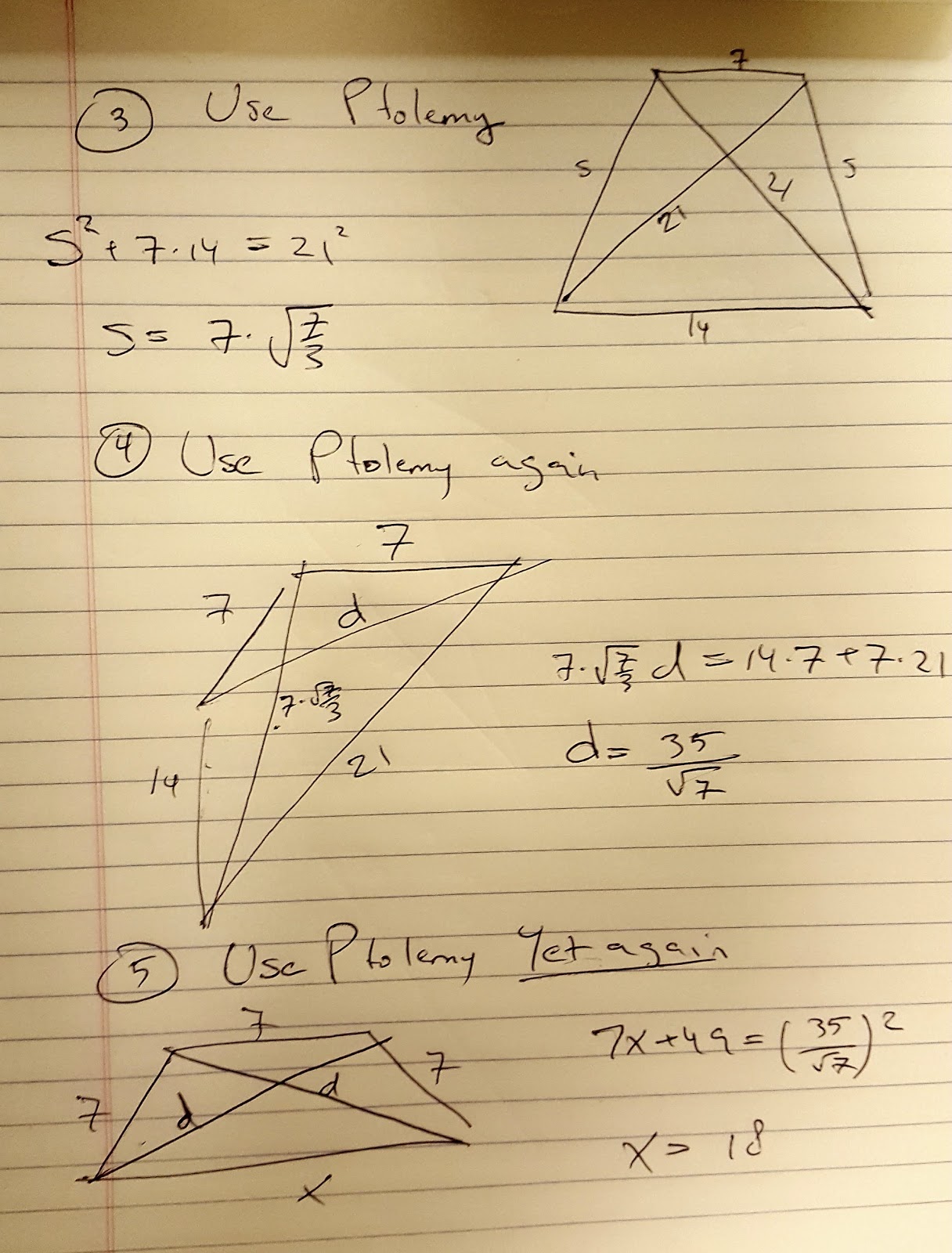
- Quick sketch of my original thinking using Ptolemy rather than similar triangles and following the diagonals through 3 cyclic quads to the result:. (Note: in my notes I wrote down the radius in the middle actually $ S = 7\sqrt{7} $ )
Leave a comment