Proof of Pentagon Construction
I was walking through the following construction of a regular pentagon from the AoPS Geometry textbook recently.
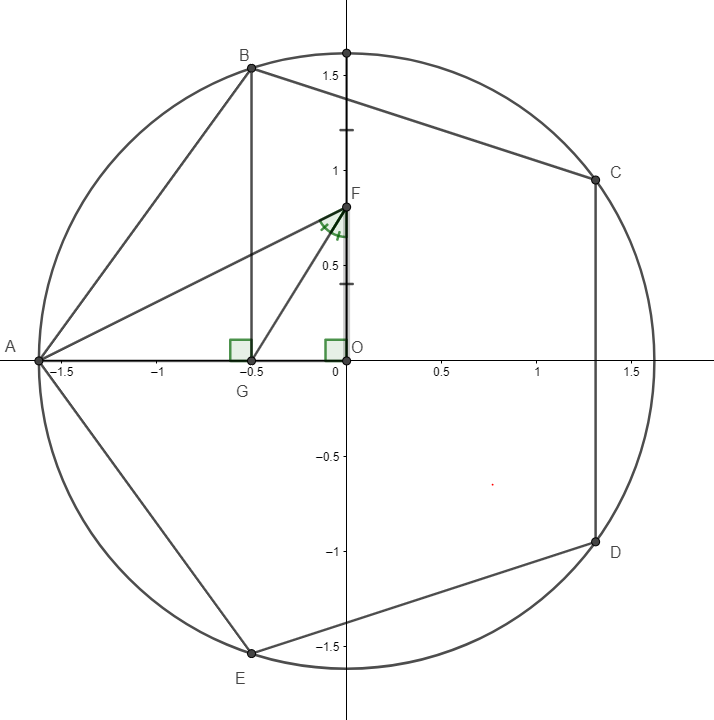
- Quarter a circle
- Construct the midpoint of one radius at F.
- Create triangle AFO
- Bisect angle AFO with segment FG
- Construct a perpendicular BG at the point G from the diameter of the circle to the circumference.
- Segment AB is $ \frac{1}{5} $ of the circumference and you can now copy it around the circle to form the pentagon.
But why does this work? What follows is a cleaned up explanation with some improvements borrowed from http://www.cut-the-knot.org
First the pentagon divides the circumference of the circle into five 72 degree arcs so it would be nice to understand the side length ratios of the 18-72-90 triangle. To get there we’ll start with its close cousin the 36-72-72. (See: Deep Dive)
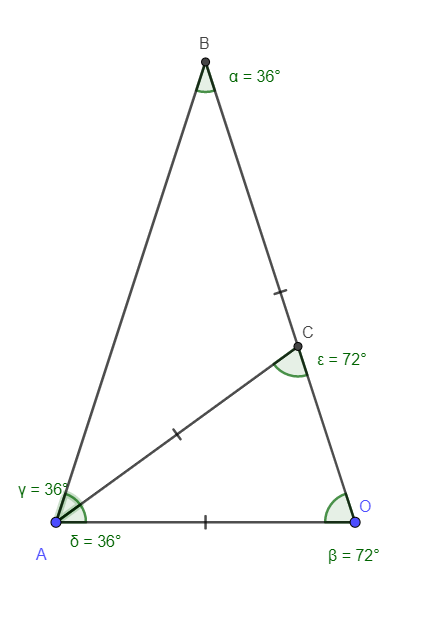
- We’re going to bisect angle A with the segment AC. This forms 2 more isosceles triangle ABC and ACO and all the segments BC, AC and AO are congruent. Moreover triangle ACO is another smaller 36-72-72
- So let AO = 1 and let CO = a
- From the similar triangles ACO and ABO we get $ \frac{1}{a} = \frac{a+1}{1} $
- Simplifying $ a^2 + a - 1 = 0 $ and $ a = \frac{-1 + \sqrt{5}}{2} $. Hey that’s almost the golden ratio. In fact $a = \phi - 1 $ and the entire side BO = a + 1 = $ \phi $
- We can then add a perpendicular bisector to derive the following ratios for the 18-72-90
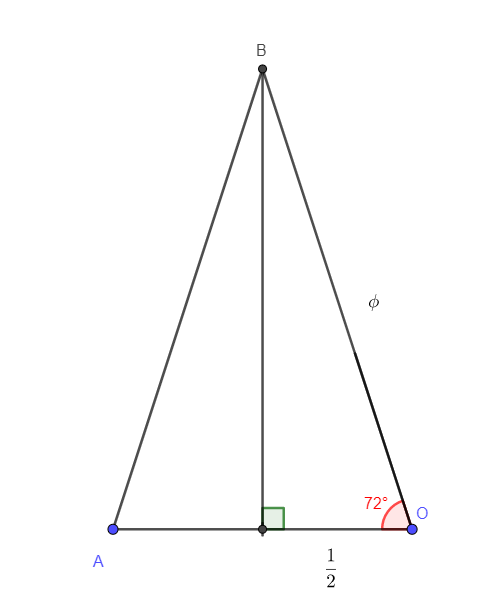
Now lets return to the construction. Without loss of generality let’s set the radius of the circle to also be the golden ratio $ \phi $. This will make the comparisons easier. It now remains to show segment OG is length of $ \frac{1}{2} $ If this is the case then triangle BOG is congruent to the one above and angle BOG is 72 degrees. From there the arc AB is $ \frac{1}{5} $ of the circle and we have our first pentagon side.
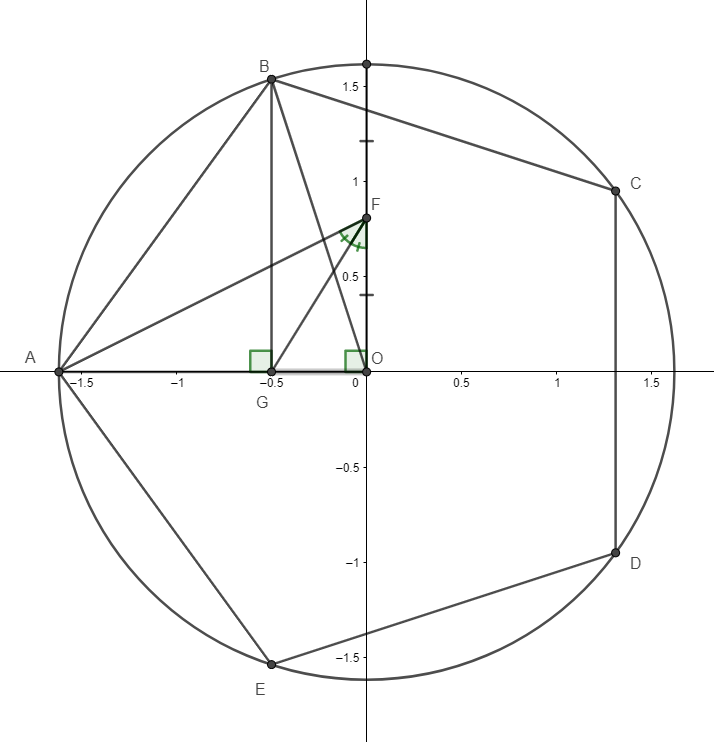
- Since the circle is radius $ \phi $, BO is already identical to the 18-72-90 triangle hypotenuse.
- Looking at triangle AFO, FO is $\frac{\phi}{2}$, AO is $ \phi $ so via the Pythagorean Theorem AF is $ \sqrt{5} \cdot \frac{\phi}{2} $
- We can now use the angle bisector theorem to find OG.
That simplifies to $ (\sqrt{5} + 1)OG = \phi $
but since $ (\sqrt{5} + 1) = 2 \phi $ we get $ 2 \phi \cdot OG = \phi $ and $ OG = \frac{1}{2} $ as needed!
Leave a comment