2/25 So Little Time

The theme for this week was definitely time pressure. After losing 2 weeks to snow days and another one to the mid-winter break I’m feeling behind. The most immediate problem: scheduling the 4th MOEMS test. I had originally planned it for a few weeks ago and the 5th one is about to be released. On top of that I have a fixed guest lecture and pi day in the next two weeks. Neither of which can be moved around.
So I was left considering:
- Do 2 tests back to back at the end of March in order to hit the deadline.
- Do 1 test now even though its the first week back and I’d prefer from a scheduling standpoint to do something freeform.
- Give up on completing all of the MOEMS parts.
I finally decided to go with option 2. I’m worried about the flow from week to week but I couldn’t quite bring myself to punt on finishing them all mostly because I think the questions are really good and we end up with a good group discussions afterwards.
What was interesting this time was based on the questions I needed to work a bit on some vocabulary. This is one of those pieces I only do on demand if a task merits it. Before we got started discussing solutions I put up the requested terms
- Factoring
- Simplest Form Fractions
Then I had kids try defining them. What’s interesting is that finding simplest form of a fraction requires one to factor. So the two terms are related. As a group, the kids were able to volunteer reasonable defs. I also tried to bring out the several senses of factoring. From break a number into a product of smaller integers, to breaking a polynomial into a product of simpler expressions, to factoring out a common multiple via the distributive law.
The second way time pressure came up was between this and the last session I’m building up a list of topics I really want to discuss in further depth. Last time, it was around a counting problem and thinking about the positive and inverse cases and which would be easier to solve. This time, I briefly referenced the divisibility rule for 11’s (which many kids knew but some only partly) but I didn’t have the time to justify why it works. I really want to come back to both of these subjects sometime in the future. As it stands I’m considering making the divisibility rule into a POTW so I can wedge it in.
Overall, this was an easier set for the kids to finish. I think the scores will be higher than last time. I’m liking the focus on non integer solutions and some of the number theoryish questions that are being asked this year.
I went back to Strimko puzzles from: http://www.puzzles.com/projects/StrimkoPrevious.htm for something to keep early finishers occupied. These were as popular as I remembered from last year.
Finally, because it was such a long gap I did not have great participation in the former POTW so after a discussion of partial solutions I gave it to the kids again to try for a 2nd time:
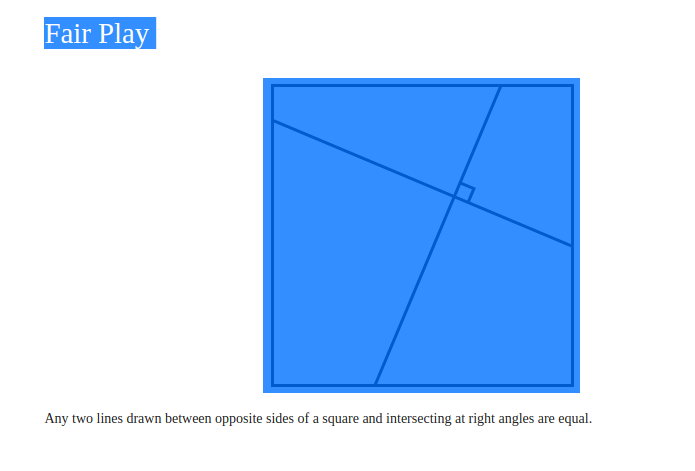
(Link: https://www.futilitycloset.com/2019/01/22/fair-play-3/)
Leave a comment