Triangle in a Square: Areas
So this happened today:
School was cancelled and my planning around another day working with combinatorics will have to be shelved.
On the fun news front:
- The kids did great at MathCounts. The team came in 2nd place and will advance to States.
- AMC10 is coming up this week.
(Post contest Photo)
So I present a fun proof I had around from a few weeks ago:
Process: This one riffs on a familiar setup for me (the equilateral triangle embedded in a square) So based on experience I already knew I should do the rearrangement coming below. It just remained to fool around with the areas a bit. Initially I came up with some awkward formulas based on tracing the 30-60-90s and just computing areas. The problem is that while it works you accumulate a fair number of squares root and scaled differences of them. At that point I decided to relook at the top quadrilateral and further divide it with some perpendiculars. Interesting and useful simplifications fell out as soon as I did it.
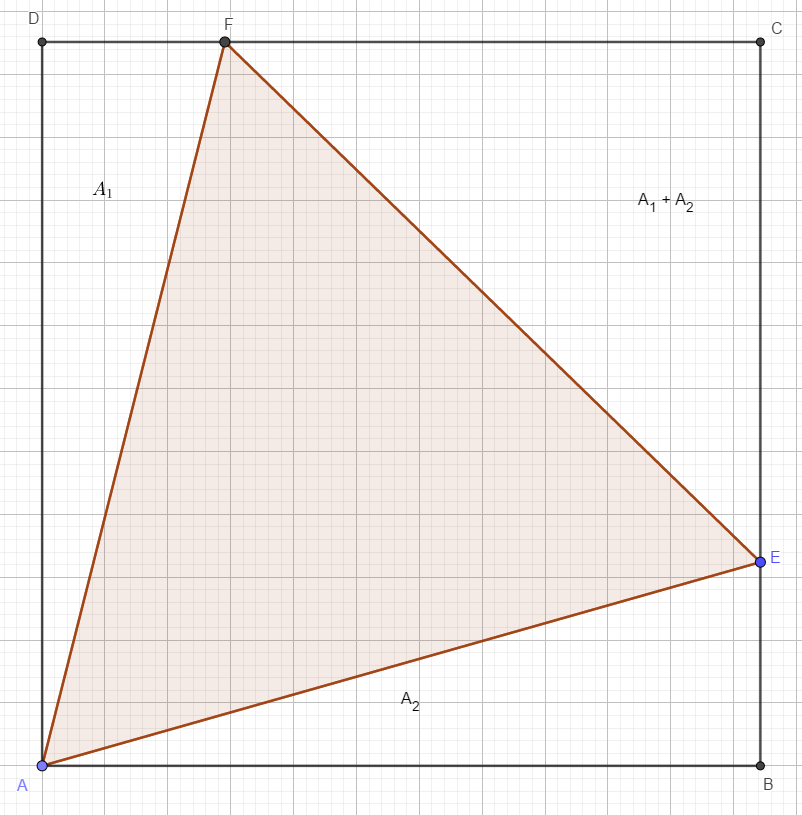
Given an equilateral triangle AEF embededd in a square ABCD, prove the area of CEF = ADF + ABE
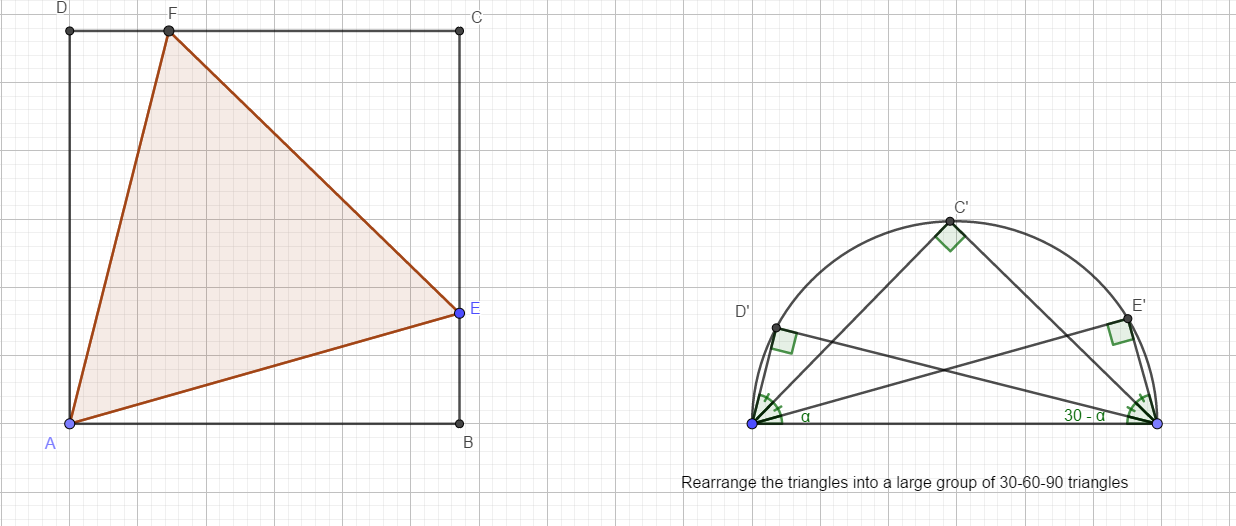
Reorganize: Rearrange the 3 triangles which all share a hypotenuse of the same length and rearrange them
as above to overlap. Doing an angle chase shows almost all the triangles are 30-60-90’s. (All the green congruent angles in the above picture are 30 degrees) This is generally usually for all such problems with the equilateral triangle embedded in a square. [Note: my drawing could have been a bit more pronounced calling out ADF and ABE are not congruent and do not have the same altitudes etc.]
Area Math:
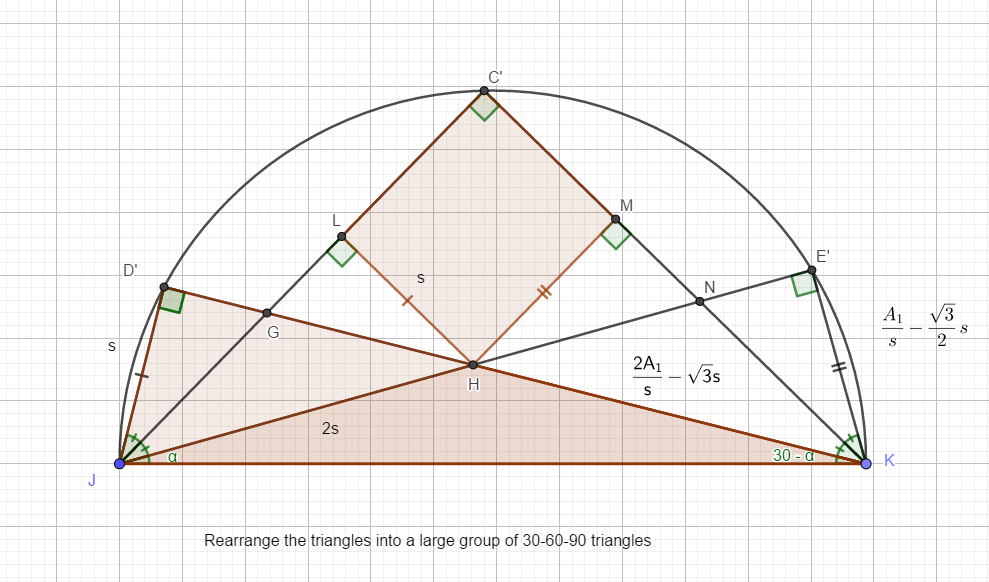
We want to find the area of CEF which is congruent to JC’K.
- Let the area of JHK = B,
- the area of JD’H = JD’K - JHK = $ A_1 - B $
- the area of KE’H = KE’J - JHK = $ A_2 - B $
After adding the perpendiculars LH and MH we can show via ASA that GLH is congruent to JD’G and likewise HMN is congruent to HE’K so
- JLH = JD’H = $ A_1 - B $
- KMH = KHE’ = $A_2 - B $
Note: The area of $ JHK = B = \frac{1}{2} JD’ \cdot HK $ (altitude and base)
At the same time area of the rectangle HLC’M = $ LH \cdot HM $ LH is congruent to JD’ from above and $ HM = \frac{1}{2} HK $ from the 30-60-90 HKM so in fact HLC’M has the same area as JHK = B!
Adding these parts all together: CEF which is congruent to JC’K which is equal
to JD’H + KE’H + JHK + HLC’M = $A_1 - B + A_2 - B + B + B = A_1 + A_2 $
Leave a comment