Carnival of Mathematics 168
Turtles - [Martin Holtham](https://twitter.com/GHSMaths)
Introduction
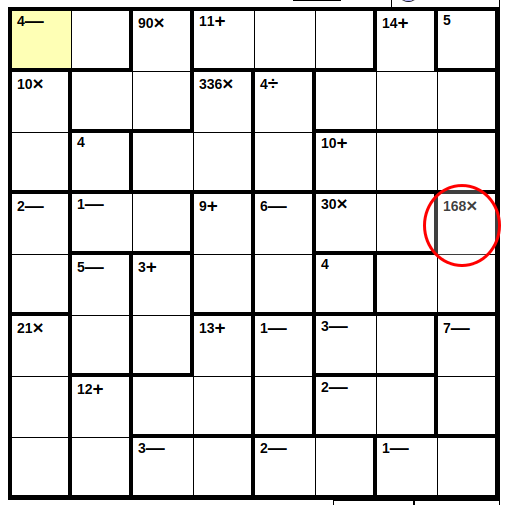
Welcome to the 168th Carnival of Mathematics. For all the other carnivals future and past, visit The Aperiodical where you can also submit future posts. Its been about a year since I last hosted Carnival 155 and let’s face it - when it came to the number 155 I went through the motions and researched various connections on the wikipedia. Being a multiple of 5 is nice but it had no personal resonance for me. So I was pleasantly excited to find out that the next one in my queue was instead 168 which is a bit of an old friend. Quite instinctively my first thought on seeing it was KenKen number (7x4x6 or 7x3x8 …)! I haven’t been doing these as religiously of late (currently I’ve been on more of a Skyscraper puzzle binge) but the factoring and fitting of said factors into shapes is engraved on my brain.
For the rest of you less religious puzzlers here’s some more 168 facts from: the wikipedia
- 168 is an even number, a composite number, an abundant number, and an idoneal number.
- There are 168 primes less than 1000. 168 is the product of the first two perfect numbers.
- 168 is the order of the group PSL(2,7), the second smallest nonabelian simple group.
- From Hurwitz’s automorphisms theorem, 168 is the maximum possible number of automorphisms of a genus 3 Riemann surface, this maximum being achieved by the Klein quartic, whose symmetry group is PSL(2,7).[2] The Fano plane has 168 symmetries.
- 168 is the sum of four consecutive prime numbers: 37 + 41 + 43 + 47.
Posts
That handled let’s get started with this month’s selections. First I can’t ignore that March includes the (in)famous Pi Day holiday. This year my favorite new video on the subject was from the Mathologer with a deep dive into the proof of Pi’s irrationality a subject I have to admit I had taken for granted up until seeing this.
For a different and unexpected appearance by pi, Andrew Taylor has an article up on aperiodical: https://aperiodical.com/2019/03/buzz-in-when-you-think-you-know-the-answer/
“How many ways are there of writing some natural number 𝑛 as the sum of two squares? I don’t want an answer for some particular n. I don’t even want a general formula. I just want to know… on average.” Not surprisingly a circle is hiding in the background. I can’t wait to try this out with my kids.
On the subject of MathEd, Dan Finkel put out an amazing set of videos in collaboration with Maths Pathway on rich learning. If you’re in a classroom this is definitely recommend: The full set is here: https://mathforlove.com/pd/
For another take on education I also really enjoyed this AoPS podcast with Sam Vandervelde https://artofproblemsolving.com/news/aftermath/aftermath-running-a-school-for-math-lovers-with-sam-vandervelde Sam has deep roots in the Math Circle Community. I myself started by reading his: Math Circle in a Box. This is a fun conversation even if you’re not planning to run an entire private school focused on Mathy kids.
Next up we have a fascinating meta blog post: https://www.scottaaronson.com/blog/?p=4133 by Scott Aaronson about the replacement of classical human proofs by machine generated and other variants. Despite their promise, this possible future direction has not overshadowed tradition yet.
“In 1993, the science writer John Horgan—who’s best known for his book The End of Science, and (of course) for interviewing me in 2016—wrote a now-(in)famous cover article for Scientific American entitled “The Death of Proof.” Mashing together a large number of (what I’d consider) basically separate trends and ideas, Horgan argued that math was undergoing a fundamental change, with traditional deductive proofs being replaced by a combination of non-rigorous numerical simulations, machine-generated proofs, probabilistic and probabilistically-checkable proofs, and proofs using graphics and video. Horgan also suggested that Andrew Wiles’s then-brand-new proof of Fermat’s Last Theorem—which might have looked, at first glance, like a spectacular counterexample to the “death of proof” thesis—could be the “last gasp of a dying culture” and a “splendid anachronism.” Apparently, “The Death of Proof” garnered one of the largest volumes of angry mail in Scientific American‘s history, with mathematician after mathematician arguing that Horgan had strung together half-digested quotes and vignettes to manufacture a non-story.”
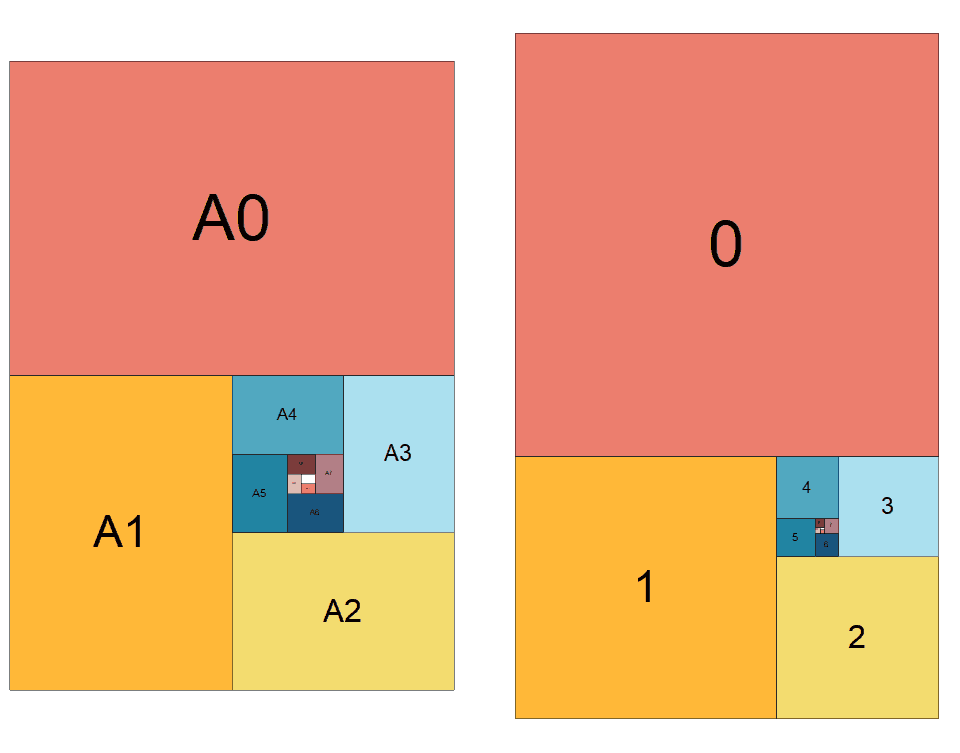
I’m fairly interested in the golden ratio as a quick browse of this blog will easily confirm so I was delighted to read: http://extremelearning.com.au/going-beyond-golden-ratio/ from Martin Roberts. Roberts takes on one of the best written explanations of the subtleties of the ratio from continued fractions to mobeius transforms and all in a really engaging framing.
“Let us imagine a game between two kids, Emily and Sam – both strong and determined in their own way who spend their entire lives trying to outwit each other, instead of doing their homework. (A real life Generative Adversial Network…)
Emily, proudly reminds us that she simultaneously bears the same first name as Emily Davison, the most famous of British suffragettes; Emily Balch, Nobel Peace Prize laureate; Emilie du Chatelet, who wrote the first French translation and commentary of Isaac Newton’s “Principia“; Emily Roebling, Chief Engineer of New York’s iconic Brooklyn Bridge; Emily Bronte author of Wuthering Heights; Emily Wilson, the first female editor of ‘New Scientist‘ publication; and also Emmy Noether, who revolutionized the field of theoretical physics.
On the other side we have Sam (and all his minion friends, who are aptly called Sam-002, Sam-003, Sam-004 ) who is part human / part robot and plays Minecraft or watches Youtube, 24/7.
They agree to play a game where Emily thinks of a number, and then Sam (with the possible help of his minions) has 60 seconds to find any fractions that are equal to Emily’s number.
And so the game begins…”
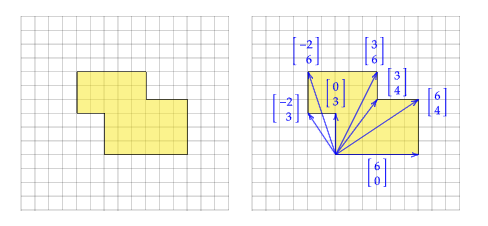
Moving domains to Linear Algebra, Josh Fisher has a nice workup on connecting matrices to both compounding interest and finding the centroid of a triangle. The embedded python code makes this easy to explore (and honestly linear algebra is made for numerical computing) https://guzintamath.com/textsavvy/2019/03/07/linear-algebra-connections/
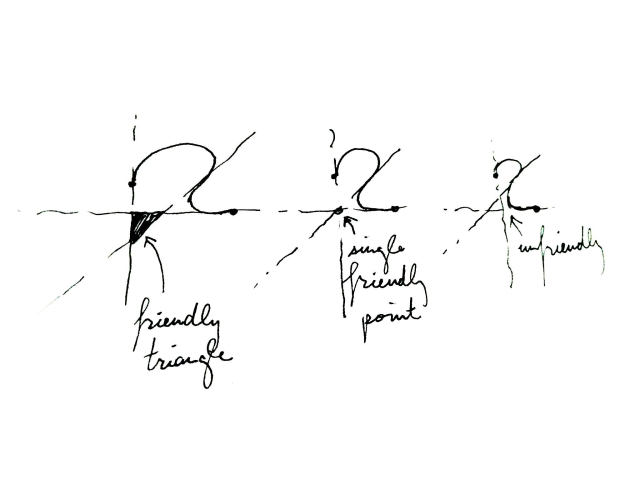 Still staying visual we come to a set of riffs on Doodling Set Theory by Sachi Hashimoto: https://strangenewuniverse.wordpress.com/2019/03/07/doodling-set-theory-7-years-later/. This is best done as two part read. Start with Evelyn Lamb’s excellent background discussion of the problem referenced in the post and then come back and read some of the further conjectures Sachi has explored.
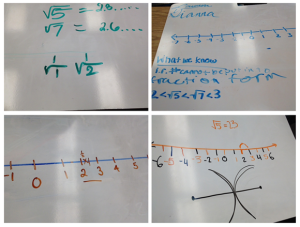
Evelyn (I’m not convinced she ever sleeps,) also has another great podcast episode with Kevin Knudson this time talking with Fawn Nguyen about the Pythagorean theorem: https://kpknudson.com/my-favorite-theorem. I’ve added a special link here to one of the referenced blog posts: Cool Irrational Number on a number Line Activity This is a really creative way to get kids thinking about both the theorem and its relationship to irrationals.
At the very end of the month we had this late breaking computational theory breakthrough in the domain of integer multiplication. Ken Regan gives a good walk through here: https://rjlipton.wordpress.com/2019/03/29/integer-multiplication-in-nlogn-time/
“David Harvey and Joris van der Hoeven are computational mathematicians. They have just released a paper showing how to multiply two 

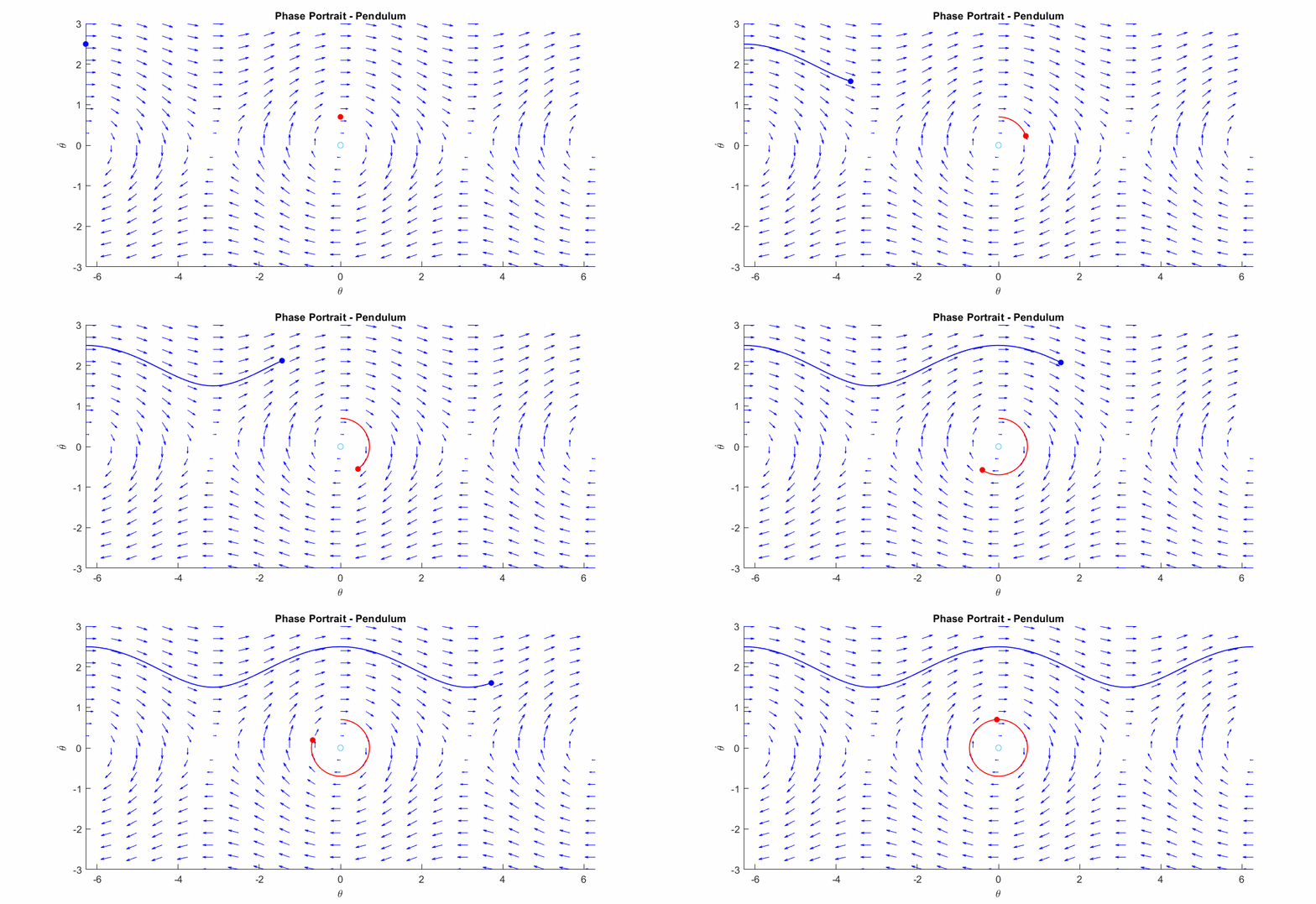
We can’t escape the month without a little bit of Calculus. For a different take, Ari Rubinsztejn wrote an interesting overview of Phase portraits: https://gereshes.com/2019/03/04/an-introduction-to-phase-portraits/ The visuals are fascinating just by themselves.
“Humans are a visual species, we look for patterns in life and we are great at finding them when they are visual. We can tell two people apart just by looking at their faces. Sometime’s we’re too good at seeing patterns and we see faces in a piece of burnt toast. If we’re presented with raw data we often can’t figure anything out, but if we change that data into a visualization, new concepts and connections often leap forward. Today we’re going to look at a way that we can solve some nonlinear systems without making any simplifying assumptions using a great tool called the phase portrait.
And last for something completely different. E.L Mezaros has an article up on a completely new to me niche genre: math fiction. Many of these stories sound really interesting. I’m going to have to check them out in the upcoming months.
“Math fiction is a niche genre that tends to be dominated by modern Greek writers. These Greek math fiction novels stand alone as interesting stories, providing a good read for anyone who’s looking for one.
But they go a step further in providing basic mathematical exposition: a learning opportunity disguised as entertainment. Here are the four best novels to read in English or translation.” https://studybreaks.com/culture/reads/greek-math-fiction-interesting/
Final Puzzle:
Colin has a fun exponent problem this month: http://www.flyingcoloursmaths.co.uk/powers
Finally (I promise) if you’re a research mathematician I always appreciate more responses to my post here: Questions For Mathematicians
Leave a comment