Spring Break - Geometry Walk Through
Note: with Spring I really have no kids. Even my own are with my parents so here’s an old walk through I had laying around. On reread after a significant gap between writing it I still really like the multiple approaches that are possible.
I saw this one courtesy of @mikeandallie:
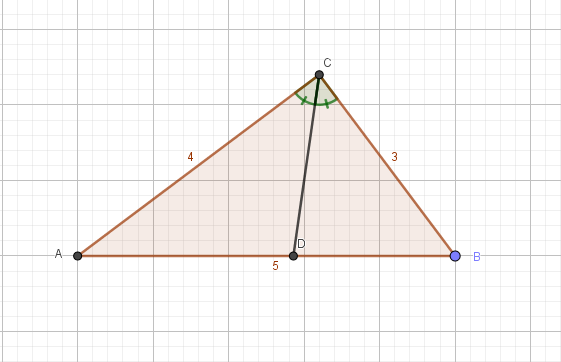
Given a 3-4-5 triangle where the angle C is bisected and connected to the hypotenuse. How long is segment CD?
I like this one for several reasons. First, its a 3-4-5 (how many posts have I talked about them now?) But secondly there are a lot of ways to look at this and solve it.
Pythagorean:
- Since we have an angle bisector we can use the angle bisector theorem to find AD and DB (Who can resist an opportunity to do that!)
$\dfrac{AD}{DB} = \dfrac{4}{3} $ and AD + DB = 5 leading to lengths of $\dfrac{20}{7}$ and $\dfrac{15}{7}$ respectively.
- We can then drop an altitude
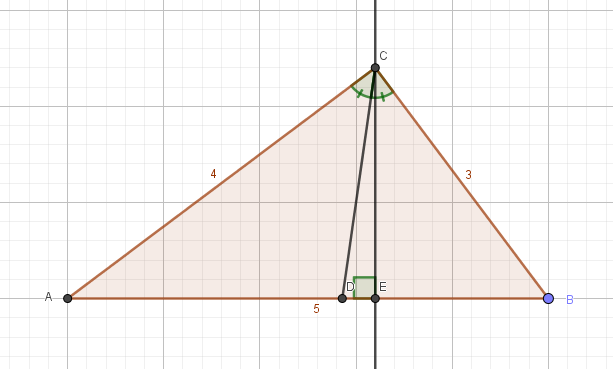
Area = $\frac{1}{2}\cdot 3 \cdot 4 = 6$ so $\frac{1}{2}\cdot 5 \cdot CE = 6 $ and CE = $\frac{12}{5}$
You can then find AE via scaling to be $\frac{16}{5}$ and subtract it to get DE.
Now apply the Pythagorean theorem on triangle CDE $CD = \sqrt{\frac{12}{5}^2 + (\frac{20}{7} - \frac{16}{5})^2}$
This will eventually simplify to $\sqrt{2} \cdot \frac{12}{7} $
That’s a lot of steps and computation.
Stewart’s Law:
We actually have all the parts to apply Stewarts law:
$ AC^2 \cdot BD + BC^2 \cdot AD = AB \cdot (AD \cdot BD + CD^2) $ or
$16 \cdot \frac{15}{7} + 9 \cdot \frac{20}{7} = 5 \cdot (\frac{300}{49} + CD^2)$
Ok that saved a few steps but still involves a lot of calculation and square roots.
Heron’s Law:
Perhaps we could use herons law to help out here: We can easily calculate the areas of the two sub
triangle ACD and BCD and then solve the resulting equation
The semi-perimeter in this case for ACD is $\frac{4 + \frac{20}{7} + CD}{2} = \frac{48 + 7CD}{14}$
$\frac{4}{7} \cdot 6 = \sqrt{S \cdot (S - \frac{20}{7}) \cdot (S - 4) \cdot (S - CD)} $
There will be some parallelism / differences of squares here but this actually an even more difficult quartic to solve and I think I’ll leave it here.
Angle Bisector:
[This is a note from the future]
Nowadays: I have a handy formula for this: theres-more-to-the-angle-bisector-theorem that while basically the same as the first 2 approaches is simpler to compute due to pre-simplification.
$ CD^2 = AC \cdot BC - AD \cdot BD $ So after using the angle bisector theorem. We merely have to do:
$ CD = \sqrt{4 \cdot 3 - \dfrac{20 *15}{7 \cdot 7}} = \sqrt{\dfrac{288}{49}} = \sqrt{2} \cdot \dfrac{12}{7} $
Break Through:
This is actually an intentionally deceptive diagram given its orientation. Everything above focused on the angle bisectors without noting that this is a right triangle and that we know they are each 45 degrees. I originally thought about that and wondered if we could do something analytic. That also made me flip the triangle around so the 45 degree line was easier to manipulate.
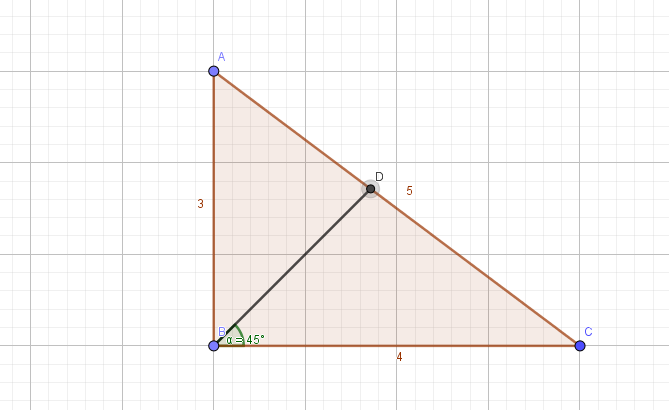
Analytic Approach:
Because its a 45 degree angle AB is also on the equation x = y. The hypotenuse is on the equation $y = 3 - \frac{3}{4} x $
We can solve this system to find the coordinates of D and then use the simplified distance formula to calculate the length AD. That still has a Pythagorean theorem embedded in it and is a small but not huge improvement over the original approach.
Similar Triangles
But before I did this, looking at the new orientation suggested adding one more line:
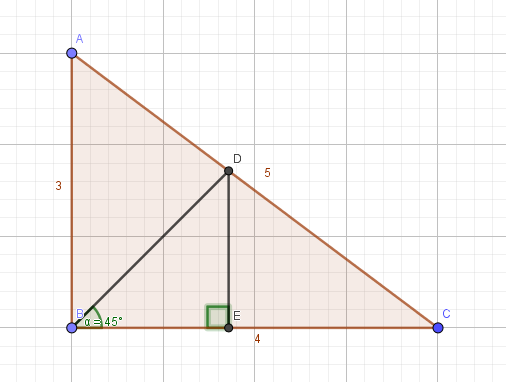
We now have a 45-45-90 triangle and a new smaller 3-4-5 triangle CDE. This is convenient. We can set BE = DE = x and CE = 4 - x.
Because CDE is also a 3-4-5 $\frac{x}{4-x} = \frac{3}{4}$ this simplies to $x = \frac{12}{7}$
and then since BD is the hypotenuse of a right isosceles triangle its just $\sqrt{2} \cdot x $ What’s especially nice is this gives a simple explanation for the radical in the original solution we found.
Moral of the story: always look for a similar triangle before jumping into a Pythagorean or more complex approach and/or keep looking at a problem beyond the first solution you see.
Leave a comment