Roots of Unity: Pursuing Extra Roots
Background: This piece all started with my last post thinking about equalities of the form $ \cos (nx) = \cos(mx) $
For a given denominator p (especially when p is odd) its evident graphically that there is a vertical symmetry between the roots:
9th Root of Unity Example:
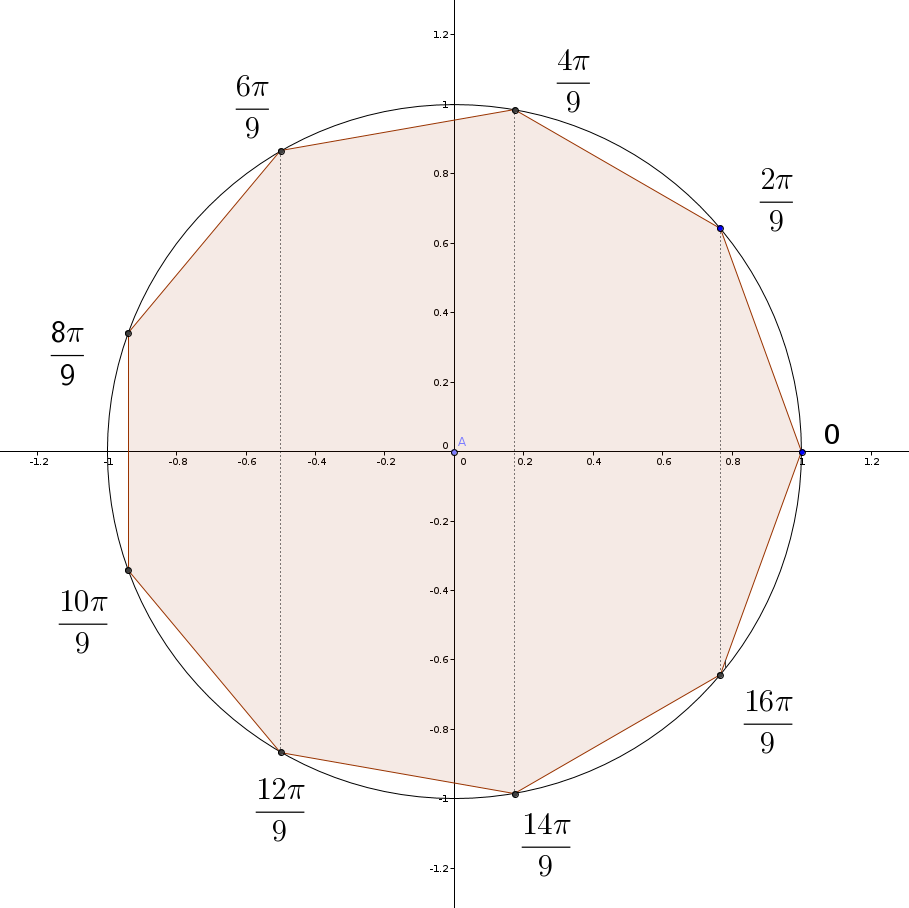
Above due to the vertical symmetry: $ \cos(x) = \cos (2\pi - x)$ for all the primitive roots. Another way of thinking of this is in terms of the first root $ \cos(\frac{2\pi}{9} \cdot n) = \cos (\frac{2 \pi}{9} \cdot (9-n)) $ You can conceptually make a scaling/rotational argument that it must then hold true for all the other roots. More formally with the cosine difference rule: $ cos(\alpha) - cos(\beta) = -s \sin(\frac{\alpha + \beta}{2} )\sin(\frac{\alpha - beta}{2}) $ we can do the following:
- $ \cos(2 \pi \cdot \dfrac{n}{p}) - \cos(2 \pi \cdot \dfrac{p - n}{p}) = -2 \sin( 2\pi) \cdot \sin(2 \pi \cdot \dfrac{p - 2n}{n}) $
- $ \cos(2 \pi \cdot \dfrac{n}{p}) - \cos(2 \pi \cdot \dfrac{p - n}{p}) =-2 \cdot 0 \cdot \sin(2 \pi \cdot \dfrac{p - 2n}{n}) $
- $ \cos(2 \pi \cdot \dfrac{n}{p}) = \cos(2 \pi \cdot \dfrac{p - n}{p}) $
This is when things start getting interesting. For the 9th root of unit above as can be seen from the circle there are only 5 distinct cosine values: 0 and the 4 paired points. From the equation above (and its fun to verify) for all these roots:
- cos(x) = cos(8x)
- cos(2x) = cos(7x)
- cos(3x) = cos(6x)
- cos(4x) = cos(5x).
Each of these equation can be reduced into one in terms only of cos(x). See: Link for a nifty triangle for more easily reducing these expressions. Once that’s done we’ll get equations of differing degrees and therefore differing numbers of roots.
Let’s start with the simplest example:
cos(5x) = cos(4x)
$ 16x^5 - 20x^3 + 5x = 8x^4 - 8x^2 + 1$
$ f(x) = 16x^5 - 8x^4 - 20x^3 + 8x^2 + 5x -1 $
This fifth degree polynomial must include all 5 distinctive primitive 9th roots of unity and it only has five roots so by the pigeonhole principal there is a one to one correspondence.
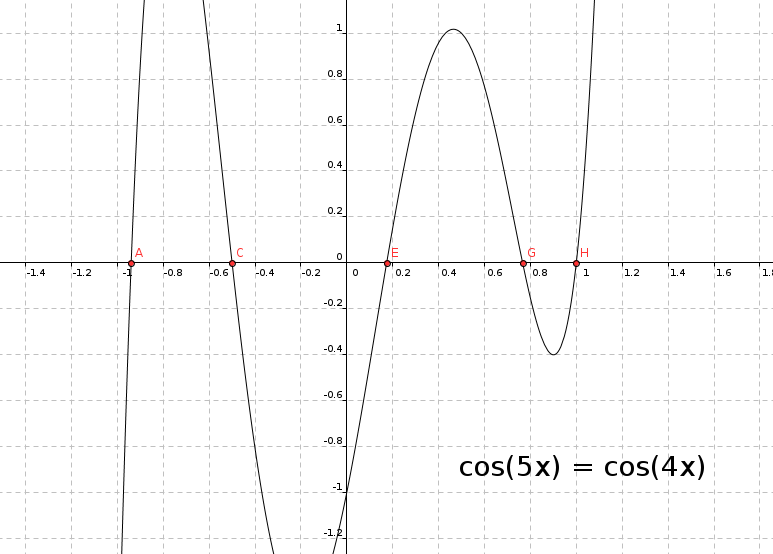
However all the other equations are in higher degrees. They still must have all the primitive ninth roots within them but there will other roots left.
Example 2:
cos(7x) = cos(2x)
$ g(x) = 64x^7 - 112x^5 + 56x^3- 2x^2 - 7x + 1 $
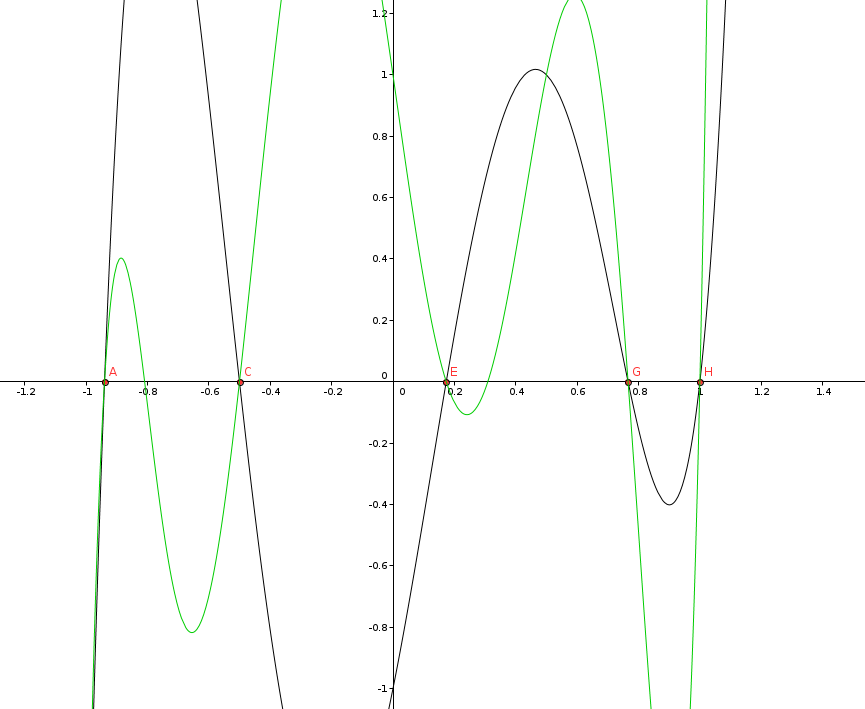
g(x) is graphed in green and you can see it interecting all the zeros of the f(x) plus 2 more points. After thinking about this a bit I began to wonder what’s the pattern to these extras? I started graphing some examples and looking at the remainders. With this example after doing the polynomial division $ \frac{g(x)}{h(x)} = 4x^2 + 2x - 1 $ It may not be immediately apparent but after trying some more examples all the residual polynomials start to look familiar. In fact this one is the characteristic equation for cos(2x) = cos(3x) without 0 the (cos(x)-1) root!
Its not too surprising that the residuals are all not random but why is this happening? The same cosine difference rule comes to our aid again.
- $ \dfrac{\cos(7x) - \cos(2x)}{\cos(5x) - \cos(4x)} = \dfrac{\ -2\sin(\frac{9x}{2})\cdot \sin(\frac{5x}{2})} {\ -2\sin(\frac{9x}{2})\cdot \sin(\frac{x}{2})} $
- $ \dfrac{\cos(7x) - \cos(2x)}{\cos(5x) - \cos(4x)} = \dfrac{ \sin(\frac{5x}{2})} { \sin(\frac{x}{2})} $
- $ \dfrac{ \sin(\frac{5x}{2}) \cdot \sin(\frac{x}{2}) } { \sin(\frac{x}{2}) \cdot \sin(\frac{x}{2})} = \dfrac{ \cos(3x) - \cos(2x)} { \cos(x) - \cos(0) } $
This same process can be repeated for any of the various characteristic equations. So you’ll always find the extra roots are from one of the lower cos(mx) = cos(nx) equations and the particular m and n are easy to find based on the ratio.
Leave a comment