5/13 Checkers Redux
I have a lot of chess players in Math Club this year and partly based on that interest and partly because I happened on a James Grimes video I decided I wanted to focus a day on checker board related problems again: 131-chessboard-problems-or-manipulatives-on-the-cheap These are a surprisingly (at least to me) rich source of mathematical material. One of the first planning issues that I had to decide about was whether to directly repeat the problem I used two years ago. I think I only have one or two students who were there last time and I doubt they would have a strong memory of that session so I kept it in my back pocket as an option.
Before diving into the main theme I began a new routine for the next few weeks. I want to leverage Purple Comet a bit more than just doing the contest. I put the graded team entries from last week out for the kids to check how they did at the start of the day but I really want to focus them more on the problems themselves than a score. So after commending how everyone did, (And we did do better on aggregate than last year) I told the group we would be communally going over one problem a week from the contest. This week I chose to start with one of the decoding problems from the middle.
(Find the max value for PURPLE)
P U R P L E
- C O M E T
==========
M E E T
After writing it on the board I then asked a series of questions about what strategies people used and what they observed about the structure of the problem. The key starting point is the rightmost digits and how much can ever be borrowed from it. Probably my favorite moment here was towards the end when we had found a few digits that had to be 1 etc and I asked what do you think we should do next? One of the kids I think in jest answered “Brute Force!” In fact, this was probably the correct viable strategy here so I was able to compliment him and ask how he would proceed.
This taken care of I was ready to dive into our main focus. I started with James Grime’s video on Wythoff’s game
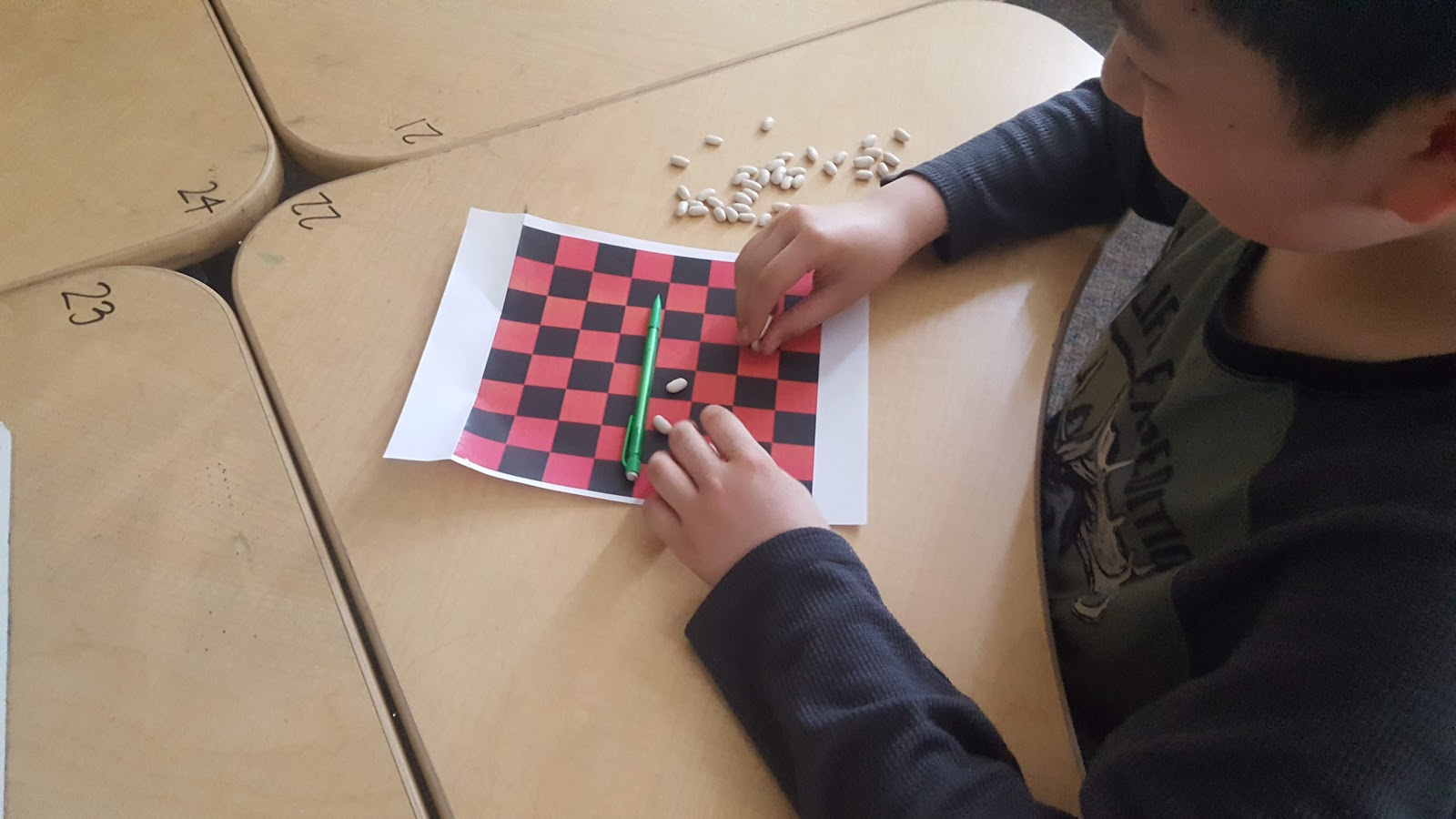
Like two years ago I played enough of the video to introduce the rules and then handed out checkerboard printouts and dried beans to use as pieces.
- This was the version I used today: http://www.clker.com/clipart-checkers-board-red-and-black.html
Then I had everyone try out the game and search for losing squares. This as expected was very engaging. The entire room was absorbed with various games and recording the positions that won and lost. After at least 10 minutes when after walking around and consulting it looked like the various groups had discovered enough things I gathered everyone together to share their findings. The kids reported a bunch of discoveries i.e. yes you can always win, the spaces in line of sight are good one s etc.. Nicely one of the sixth grade clusters had precisely discovered the correct layout shown in the videos and we talked a bit about its reflective symmetry. That made for a good bridge to show the final part of James’ video. No one had noticed the golden ratio connection so this made for a fun moment.
We had about half the hour left so I gave everyone a choice whether to try a medium or slightly harder complexity checkers related game next. Based on the room I went for the Conway Soldiers problem.
This also has a great intro video from numberphile. I’m really fond of Professor Zvezdelina Stankova as a speaker and there is a mention of John Conway which ties into my emphasis on Mathematics being a living field.
Again I only went far enough through the video to setup the problem and then I stopped and had the kids investigate. Most groups at least found how to get to row 2, about half made it to row 3 before we ran out of time. For this one I made sure to reserve enough time to show the back half of the video. However, there’s a companion 40 minute with the proof of why the 5th row is impossible. I think its accessible with perhaps some periodic breaks for questions and explanations. The kids seemed games so I’m considering whether to devote a second week to this. If so I’ll pre-plan where I think I want to break in have various discussions.
Leave a comment