Euler Line Walkthrough
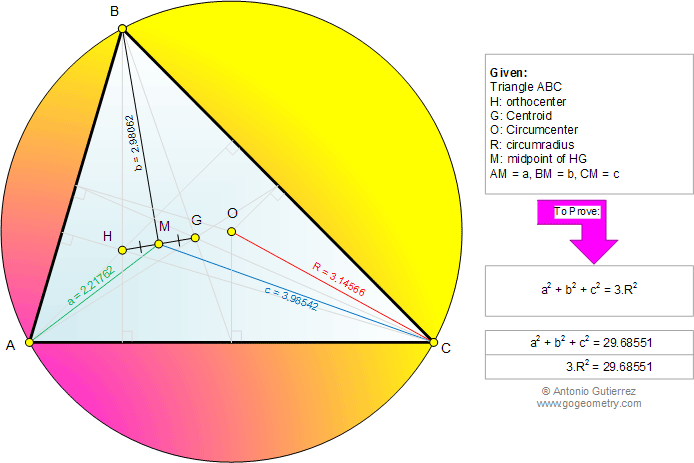
- First HO is the Euler Line and the ratio of HG:OG is 2:1 so since HM = MG this is trisecting the Euler line and HM = MG = OG.
- Its also well known $ OG^2 = R^2 - \frac{1}{9}(AB^2 + BC^2 + AC^2) $
1. I’d like apply Stewarts’s theorem to triangle AMO but I need to know the length of AG first. However AG is the top part of the median from A through centroid G and therefore 2/3 of its length. And we can calculate the length of the centroid itself using Stewart’s theorem a second time:
let M’ be the midpoint of BC then $ (AB^2 + AC^2)\cdot BM’ = 2BM’(BM’^2 + AM’^2) $
$ => AM’ = \sqrt{\frac{AB^2 + AC^2}{2} - \frac{BC^2} {4}} $
So combining: $ AG = \frac{2}{3} AM’ = \frac{2}{3} \sqrt{\frac{AB^2 + AC^2}{2} - \frac{BC^2} {4}} $
- Now we’re good to go: $ (a^2 + R^2)OG = 2OG (OG^2 + AG^2) $
With the 2 substitutions from above:
$ a^2 + R^2 = 2R^2 - \frac{2}{9}(AB^2 + BC^2 + AC^2) + \frac{8}{9}(\frac{AB^2 + AC^2}{2} - \frac{BC^2} {4}) = 2R^2 + \frac{2}{9}(AB^2 + AC^2) - \frac{4}{9}BC^2 $
- Do this same calculation for the other 2 triangles BMO and CMO and add them all together to get:
$ (a^2 + b^2 + c^2) + 3R^2 = 6R^2 + \frac{4}{9}(AB^2 + BC^2 + AC^2) - \frac{4}{9}(AB^2 + BC^2 + AC^2) $
This simplifies to: $ (a^2 + b^2 + c^2) = 3R^2 $
Leave a comment