6/3 Tesselations
I skipped blogging last week given a hectic schedule and the fact I had outlined my plan already here: 513-checkers-redux but I’m still thinking over one part of that session. I have been doing group problem solving warm up with the purple comet problems. 2 weeks ago I chose this one:
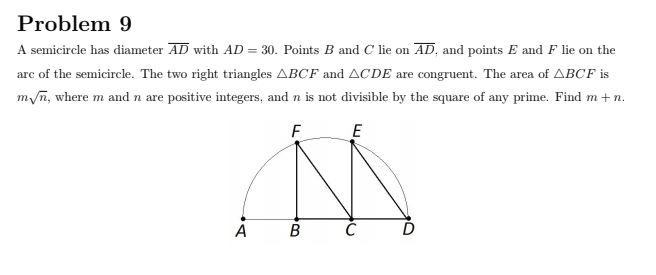
And then yesterday I picked the following:

In both cases, we had really excellent flow. I spent a lot of time first asking questions about what the problem was asking especially in the second case. For every term, I thought might be unknown, i.e. arithmetic progression I queried the room for definitions and sometimes examples and clarificiations. Then I just emphasized I’d like everyone to tell me what they noticed and wondered. From there, both times we had a chain of realizations involving the majority of the kids. No one jumped straight to the solution which was perfect but we also didn’t get stuck.
For example, this time, one kid started by finding 672 + 673 + 674. Then another noticed you could generalize to 671 + 673 + 675 etc. Then another theorized that the middle number must always be 673 and when asked I was able to get yet another to give an algebraic explanation of this. From there, we were able to get ideas about how many pairs there were with a quick detour to think about whether it was 637 divided by 2 or 3.
I’m still trying to decide, what made both sessions so great: the end of the year experience, the fact everyone had seen the problems when we did them the first time, or my emphasis on the process of hypotheses or something else? I’m thinking that I will probably experiment next year around the group process. Perhaps if we start a problem of the week after handing it out for 5 minutes, I’ll generate better discussions the next week.
Tesselation:
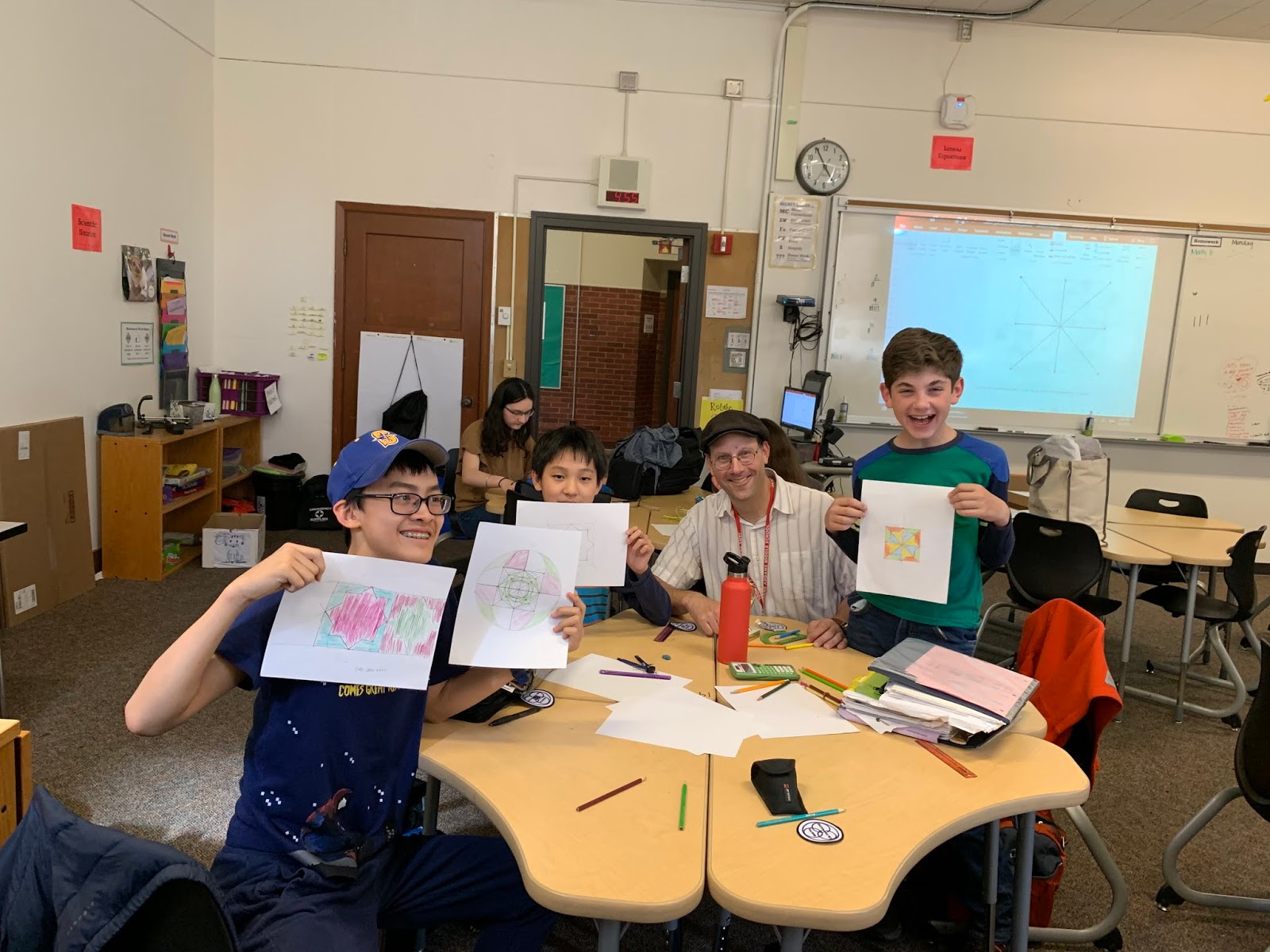
This week was a chance to go out on a limb again exploring some math art. I’ve been meaning to do a project around Islamic geometric tiling and I had a tuturial slide deck from Clarissa Grandi: https://www.artfulmaths.com/uploads/5/2/0/5/52054835/islamic_geometry_fourfold_patterns.pptx that I decided to structure the main day around. After playing around, on the weekend to get a feel for the material I was a bit nervous.
- How long would it take?
- Would I have enough compasses after asking everyone to bring one?
- Would it be compelling?
Even as I started on the warm up problem, several kids were excited after peeking at the first slides and I stopped worrying at all about engagement. We ended up with just barely enough compasses. I’m not sure why a few students brought broken ones but we compensated. If I repeated, I think I would reach out to the geometry teachers and borrow some classroom ones. And as for time, we didn’t really do more than 2 of the basic configurations. There is more than enough material here for an hour.
What I’d recommend is actually printing out the directions for each table though. That helps with the different pace at which everyone draws the figures.
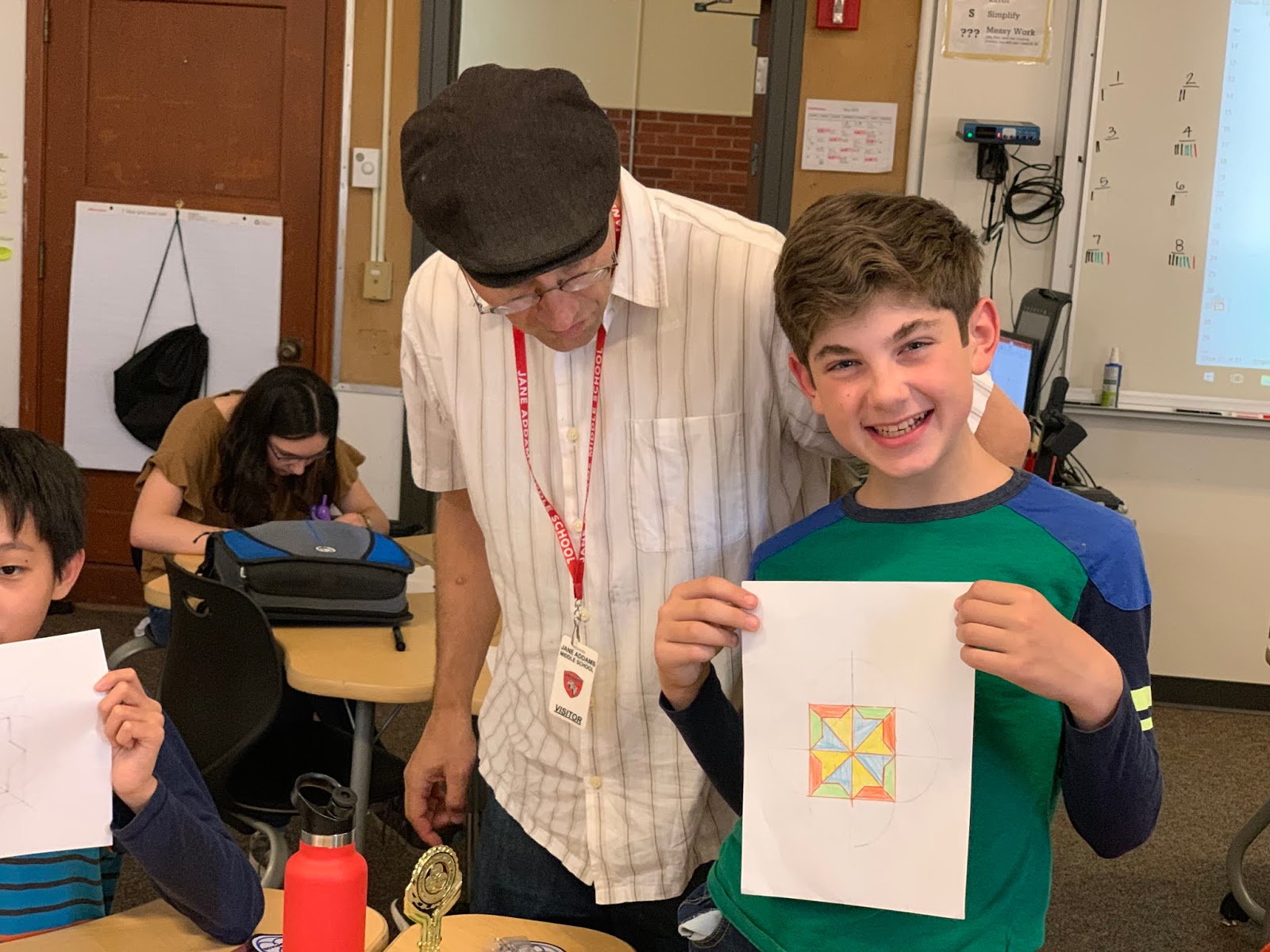
(I had someone else taking pics yesterday so - there isn’t as much student work and a bit more of me than usual)
Leave a comment