Summer ‘19: What did I do last summer?
Six years ago I really viewed many Mathematical topics as cut and dry. How hard can it be to learn everything there is to know about say Algebra I? Is there really anything new to find out about parabolas? I don’t think that exactly anymore as I continue to find further depths to even the most well trod subjects. These are not usually obvious though and discovering them takes some work. Towards that goal, I constantly read new material that comes my way. Its not hard to find a constant stream of new mathematical writing but a lot of what I see tends to be a repeat of something I’ve read before. Sometimes a few months go by without learning anything. This summer, however, was surprisingly rich in terms of personal math discoveries.
Criteria:
- Whatever the math is it has to be new to me. That rules out a lot of great writing a la the BigMathOff for instance.
- I’m particularly fascinated by geometry topics although in hind sight this period was heavily about polynomials.
- If I spent more than a few days playing with an idea, I consider it inherently interesting for purposes of this list.
Topics:
-
Quadrature of the Parabola (and parabolas in general). This all started after reading Steven Strogatz’s new book on Calculus. A surprising amount falls out of a parabola beyond the quadratic formula. Here I wrote up some coalesced thinking around finding the area under a curve or more properly the geometry that builds up to it: quadrature-of-the-parabola-proposition-2 There were several followup parabola problems that I saw afterwards that built on this thinking.
-
Morley’s Triangle: After a throwaway comment by Sam Shah I spent a week fooling around with this angle trisection:
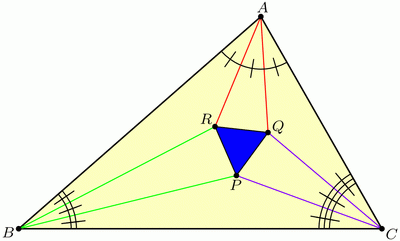
As often occurs there is a lot of really great material on cut-the-knot.org: https://www.cut-the-knot.org/triangle/Morley/ I particularly liked John Conways’s backwards construction.
-
Polynomial Division to find tangent lines. It turns out you can use polynomial division (!) to find the tangent line to a curve: https://en.wikipedia.org/wiki/Polynomial_long_division#Finding_tangents_to_polynomial_functions. Working out why it worked was an interesting exercise. In particular: I thought a lot about inflection points and what a tangent really means there geometrically.
-
Polynomial reciprocals: Given a polynomial equation $ a_1 x^n + a_2 x^{n-1} …. + a_n = 0 $. We can perform the following substitution: $ y = \frac{1}{x} $ and (after multiplying by $y^n$ out pops the inverted equation: $a_ny^n + + a_{n-1} y^{n-1} …. + a_0 = 0$. But then look at the roots of the original equation $ (x - r_1)(x - r_2)….(x - r_n) = 0 $ After the substitution the new roots are just the reciprocals. Ex: $ \frac{1}{y} - r_1 = 0 \rightarrow y = \frac{1}{r_1} $ There are some linear algebra extension of this I have to look into more.
-
Lill’s Method to solve polynomials: This is the most recent discovery and I’m still thinking/playing with it.
Open question :
Green path is the given one - vs blue path which encodes one of the roots pic.twitter.com/prasPCpgMu — Benjamin Leis (@benjamin_leis) August 14, 2019
Honorable Mention:
- Grant Sanderson’s Keep/Kill/Divide https://aperiodical.com/2019/07/the-big-internet-math-off-2019-group-1-grant-sanderson-vs-alaric-stephen/
I haven’t actually dug into this one yet but it was fascinating and I need to make time to look at it more.
Leave a comment