More Piled Squares
–>
[@aburi_roll_cake]
Here’s another lovely variant on the piled up squares problems from Japan:
Prove A B C are collinear in the figure above.
I was interested because I just finished thinking about the interior triangles in this case: cool-geometry-problem and how its particularly easy to prove they are all equal in area via the law of cosines. So I decided to go down a trigonometric route at first. But there are several fundamental observations about this construction that dropped out that I haven’t discussed before that especially make it worthwhile.
Note: there’s almost an embarrassment of riches here. I fooled around with the Law of Sines before deciding the Law of Cosines was more fundamental as well as squaring off the entire figure before again discarding it as unnecessary,
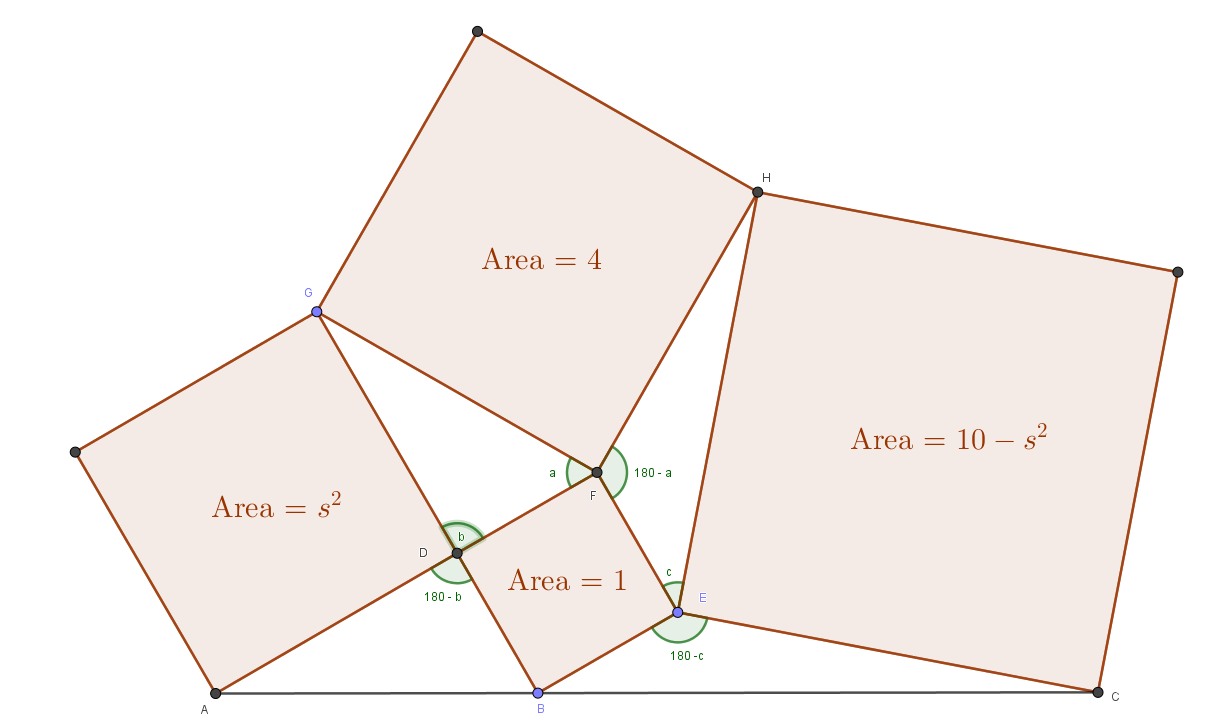
Main Procedure:
- First I let the side of the leftmost square be s. and its area is therefore $ s^2 $. Now we can apply the law of Cosines to triangle DFG:
$1^2 + s^2 - 2s\cos{b} = 4 \rightarrow 2s\cos{b} = s^2 - 3 $
- I can reuse this value to find length of AB since $ \cos{x} = -\cos{(180-x)} $
$ AB^2 = 1^2 + s^2 + 2s\cos{b} = 2s^2 - 2 $
- I can also calculate sin(180-b)=sin(b)
$ \sin{b} = \sqrt{1 - \dfrac{(s^2 - 3)^2}{4s^2}} = \sqrt{\dfrac{-(s^4 -10s^2 + 9)}{4s^2}} = \dfrac{ \sqrt{(s^2 -1)(9 - s^2)}}{2s} $
- Now I repeat this process between triangles DFG and EFH using a as the central angle and then between the EFH and BCE with c as the central angle to find all told:
$AB^2 = 2(s^2 - 1) \text{ and } \sin{b} = \dfrac{ \sqrt{(s^2 -1)(9 - s^2)}}{2s} $
$EH^2 = 10 - s^2 \text { we don’t need this sin value }$ $BC^2 = 2(9 - s^2) \text{ and } \sin{c} = \dfrac{ \sqrt{(s^2 -1)(9 - s^2)}}{2 \sqrt{10 - s^2}}$
Note: how the same polynomial shows up in both numerators and its half of the square root of the product of the side lengths.
Checking the Angles we care about:
Now we have everything we need via the law of Sines to find the sines of the two angles DBA and EBC. The hope is that they will be complementary.
-
$ \sin{\angle{DBA}} = \dfrac{\sin{(\angle{180 -b})} \cdot AD}{AB} = \dfrac{ \sqrt{(s^2 -1)(9 - s^2 )}}{2s} \cdot \dfrac{s}{ \sqrt{2(s^2 - 1)}} = \dfrac{\sqrt{9 -s^2}}{2 \sqrt{2}} $
-
$ \sin{\angle{EBC}} = \dfrac{\sin{(\angle{180 -c)})} \cdot CE}{BC} = \dfrac{ \sqrt{(s^2 -1)(9 - s^2)}}{2 \sqrt{10 - s^2}} \cdot \dfrac{\sqrt{10-s^2}}{\sqrt{2(9 - s^2)}} = \dfrac{\sqrt{s^2 -1}}{2 \sqrt{2}} $
By squaring we can verify that $ \sin^2{\angle{DBA}} + \sin^2{\angle{EBC}} = 1 $ So they are complementary i.e. DBA + EBC = 90 and therefore ABC is a straight segment.
Alternate Trig Approach:
This is basically the approach above after I polished it a bit to remove most of the more complicated algebra. There’s a well known adage about repeating the same procedure and expecting a different outcome is the definition of insanity. But in this case, it only takes 8 repeated applications of the Law of Cosines to reach our result.
First we need a small lemma that formalizes something used above:
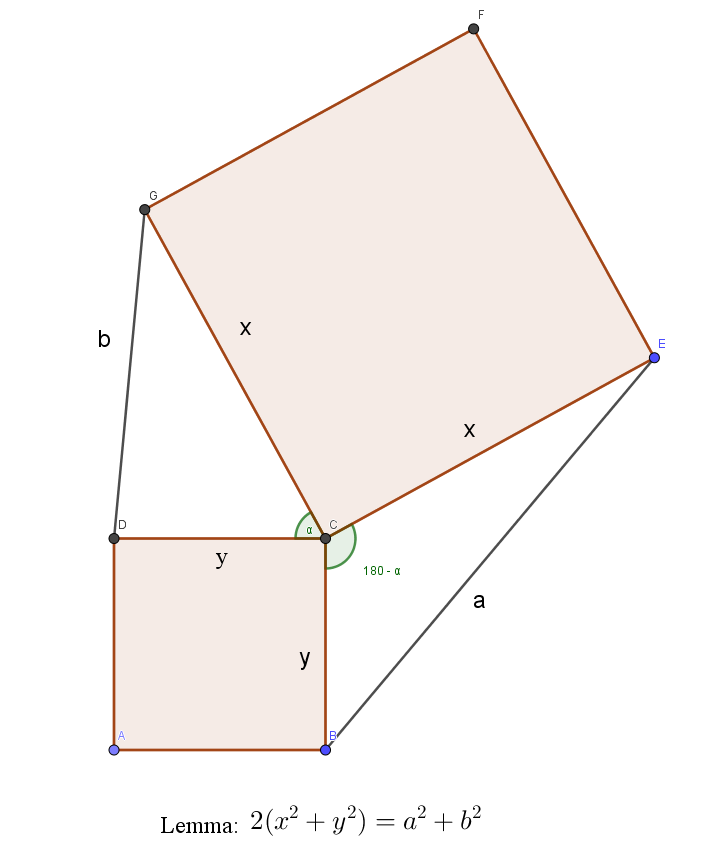
This is found using the law of Cosines on the two triangles noting the cos(x)=-cos(180-x):
$ x^2 + y^2 - 2xy \cos{\alpha} = b^2$
$ x^2 + y^2 + 2xy \cos{\alpha} = a^2$
Add the two versions together to get:
$2(x^2 + y^2) = a^2 + b^2$
Applying this to the problem we find 3 relationships:
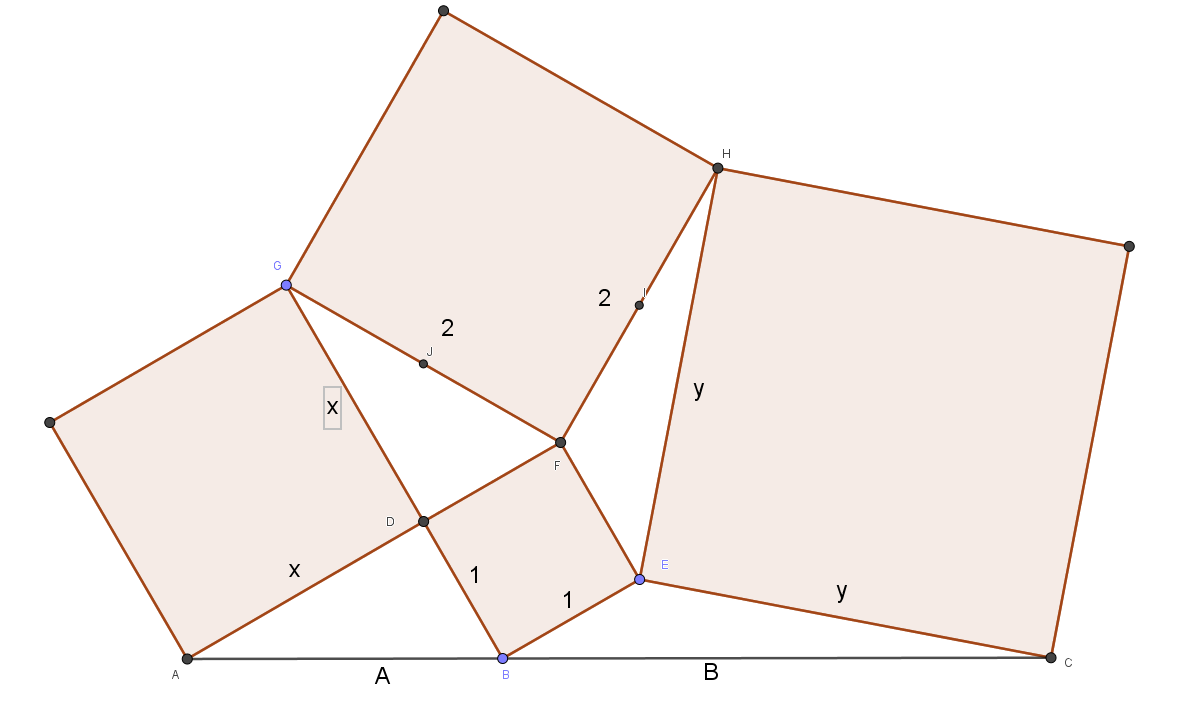
- Between the squares with lengths of 1 and x: $ 2(x^2 + 1^2) = A^2 + 4 \rightarrow$ $\mathbf{A^2 = 2x^2 - 2} $
- Between the squares with lengths of 1 and y: $ 2(y^2 + 1^2) = B^2 + 4 \rightarrow $ $\mathbf{B^2 = 2y^2 - 2}$
- Between the squares with lengths of 1 and 2: $ 2(1^2+ 2^2) = x^2 + y^2 \rightarrow$ $\mathbf{x^2 + y^2 = 10} $
Now we’re going to use the Law of Cosines yet again on the two lower triangles
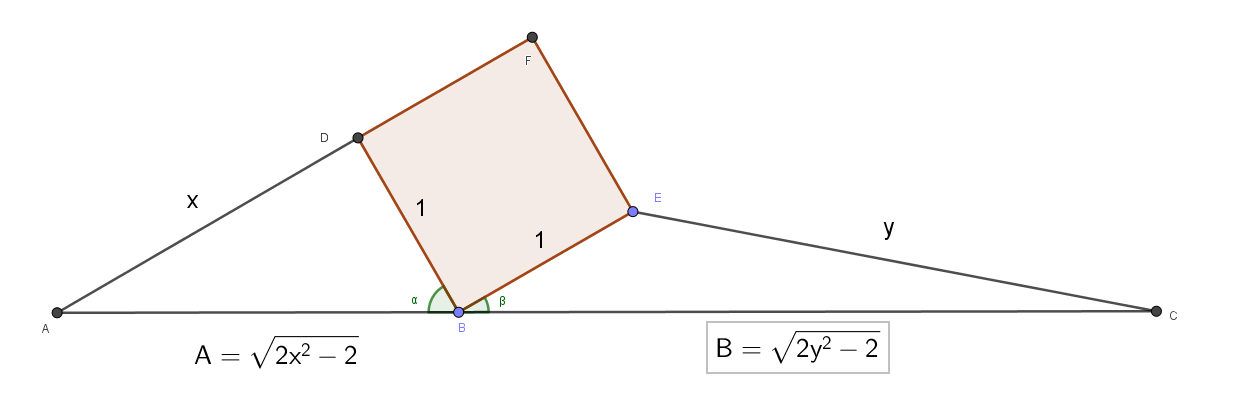
- $ 1 + (2x^2 - 2) - 2 \sqrt{2x^2 - 2} \cos{\alpha} = x^2 $
- Solving for cos we get: $ \cos{\alpha} = \dfrac{x^2 - 1 }{2 \sqrt{2x^2 - 2}} = \dfrac{\sqrt{x^2 - 1}} {2\sqrt{2}} $
- Since its completely symmetrical: $ \cos{\beta} = \dfrac{ y^2 - 1 }{2 \sqrt{2y^2 - 2}} = \dfrac{\sqrt{y^2 - 1}} {2\sqrt{2}} $
Here let’s check if the two angles are complementary (remembering $ x^2 + y^2 = 10) $ from above:
- $ \cos^2 \alpha + \cos^2 \beta = \dfrac{ x ^2 - 1 + y^2 - 1 }{8} = \dfrac{ (x^2 + y^2) - 2}{8} = \dfrac{10 - 2}{8} = 1 $
Since both the original functions are non-negative, we don’t have to worry about inverses and this implies $ cos \alpha $ is in fact $ \sin \beta $ and vice versa. So they are complements and we are done!
Euclidean Take
I find the second approach fairly neat and I like the lemma on its own but it doesn’t clearly show why the 2:1 ratio in the given squares is so crucial (other than the algebra working out). So I’m going to close with a Euclidean version based on some ideas from @illarosac.
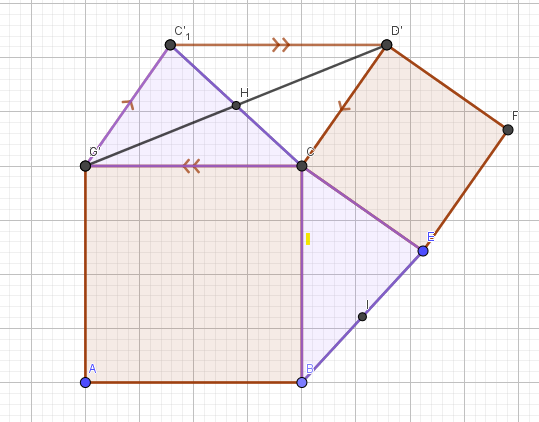
Everything starts with an interesting Lemma again: if you extend either triangle into a parallelogram as above you end up with a congruent version of the other triangle.
- This is proved via SAS: two sides are the same and the interior angle can proved the same through a quick angle chase.
- Note: the version is also rotated exactly 90 degrees
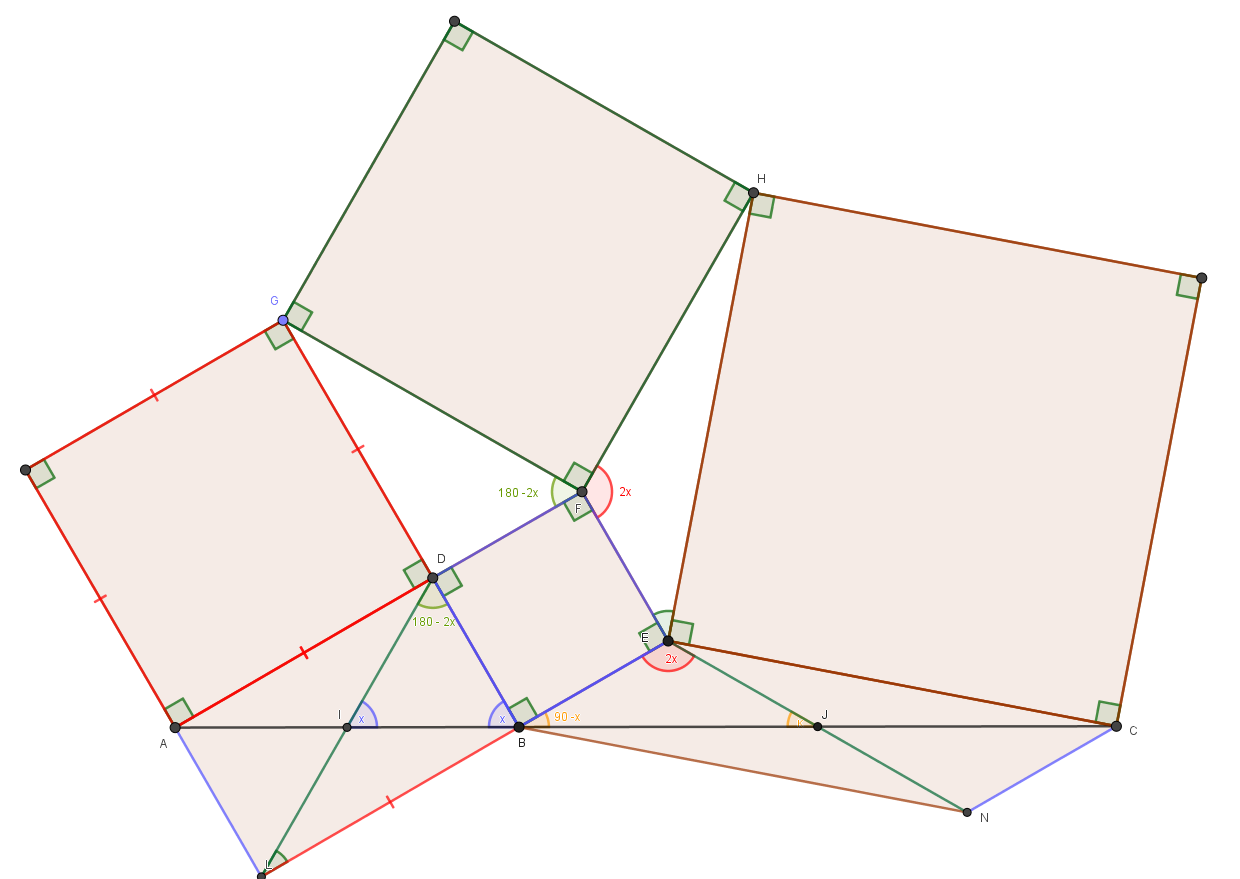
This version starts by using the lemma above on the two sides we’re interested triangles: ABD and BEC.
- From our parallegorams: $ \triangle{DBL} \cong \triangle { FDG} $ and $ \triangle{BEN} \cong \triangle{EFH} $
- In addition using the fact that the diagonals of the parallelograms intersect at their midpoints we note that DI is half of DL which has length 2 so DI has a length of 1 and therefore DIB is an isosceles triangle.
- This repeats on the other side: EJ is also half of EN which is length 2. So BEJ is also isosceles
[Note: this is why the side ratios 2:1 are key: we need to form these isosceles triangles.]
Now we can engage in an extended angle chase going clockwise starting at point B. I’ve highlighted the congruent angles with various colors above:
- let $ \angle{DBI} = x $ then $ \angle{DIB} = x $ from the isosceles triangle.
- The remaining $ \angle{IDB} = 180 - 2x $ and its congruent to $ \angle{GFB} $
- Then since $ \angle{EFH} $ is supplementary to $ \angle{GFB} $ it must be 2x.
- Then $ \angle{IDB} $ is congruent to $ \angle{GFB} $ and its also 2x.
- Finally since we have our right side congruent triangle $\angle{EBJ} = \angle{EJB} = 90 -x $
All of which shows EJB and DBI are complementary and as we reasoned the previous 2 times the overall points A,B, and C are collinear.
–>
Leave a comment