10/14 Radicals and other scallywags
There’s a lot to reflect upon after today. Going into the session I had 2 main goals:
- Spend some time talking more about Math stereotypes after last week.
- Try out some meaty task.
I had been toying with several different ways to go but became interested in a puzzle that involved a combination of logic, algebra and manipulating square roots. The puzzle itself is tricky to I worked backwards from it creating a sequence of buildup tasks that built up the ideas that would be used in the final stage. That meant deciding on a basic group discussion around manipulating square roots i..e how can we prove:
- $\sqrt{a \cdot b } = \sqrt{a} \cdot \sqrt{b}$
- $\sqrt{ \dfrac{a}{b} } = \dfrac {\sqrt{a}}{ \sqrt{b}}$
- $\dfrac {a}{ \sqrt{b}} = \sqrt{ \dfrac{a^2}{b} }= $
From there I found an open middle type problem with square roots that I thought would be a natural progression. I rounded that off with two problems that stressed finding products and sums of numbers that added up to specific targets. And finally that led to the puzzle itself:
A teacher wrote four positive numbers on the board and invited his students to calculate the product of any two. The students calculated only five of six products and these are the results: 2, 3, 4, 5, 6.
What is the last product?
What are the original four numbers?
This sequence in addition to building towards a goal gave me some head room for the students who are still in Math7 and Math8 to engage with something accessible. I knew from the outset that not everyone would finish but I thought the intermediate tasks were meaningful on their own. (In practice because of the admin items and math discussions only a few 8th graders really made it all the way through, most kids were in the middle and a few really had fun with the first problem and kept hammering away at it)
The way things played out.
We started with an election for a club President and Vice President. As usual the kids really got into the process. Somewhat asymmetrically, only 1 girl ran for President and then 10 kids ran for vice president. What was nice, was I had my volunteer parent collect and tabulate results so I could focus on moving forward while that process completed.
Then I threaded in the Math Stereotypes discussion. For context, last week, I had 2 younger kids say something similar to “I’m Asian so therefore I’m good at Math”. I decided to just go around the room and ask everyone what they felt about the statement. There were a lot of mentions of stereotypes, “That’s not True”, and “It made me feel uncomfortable”. So I think overall it was a productive move and hopefully made everyone think a little more about the issue. My only concern was I feel like I also ended up surfacing some insecurities among one or two Asian girls who said something along the lines of “I’m Asian and I’m not good at Math”. All of which means I think we’re going to need to have another meta discussion next week around that topic. There’s some irony here in that I’m skeptical of the effectiveness of Growth Mindset messages but in practice I’m pushed towards talking about them anyway. Also, especially for future weeks but also long term I’m going to try to be deliberate about noticing what the insecure students are doing and looking for appropriate moments to recognize their work when its interesting. [Note: found a video from Tai-Danae Bradley that I might use along these lines]
At this point we went over the problem of the week. I was very pleased with the demos. Before asking for complete solutions I asked for what did everyone notice about the drawing. This drew out some beginning ideas (and I need to be conscious about continuing to always do this first) Then I had several kids discover my favorite intuitive solution to the problem:
!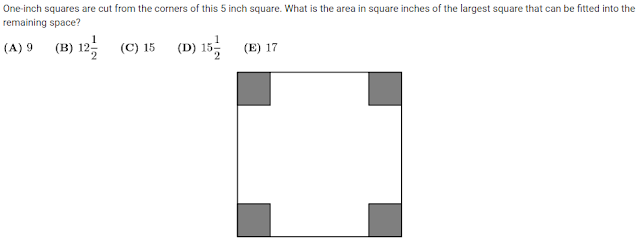
Basically they noticed a maximal square would be made up of the inner square plus four outer triangles and both areas are not too hard to compute:
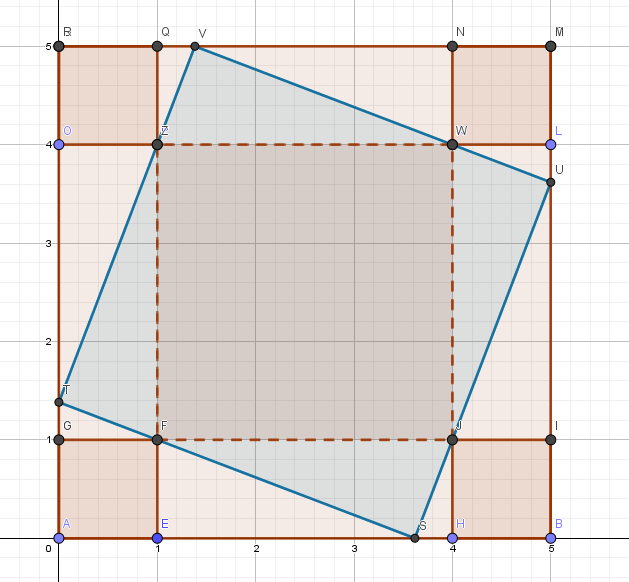
Out board discussion on radicals followed afterwards. During this time, everyone listened and multiple great ideas were shown but I’m definitely still working on getting full participation from the entire room especially the new 6th graders. Just like above, a long term project is to create situations where people present their work to bring them up to the board in front of everyone.
Next: I had the kids breakout into group to work on the rest of the problem sequence. In my continued experiments with handling a full classroom of kids I tried out the document camera for the first time with this page:
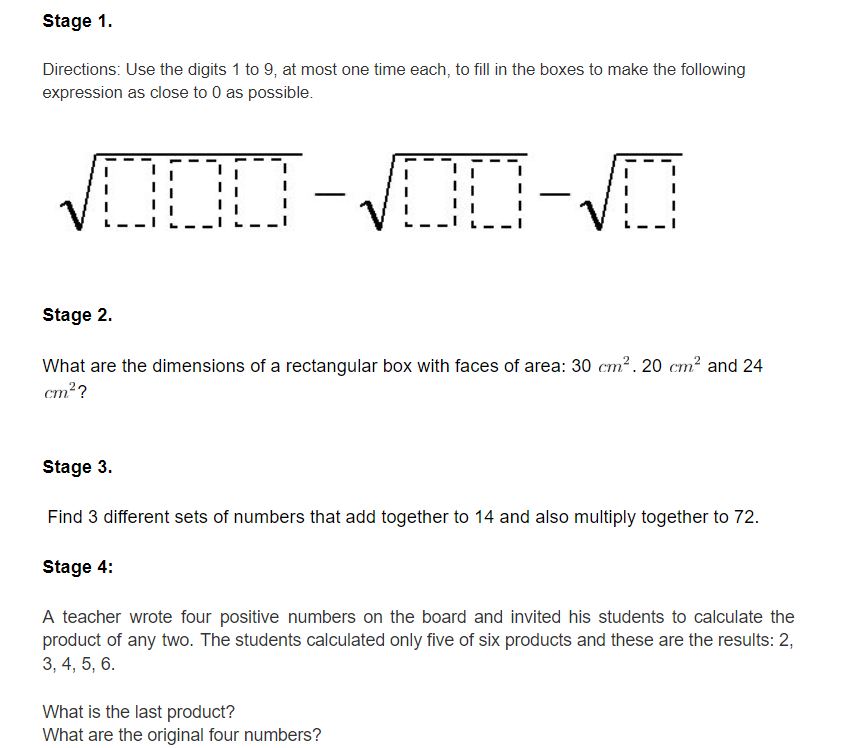
Overall I will repeat using the camera since its not too hard to run, neater than my handwriting and saves paper when everything can fit on a single board. The one downside is after a little while I had the kids writing solutions they found to Stage 1 communally on the whiteboard and they easily could block the view of the problems when standing up at the front.
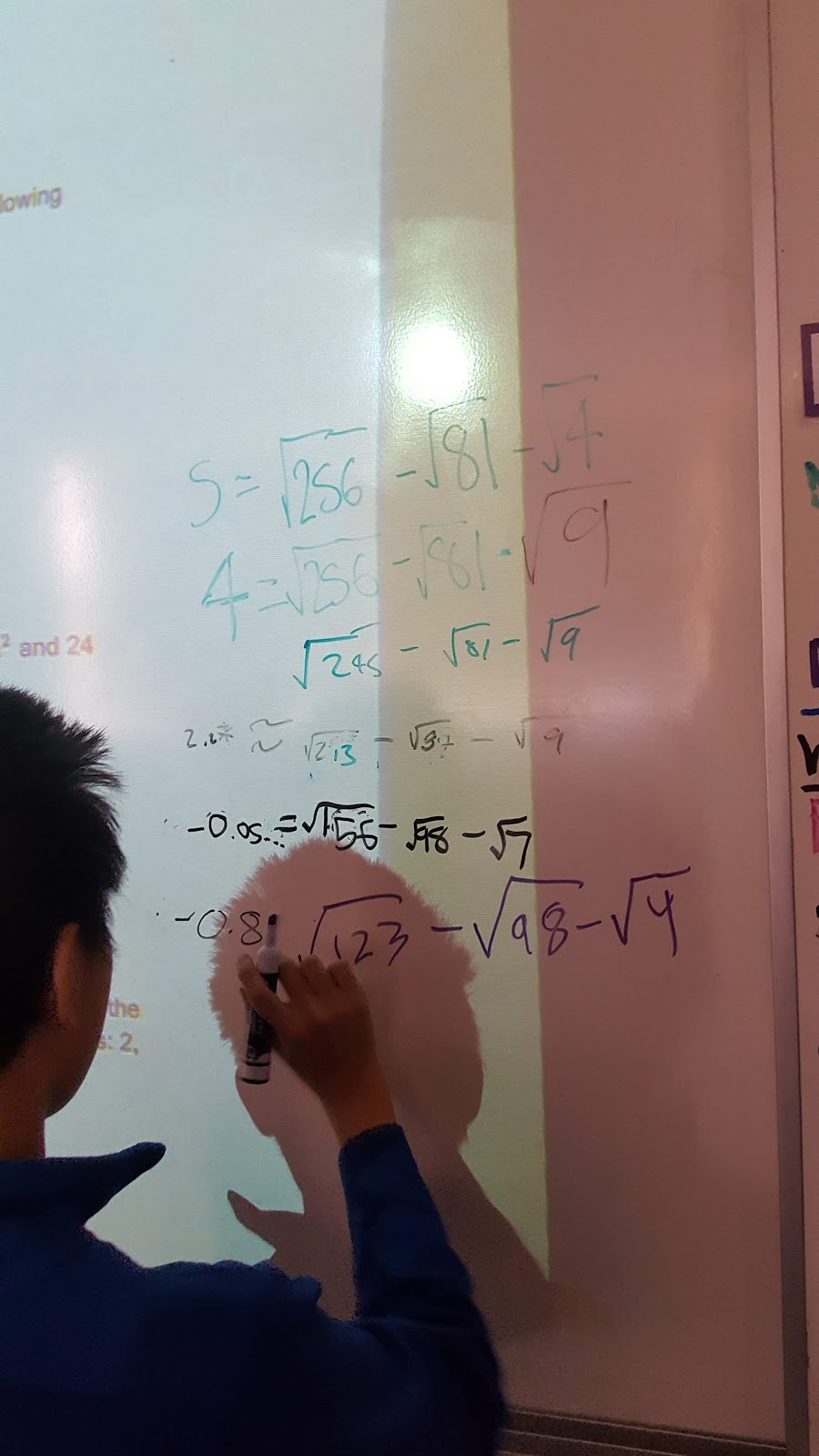
But on the bright side, the first problem was highly engaging as expected and having everyone see what had been found created incentive/excitement to look for an even better solution. This was another meta moment where I chose an activity that I think can be easily overused but in small does is very effective.
Looking Forward: So we definitely have another meta conversation to engage with. I’m tempted to go with a math game or perhaps try out modular origami next week just to switch things up.
Leave a comment