Trig Angle Addition Two Ways
I’m really enjoying contrasting these two approach right now to deriving the since and cosine angle addition formulas. Just like in the normal pedagogy for trigonometry you can approach the topic from the perspective of right triangles or the unit circle.
Right Triangle Approach
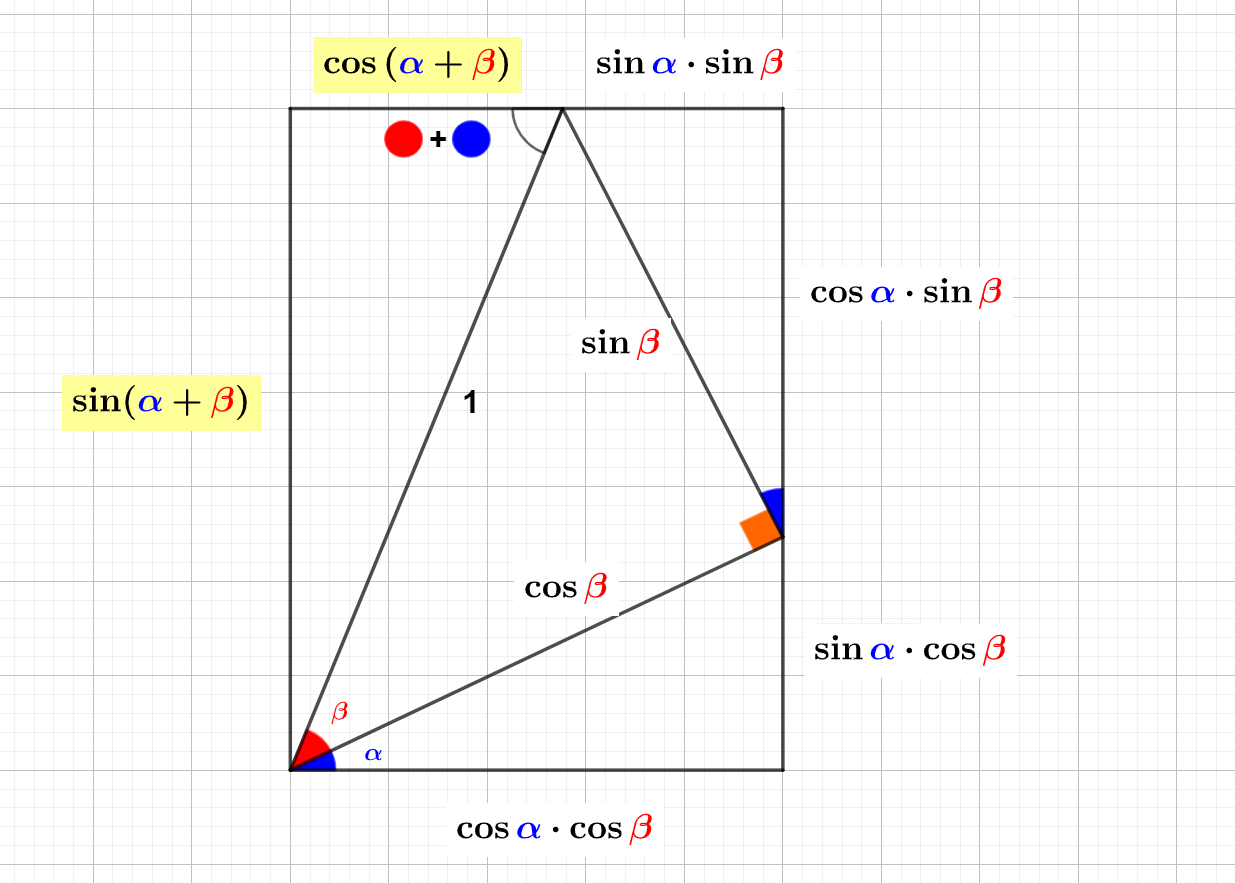
- Stack two triangles on top of each other $ \triangle{AFE} $ which has angle $ \alpha $ and a hypotenuse of length 1 and AED which has an angle of $ \beta $.
- Now start calculating the lengths of the sides for all the triangles starting with AFE then AED, then EFC and finally ABF.
- Finally note $ \angle{BFA} $ is $ \alpha + \beta $ and we have the sine and cosine values on the two edges AB and BF!
Unit Circle Approach
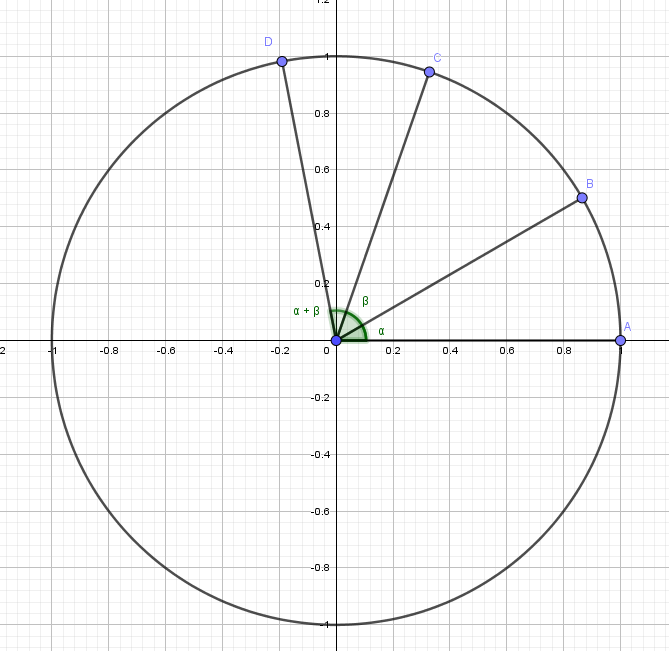
- $ \angle{AOB} = \alpha $, $ \angle{BOC} = \beta $ and $ \angle{AOD} = \alpha + \beta $
- Using cis notation $ B = \cos(\alpha) + i \sin(\alpha) $ and $C = \cos(\beta) + i \sin(\beta) $
- By definition multiplying OB and OC together is $ ||OB|| \cdot ||OC|| (\cos(\alpha + \beta) + i\sin(\alpha + \beta)) $ or point D since the magnitudes are both 1.
- The coordinates of D can also be found via the distributive law to be: $ \ (\cos(\alpha) \cdot \cos(\beta) - \sin(\alpha) \cdot \sin(\beta)) + i (\sin(\alpha)\cdot \cos(\beta) + \sin(\beta) \cdot \cos(\alpha) ) $
- Equating the two forms we once again have the cosine and sine addition formulas!
Leave a comment