Dot in a Box
[@fleonsotelo]
I’ve seen several variants on this type of problem in the past. Another variant came up a few days ago on twitter via Leon Sotelo. So I think it would be fun to talk about some of the general properties it has.
Missing Diagonal
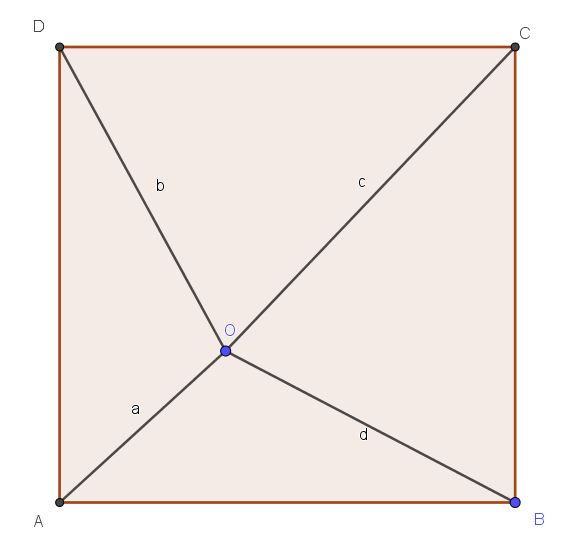
If you’re like me, you might start by wondering about the missing diagonal in the picture above. Can we figure out what its length is? The general answer is yes due to this invariant:
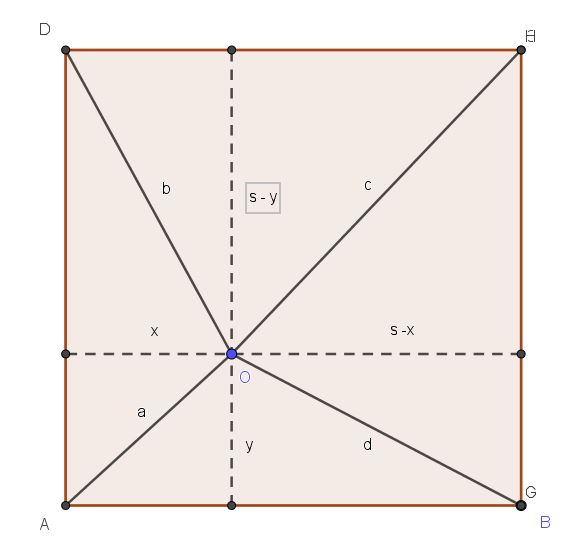
First we’ll add in some perpendiculars through O in the middle and assuming the side length is s,
we get the segment lengths above. Then we can just use the Pythagorean theorem and rearrange the terms:
\[b^2 + d^2 = (x^2 + (s-y)^2) + (y^2 + (s-x)^2) = (x^2 + y^2) + ((s-x)^2 + (s-y)^2) = a^2 + c^2\]So for example in the original problem the missing diagonal is of length $ \sqrt{17 + 25 - 4} = \sqrt{38} $
## Double the Area
Next we're going to double the area of the square by taking all of our
original triangles and rotating them around vertices as follows:
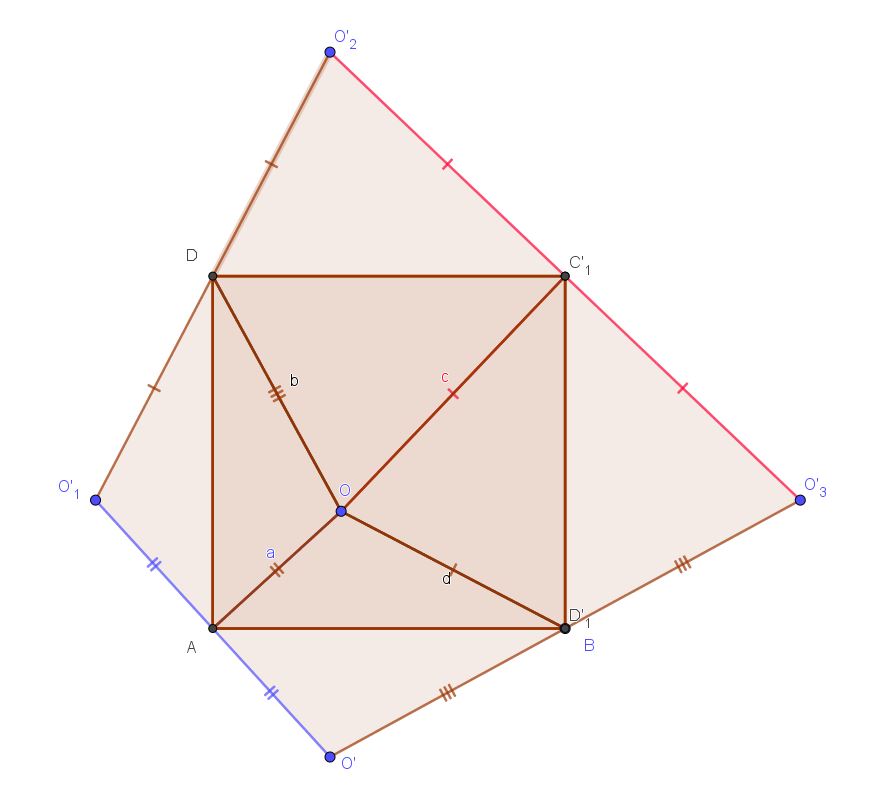
This has some interesting properties: Due to all the complementary angles after rotation all the points on the outside ends up being collinear and we have a new quadrilateral with every side length double the side length of one of the original diagonals.
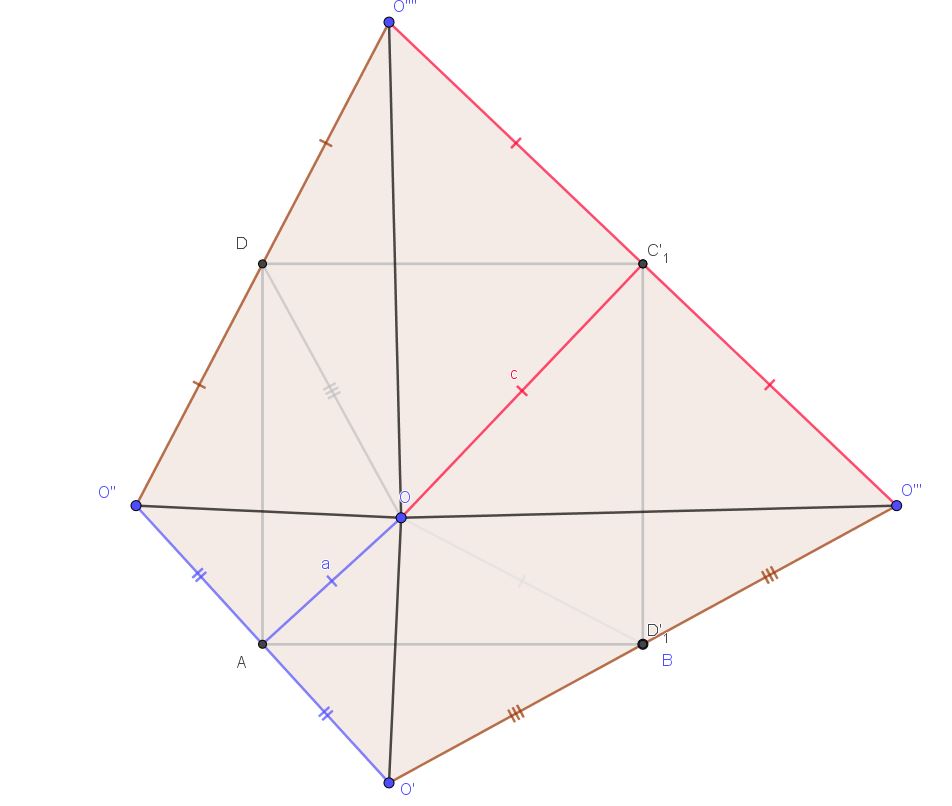
And in fact its easy to find half of the new quadrilaterals area $ \triangle{OO’O’’}$ and $ \triangle{OO’'’O’’’’} $ are both right isosceles and have an area equal to $ a^2 + c^2 $
Also the other half of the quadrilateral are two triangles of equal area. This is easiest to see via trigonometry:
Area of $ \triangle{O'OO'''} = \frac{1}{2} \sqrt{2}a \cdot \sqrt{2}
c \cdot \sin{(O'OO''')} $
Area of $ \triangle{O'O''O''''} = \frac{1}{2} \sqrt{2}a \cdot
\sqrt{2}c \cdot \sin{(O''OO'''')} $
But the two angles are supplementary and therefore their sine values are the
same.
Further B and D are midpoints so they each divide the bigger triangles
into two subtriangles of equal area i.e. [O'OB] = [O'''OB]
= [O''OD] = [O''''OD].
There are few different ways to go from here but the most straightforward is
to use a modified form
of Heron's formula: (See [here](/2019/09/26/herons-formula-vs-trigonometry.html) for a detailed dive on this) I'm going to process one of the single
small triangles that is a quarter of the total.
$$ [O'BO] = \frac{1}{4} \sqrt{4b^2d^2 - (c^2 -a^2)^2} $$ and [O'OO''']
is twice this value or $$ \frac{1}{2} \sqrt{4b^2d^2 - (c^2 -a^2)^2}$$
(Note: this is highly symmetrical so you can swap a,c for b,d.)
Putting it all together: $ [ABCD] = \dfrac{1}{2}\left ( (a^2 + c^2) +
\sqrt{4b^2d^2 - (c^2 -a^2)^2} \right) $
And returning to our original problem $ [ABCD] = \dfrac{1}{2}\left (
(4 + 38) + \sqrt{4 \cdot 35 \cdot 17 - ((38 - 4)^2} \right) = 21
+ 2 \sqrt{34} $
## Shortcut
That was a general geometric approach. However it always pays to look at
what happens with the specific instance of this setup that you have.
And in this case a nice simplification falls out after doing the
rotation/translations: One of the sub triangles is also a right
triangle.
## But why not use all Trigonometry?
Like most problems this one is solvable multiple ways. An alternate approach
is to take a look at the corner and solve via only trigonometry:
For this we'll focus on a single corner A (you could work
out of the center but the algebra is messier):
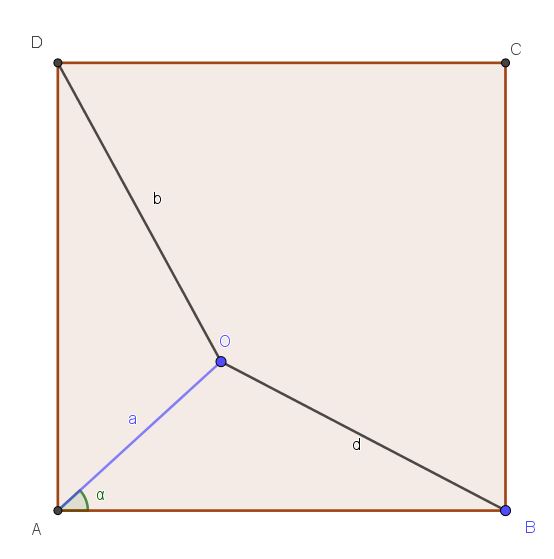
Using the law of cosines:
  - for AOB:  $ a^2 + s^2 -2as \cos{\alpha} = d^2 $
  - for AOD: $ a^2 + s^2 -2as \cos{(90 - \alpha)} = b^2 $

Solving for the trig functions:


  - $ \cos{\alpha} = \dfrac{a^2  + s^2 - d^2}{2as} $

    $ \cos{(90 - \alpha)} = \sin{ \alpha} = \dfrac{a^2  + s^2 -
    b^2}{2as} $


  We now can use the Pythagorean relationship sin^2 + cos^2  = 1
  to get an equation:


$$ (a^2  + s^2 - d^2)^2 + (a^2  + s^2 - b^2)^2 = 4a^2 s^2 $$
After a messy expansion we get:
$$2a^4 + 2s^4 + b^4 + d^4  - 2a^2 d^2  - 2s^2 d^2 - 2a^2 b^2 -
2s^2 b^2 = 0$$


That turns out to be a quadratic in terms of s^2 which is our desired area A
or:


$$2A^2 +  -2(b^2 + d^2)A  - 2a(b^2 +d^2) + 2a^4 + b^4 + d^4 = 0 $$
You can solve this quadratic for A to arrive at:
$$ A = \dfrac{ (b^2 + d^2) \pm \sqrt{ (b^2 + d^2)^2 - 2 \cdot (-2a(b^2 +
d^2) + 2a^4 + b^4 + d^4)}} {2} $$


And with some algebraic manipulation you can get this into the equivalent
form from the first section. Having done it both ways I  think its a
bit more difficult. The algebra is messy, you have to deal with 2 cases of
the quadratic formula and it doesn't have the clear geometric model that we
get from the first approach.    (But I'm relieved its
consistent)  I'll have to think on this some more to see if this can be
simplified.
How about three circles?
We can also think about this as 3 circle equations. The mechanics will
actually look fairly similar to the trigonometry just now done analytically.
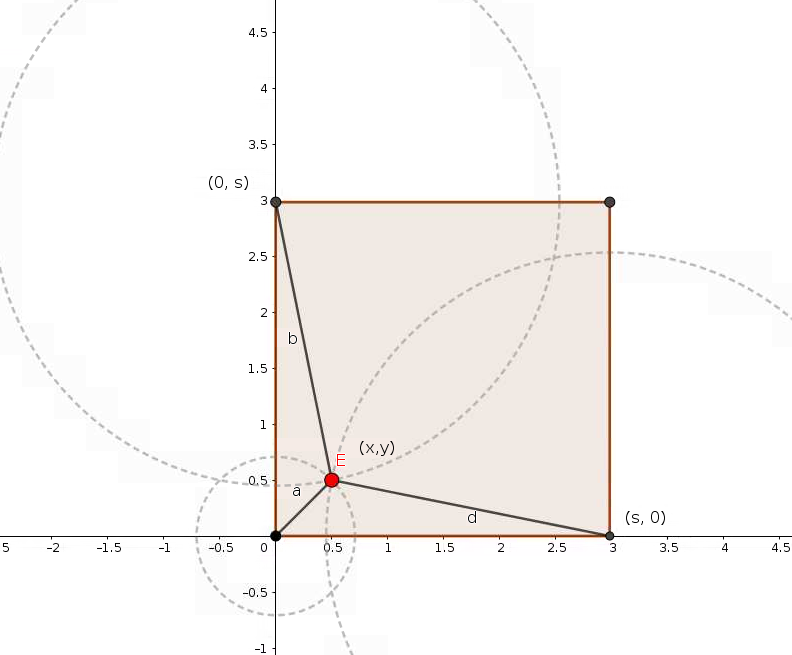
Setup from above we setup 3 circle equations that intersect at the
coordinate (x,y)
$$ (x - s)^2 + y^2 = d^2   \rightarrow   s^2 - 2sx = d^2
- a^2$$


$$ x^2  + (y-s)^2 = b^2  \rightarrow s^2 - 2sy  = b^2 - a^2$$
The later two equations can be added and subtracted to derive
\[x - y = \frac{b^2 - d^2}{-2s}\]$$ x + y = \frac{b^2 + d^2 - 2a^2 - 2s^2}{-2s} \rightarrow
x + y = \frac{c^2 - a^2- 2s^2}{-2s} $$
This looks like a dead end at first since we want to get rid of x and y but we can go back to our first original equation and see that squaring things may help \((x - y)^2 = a^2 - 2xy = (\frac{b^2 - d^2}{-2s})^2\)\( (x + y)^2 = a^2 + 2xy = (\frac{c^2 - a^2- 2s^2}{-2s})^2 \) Adding together yet again we get \(2a^2 = \frac{(b^2 - d^2)^2 +(c^2 - a^2- 2s^2)^2}{4s^2}\) This then becomes a quadratic in terms of just s^2 and constant terms: \(4s^4 + (-4c^2 - 4a^2) s^2 + \left ((b^2 - d^2)^2 + (c^2 - a^2)^2 \right) = 0 \) Solving for s^2 with the quadratic equation will again lead to the same formula
Leave a comment