Walkthrough of Geometry Problem from Michael Pershan
This post is motivated by a conversation I had with Michael where I asked if he would be willing to document his problem solving process and if so I would do the same for a problem.
Here’s the one he chose: Full Link
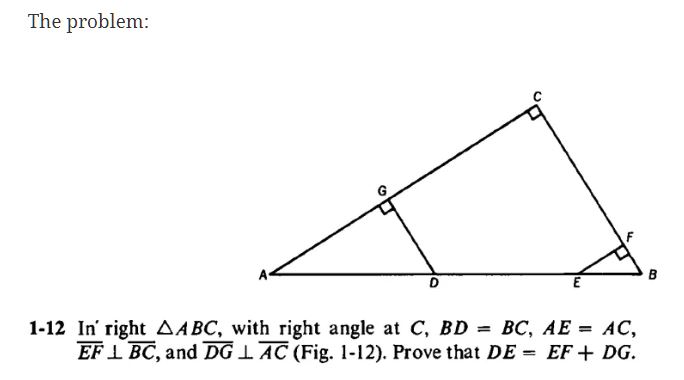
I’m trying to show how solving these type problems is very experimental for me so I actually just took photos as I went along to make sure I didn’t miss anything.
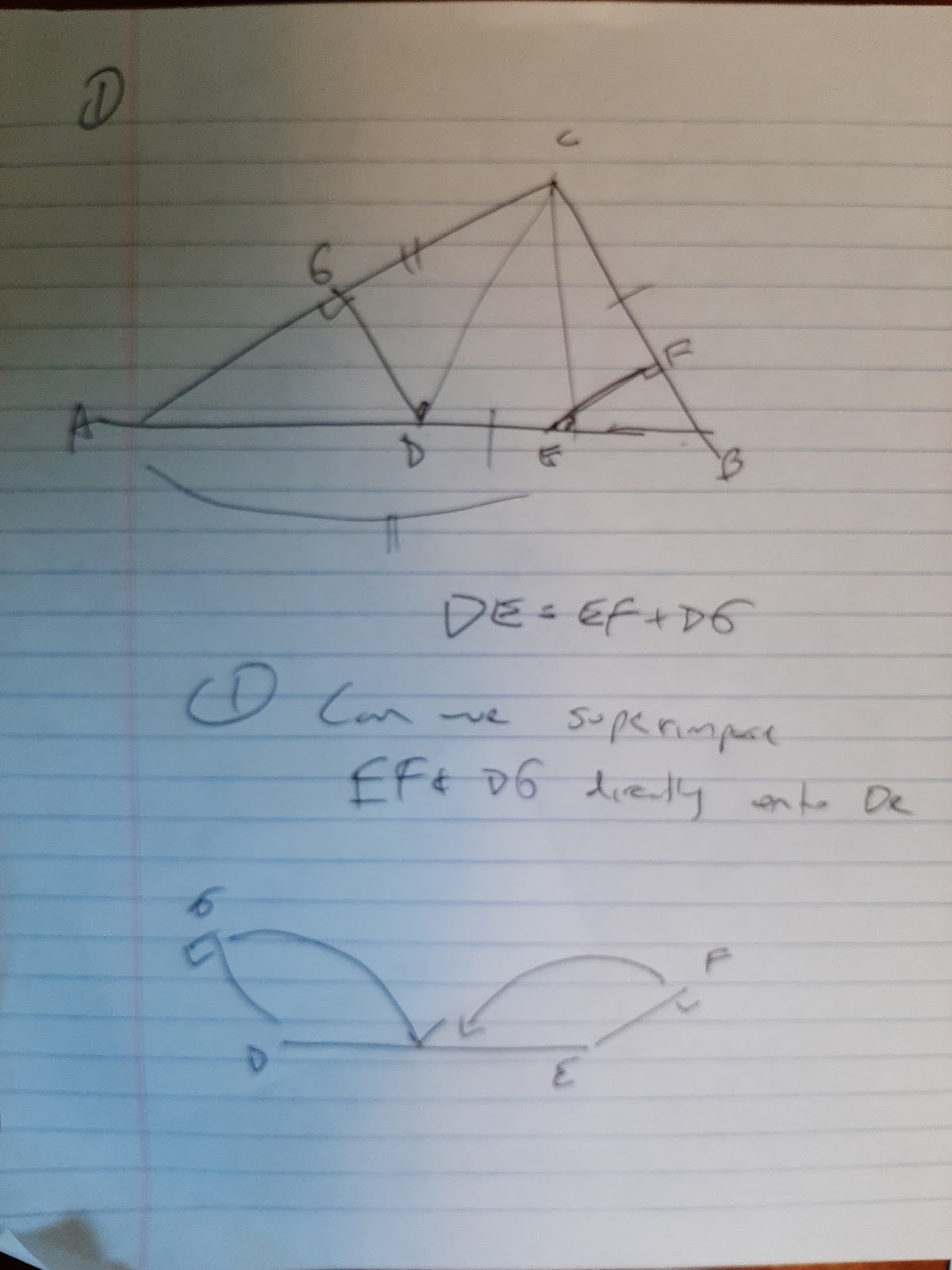
To start off with I sketched the problem and thought about it for a little bit. The idea I thought I wanted to explore first was whether or not I could superimpose a segment say DG onto the bottom and then show the remaining segment was congruent to EF. I ended up sticking with this idea through the entire process as my end goal. (There actually are two ways to superimpose and I started with the simpler of the two but you could do it the other way around where DG translated onto the right hand rather than the left hand side. I noted that but hoped the easier way would work)
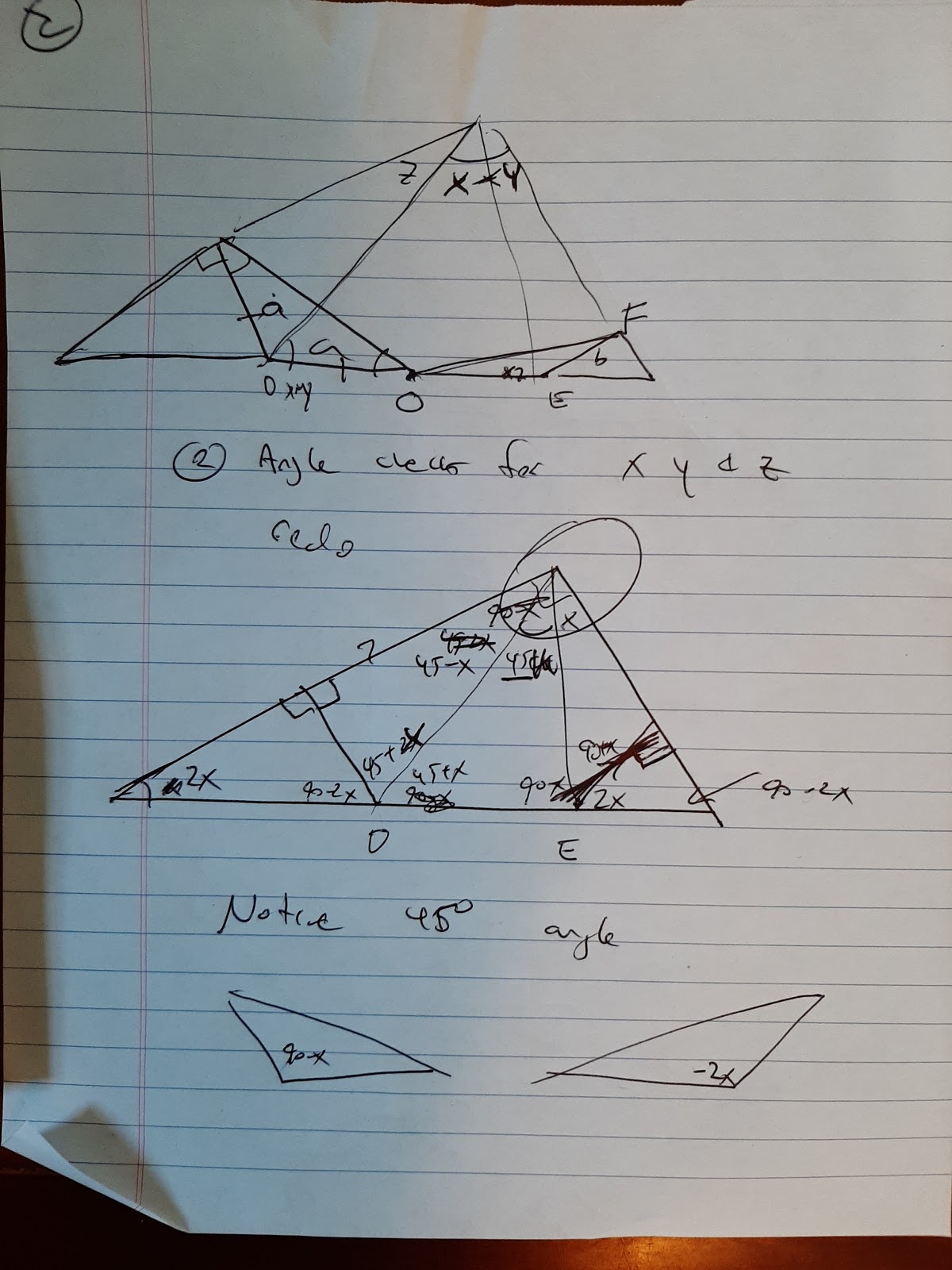
Next I just put a point O in so that GDO was isosceles and looked at what I had. Right below doing that I start an angle chase. My goal was to show OFE was also isosceles. During the chase I found a nifty 45 angle which I could play around with at DCE. I also traced out the two isosceles triangles and noted there obtuse angles (90 - x and 180 - 2x) These didn’t look visually congruent or seem like they should be so that wasn’t promising.
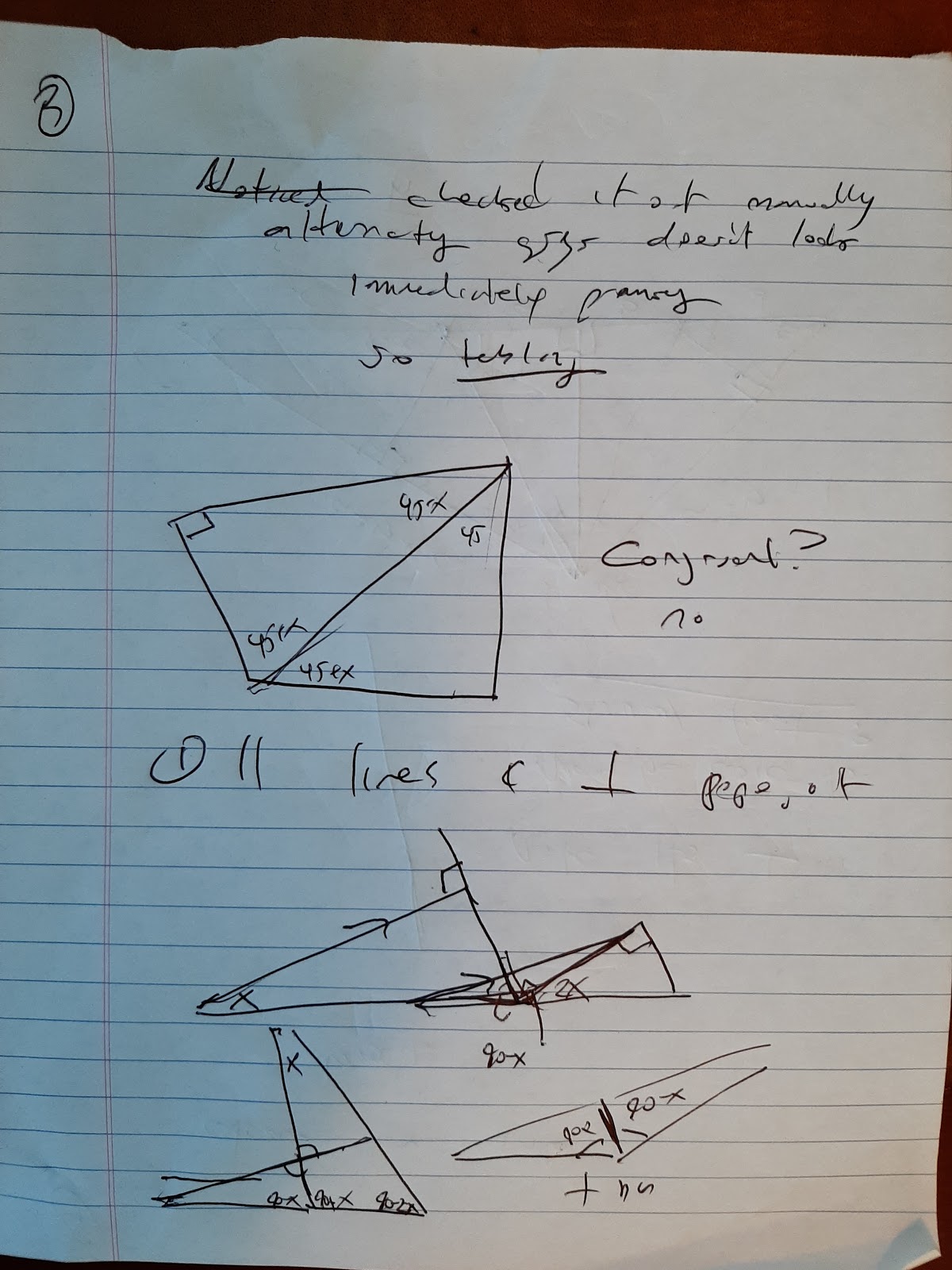
Ok here come a couple more dead ends.
- I manually checked the more complicated super imposition at this point (in geogebra) and noted it visually didn’t seem helpful so I would table it unless everything else didn’t pan out.
2 Then I connected BC and for a second thought they were congruent and then realized that definitely wasn’t the case.
3. Then I played with 45 degree angle completing an isosceles right triangle.
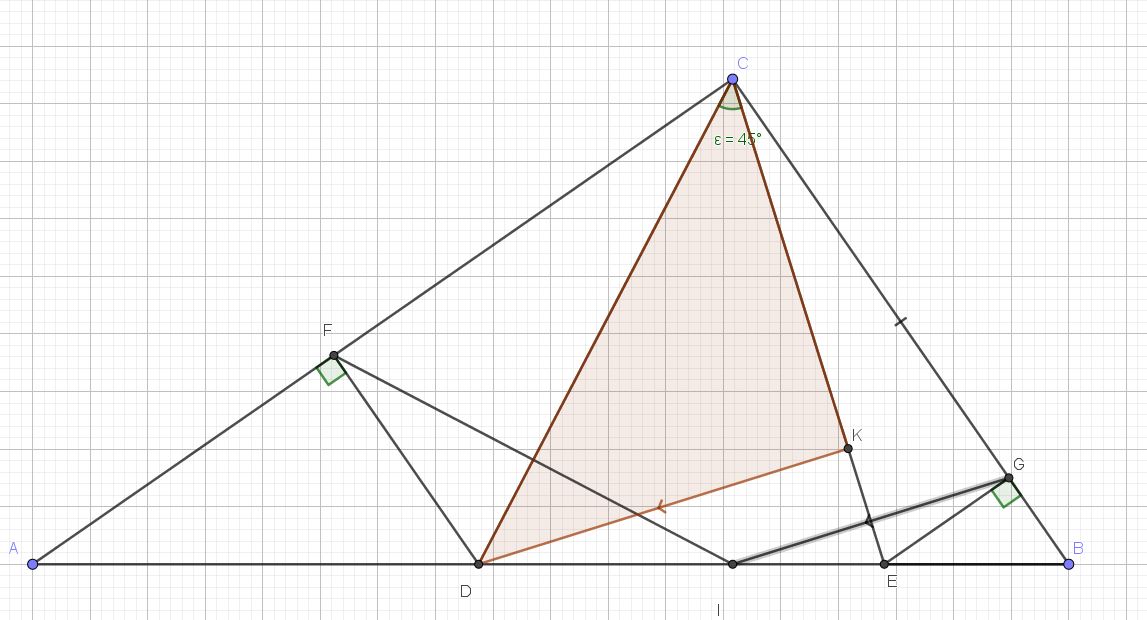
As you can see above this created some interesting parallel lines at DK and IG. If I could prove that they were really parallel that would be a big help - but how? I also angle chased and found triangle EKD was similar to the one at the top at C and I drew them together to see if that would help. Short story nothing obvious fell out.
Finally at the very lower right corner I also noticed that it looked like there was a right angle at the intersection between EG and CE and if that was the case I also would get a lot of leverage but I wasn’t sure yet how to do that. (I didn’t realize it yet but this was the first piece of the soln I had really found)
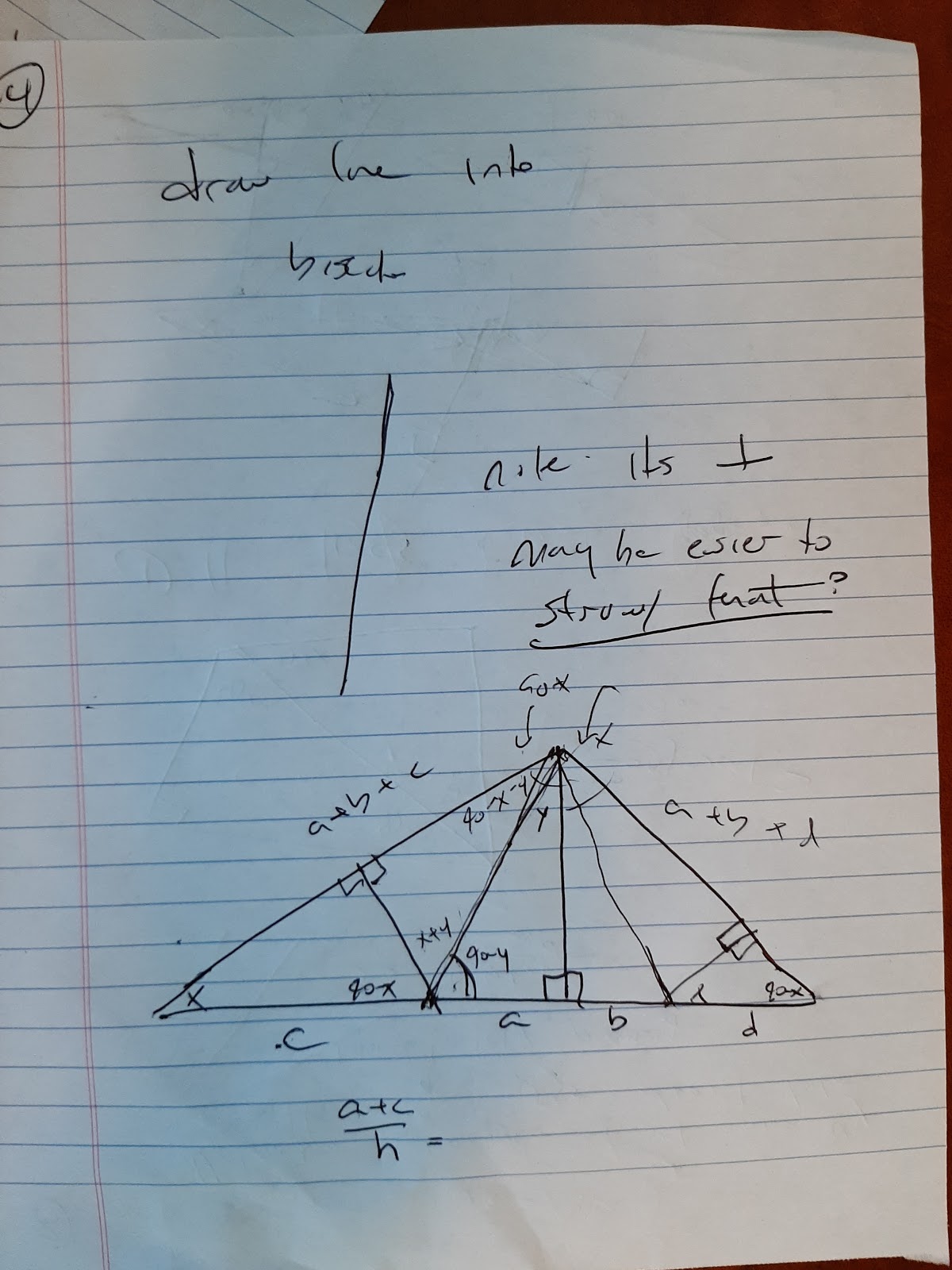
At this point I added in the segment CE and I noted that it looked perpendicular. That would also be potentially really useful for making congruent and similar triangles (so I verified it in geogebra just to be sure). I took a detour next and started to compute ratios using the similar triangles. Again that seemed overly complicated. But I was already convinced that the perpendicular was the key to the problem and if I had it I could show a bunch of triangles were congruent so I decided to restart and draw the perpendicular first and try an angle chase after that.
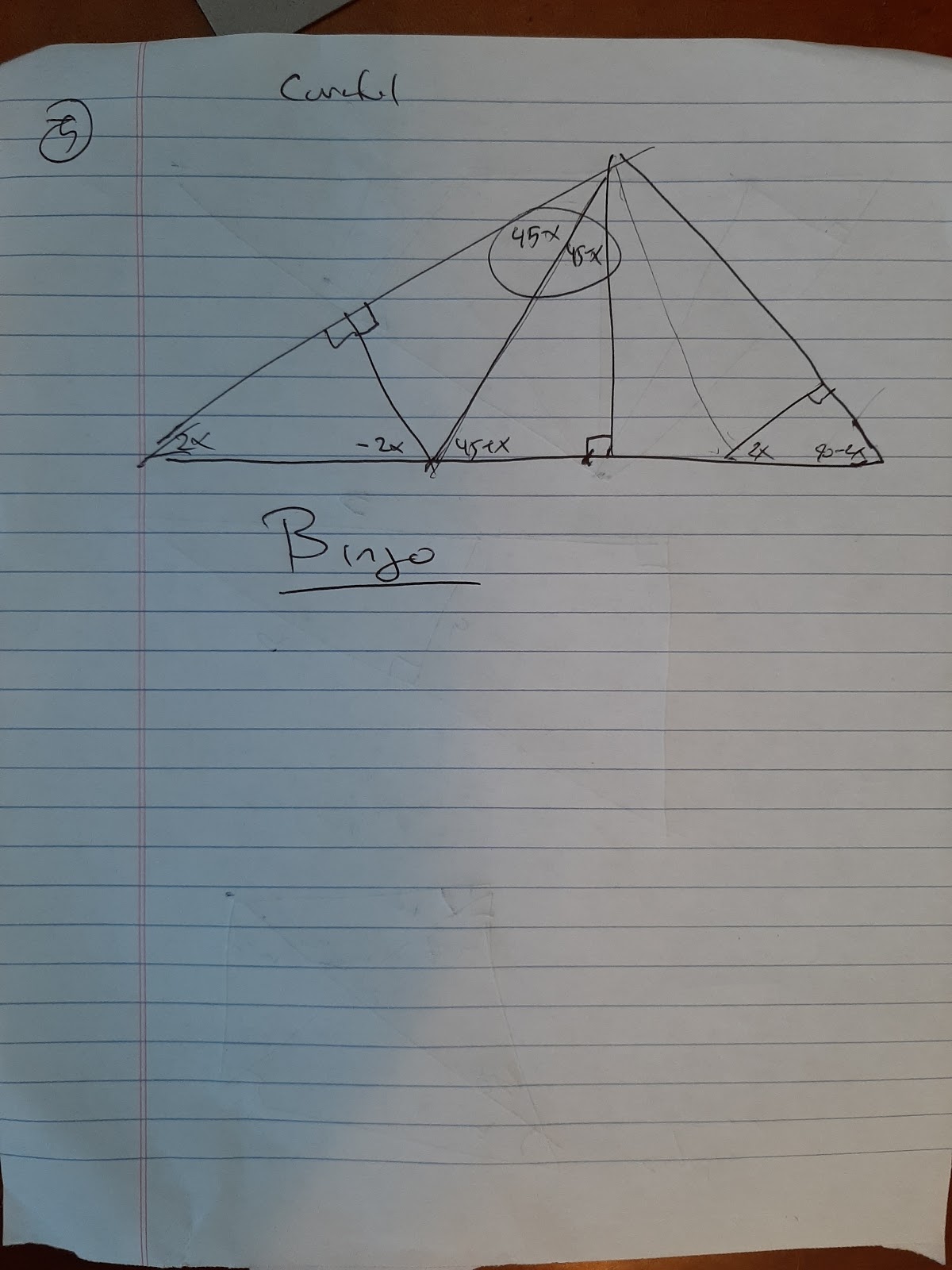
Sure enough this try worked. The angles worked out perfectly to give congruence. Note: I chose 2x for convenience to avoid fractions.
Final Cleaned up proof
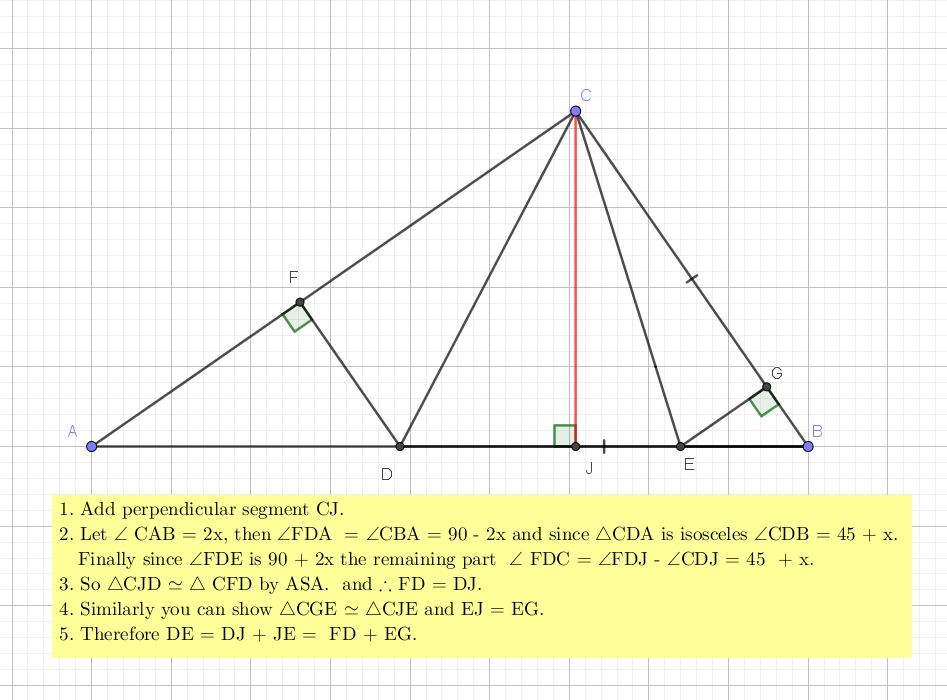
As you can see there was a fair amount of thinking that collapsed in too this much shorter and linear final result.
Leave a comment