More Heron’s Formula Extensions
Continuing on the theme from the last post: going-one-step-beyond-herons-formula here’s another problem showing the power of the full conceptual framework. Heron’s formula itself even makes an appearance again at the end.
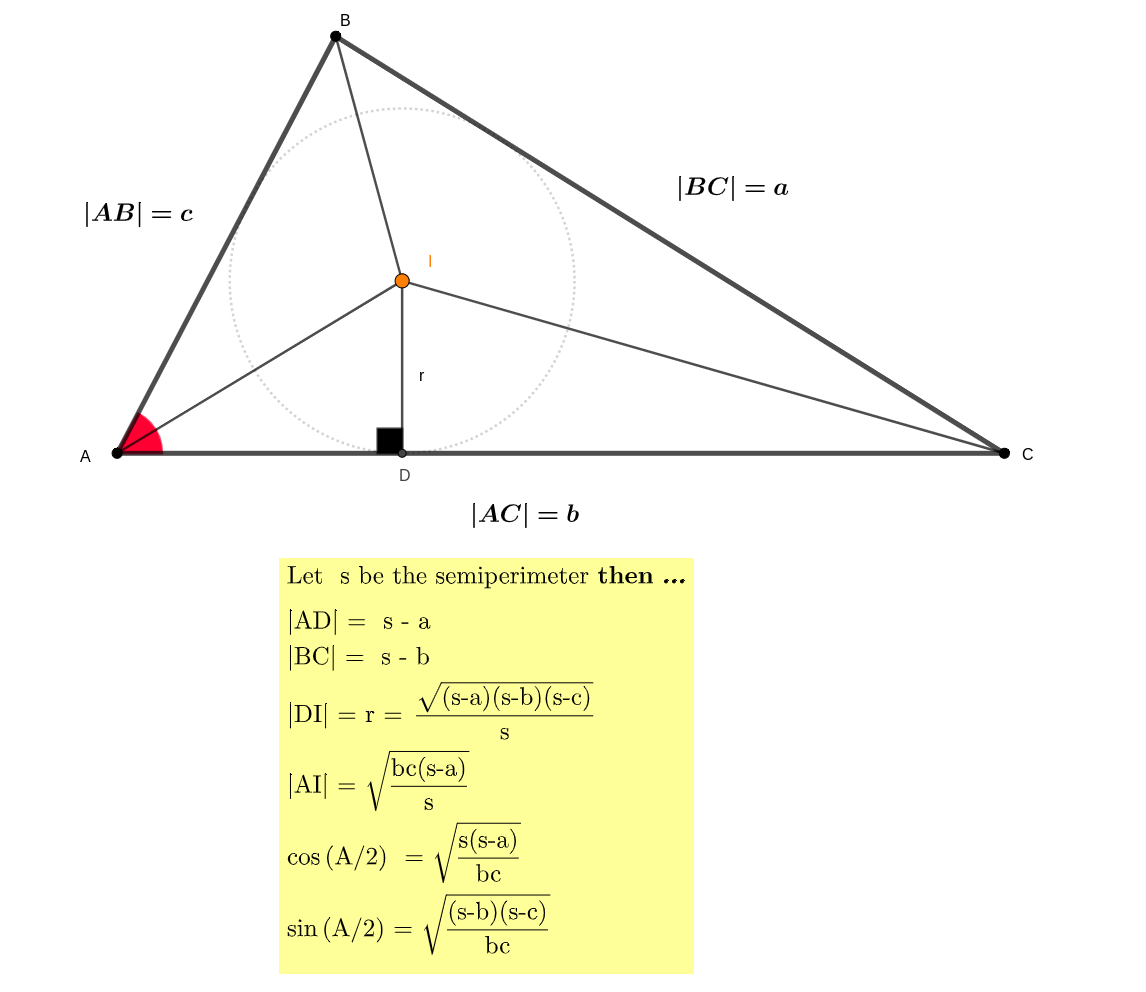
Problem
Given a $\triangle{ABC} $ show that $ \tan\left(\dfrac{a}{2}\right)\tan\left(\dfrac{b}{2}\right) + \tan\left(\dfrac{a}{2}\right)\tan\left(\dfrac{c}{2}\right) + \tan\left(\dfrac{b}{2}\right)\tan\left(\dfrac{c}{2}\right) = 1 $
Traditional ApproachThere are many ways to attack this problem using trig identities I’m going to demonstrate one that is very linear in the progression of ideas and that focus on a direct simplification of the left hand side. To do that I’m going to take advantage of the triangle angles.- We know that a + b + c = 180 so $ \dfrac{a}{2} + \dfrac{b}{2} + \dfrac{c}{2} = 90 \rightarrow \dfrac{c}{2} = 90 - \left( \dfrac{a}{2} + \dfrac{b}{2} \right) $ So first isolate $ \dfrac{c}{2} $ $ \tan\left(\dfrac{a}{2}\right)\tan\left(\dfrac{b}{2}\right) + \tan\left(\dfrac{a}{2}\right)\tan\left(\dfrac{c}{2}\right) + \tan\left(\dfrac{b}{2}\right)\tan\left(\dfrac{c}{2}\right) = $ $ \tan\left(\dfrac{a}{2}\right)\tan\left(\dfrac{b}{2}\right) + \tan\left(\dfrac{c}{2}\right) \cdot \left( \tan\left(\dfrac{a}{2}\right) + \tan\left(\dfrac{b}{2}\right) \right) $ Now looking at $ \tan\left(\dfrac{c}{2}\right) $ we already know that’s $ \tan\left(\ 90 - \left( \dfrac{a}{2} + \dfrac{b}{2} \right ) \right) $ But $\tan(90-x) = \dfrac{\sin(90 - x)}{\cos(90 -x)} = \dfrac{\cos x}{\sin{x}} = \cot{x} $ We can also now use tangent addition: $ \tan\left(\dfrac{a}{2} + \dfrac{b}{2}\right) = \dfrac{\tan\left(\dfrac{a}{2}\right) + \tan\left(\dfrac{b}{2}\right)} {1 - \tan\left(\dfrac{a}{2}\right) \cdot \tan\left(\dfrac{b}{2}\right)} $ So together we get $ \tan\left(\dfrac{c}{2}\right) = \dfrac{1 - \tan\left(\dfrac{a}{2}\right) \cdot \tan\left(\dfrac{b}{2}\right)} {\tan\left(\dfrac{a}{2}\right) + \tan\left(\dfrac{b}{2}\right)} $ Substituting into our equation we get: $ \tan\left(\dfrac{a}{2}\right)\tan\left(\dfrac{b}{2}\right) + \dfrac{1 - \tan\left(\dfrac{a}{2}\right) \cdot \tan\left(\dfrac{b}{2}\right)} {\tan\left(\dfrac{a}{2}\right) + \tan\left(\dfrac{b}{2}\right)} \cdot \left( \tan\left(\dfrac{a}{2}\right) + \tan\left(\dfrac{b}{2}\right) \right) $ That has a very convenient cancellation: $ \tan\left(\dfrac{a}{2}\right)\tan\left(\dfrac{b}{2}\right) + 1 - \tan\left(\dfrac{a}{2}\right) \cdot \tan\left(\dfrac{b}{2}\right) = 1 $
Overall this is fairly neat but it needs a few identities and doesn't give
any geometric notion about what's going on.
Using Ratios Instead
This time we're going to go back to the diagram and express the tangents as
a ratio. In general $ \tan\left(\dfrac{a}{2}\right) = \dfrac{r}{s-a}
$  where r is the inradius and s is the semiperimeter.
So substituting in we get:
$ \tan\left(\dfrac{a}{2}\right) \tan\left(\dfrac{b}{2}\right) +
\tan\left(\dfrac{a}{2}\right)\tan\left(\dfrac{c}{2}\right) +
\tan\left(\dfrac{b}{2}\right)\tan\left(\dfrac{c}{2}\right)$


$  = \dfrac{r^2}{(s-a)(s-b)} + \dfrac{r^2}{(s-a)(s-c)} +
\dfrac{r^2}{(s-b)(s-c)} $


 $ = \dfrac{r^2 \cdot ((s - a) + (s -b ) + (s -c))}{(s-a)(s-b)(s-c)}
$


 $ = \dfrac{r^2 \cdot s }{(s-a)(s-b)(s-c)} = \dfrac{r^2 \cdot s^2
}{s(s-a)(s-b)(s-c)} $


 But both the numerator and denominator are expressions for the area of
the triangle: (semiperimeter $\cdot$ inradius and heron's formula)
So we get: $ \dfrac{[ABC]^2}{[ABC]^2} = 1 $
This way, for me at least, shows the symmetry of what’s going on is very direct and the intermediate expressions are all recognizable in a geometric sense.
Leave a comment