Going one step beyond Heron’s Formula
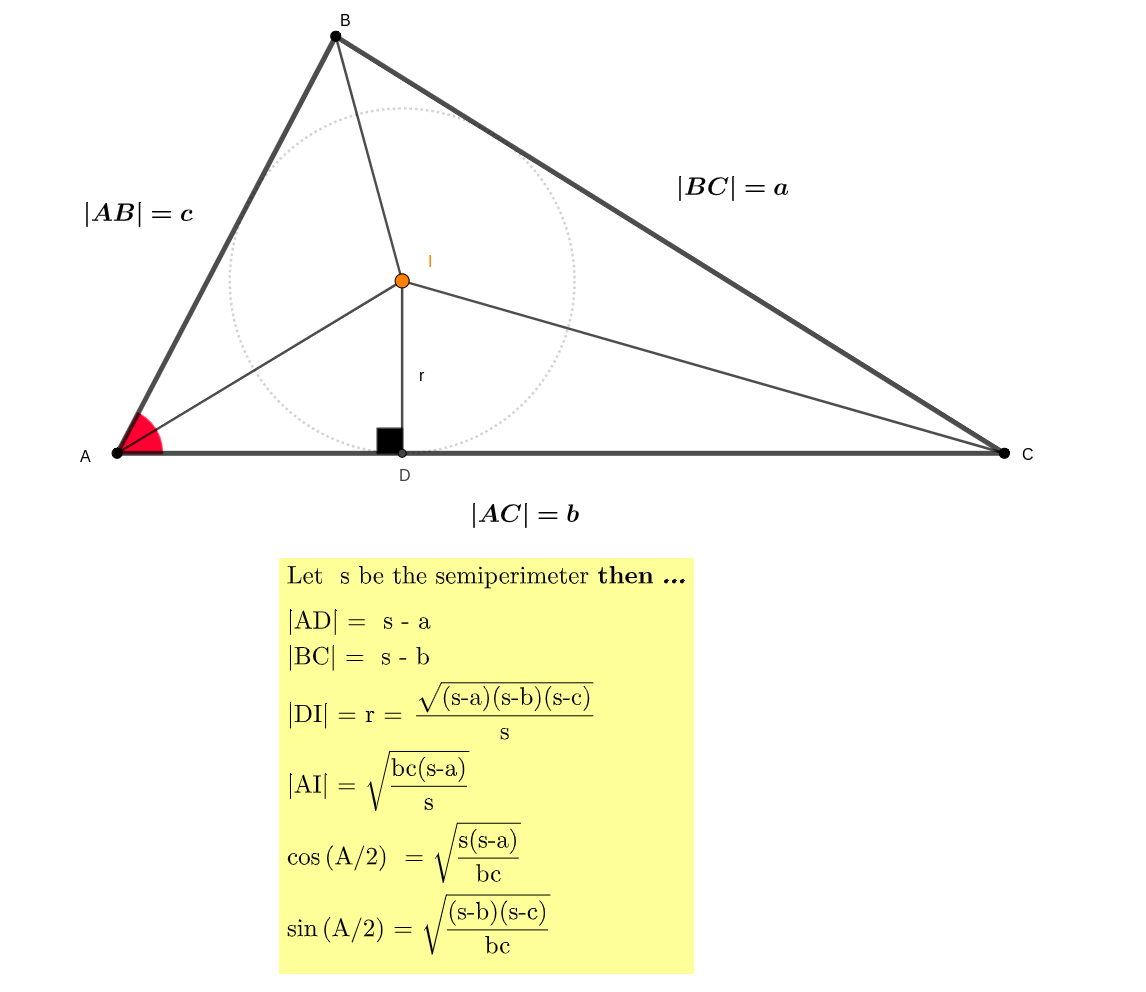
Above I’ve found the incenter of the triangle at the intersection of the angle bisectors and rewritten all segments lengths in terms of the semi-perimeter and and side lengths. This is a great exercise to have someone work through. For me the process highlighted a lot of the structure of how the incircle works.
- Fundamental tool: The law of cosines gives us an expression for cos θ in terms of only the side lengths$ a^2 + b^2 - 2ab \cdot \cos \theta = c^2 $ $\rightarrow$ $ \cos \theta = \dfrac{a^2 + b^2 - c^2}{2ab} $ The half angle formulas let us break that downA quick chase of the side lengths on the outside via the congruent triangles will find their formulas in terms of s and a,b,cApplication
I have a fairly traditional derivation of Heron’s Law here: herons-formula but the identities above allow this more unconventional approach.
- Start with standard trigonometric definition for $ [ABC] = \dfrac{1}{2}bc \cdot \sin(A) $
- Expand using the double sine formula to: $ [ABC] = bc \cdot \sin(A/2) \cdot \cos(A/2) $
- Substitute in the values from above to get $ [ABC] = bc \cdot \sqrt{\dfrac{s(s-a)}{bc}} \cdot \sqrt{\dfrac{(s-b)(s-c)}{bc}} $ 4. Which simplifies to the familiar Heron’s Formula $ [ABC] = \sqrt{s \cdot (s-a)(s-b)(s-c)} $
Leave a comment