Reflective Property of a Parabola
Reflective Property of a Parabola
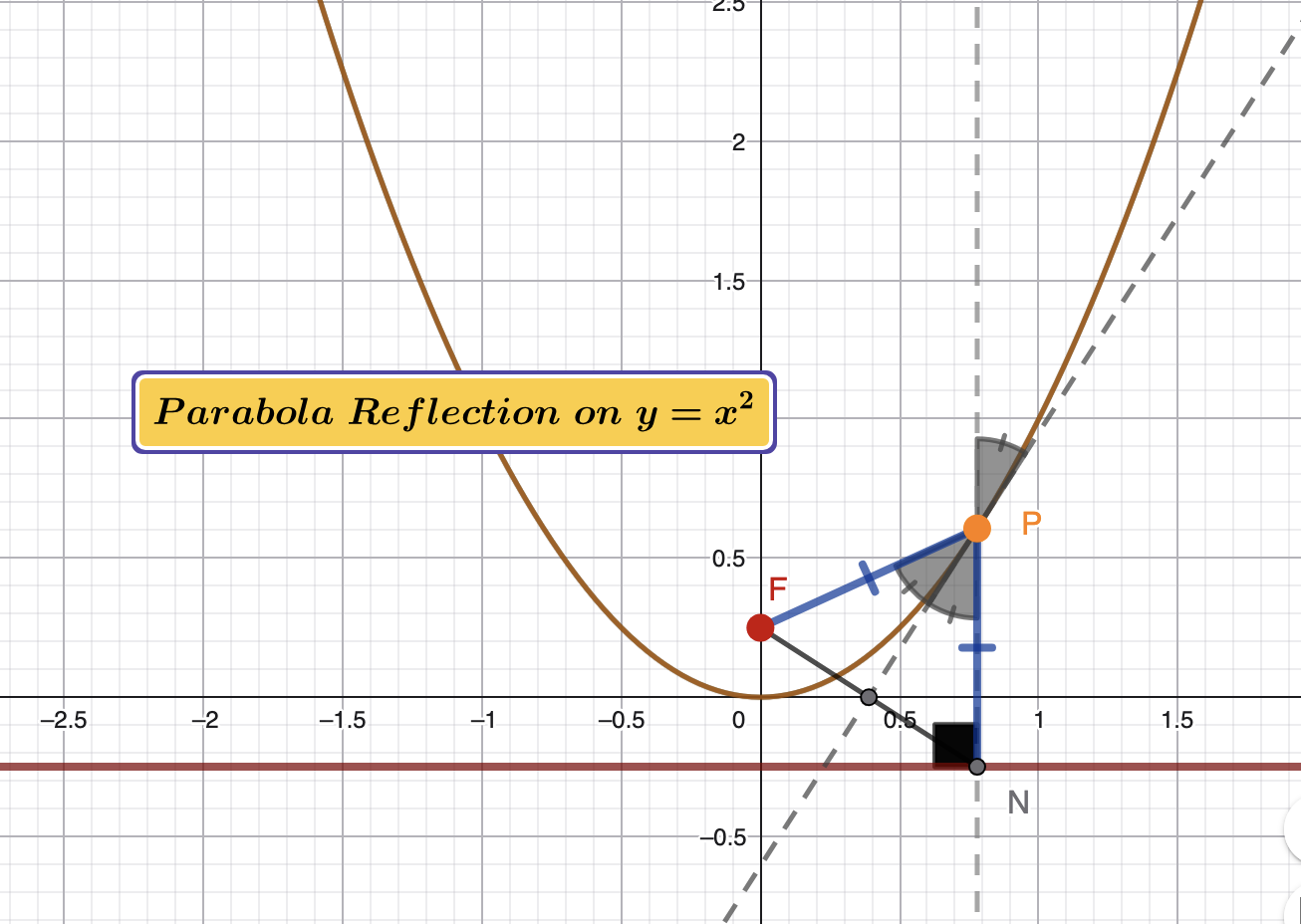
We’ve been going the reflective property for a parabola in class and I wanted to make my own diagram to illustrate a few nice points (and all without calculus).
First without loss of generality I’m going to use the simplest quadratic equation $y=x^2$ but remember “There is only true parabola”
That said to set the context, for this parabola the directrix is at $y=-\frac{1}{4}$ and the focus F is at $(0,\frac{1}{4})$
-
By definition every point P on the parabola is equidistant from the focus F and a perpendicular line down to the directrix $\overline{\rm PN}$
-
That means by definition P is also on the perpendicular bisector of FN (every point on the perpendicular bisector is also equidistant from the two endpoints).
-
What’s super nice its easy to prove that no other point on the parabola also lies on the $\perp$ bisector.
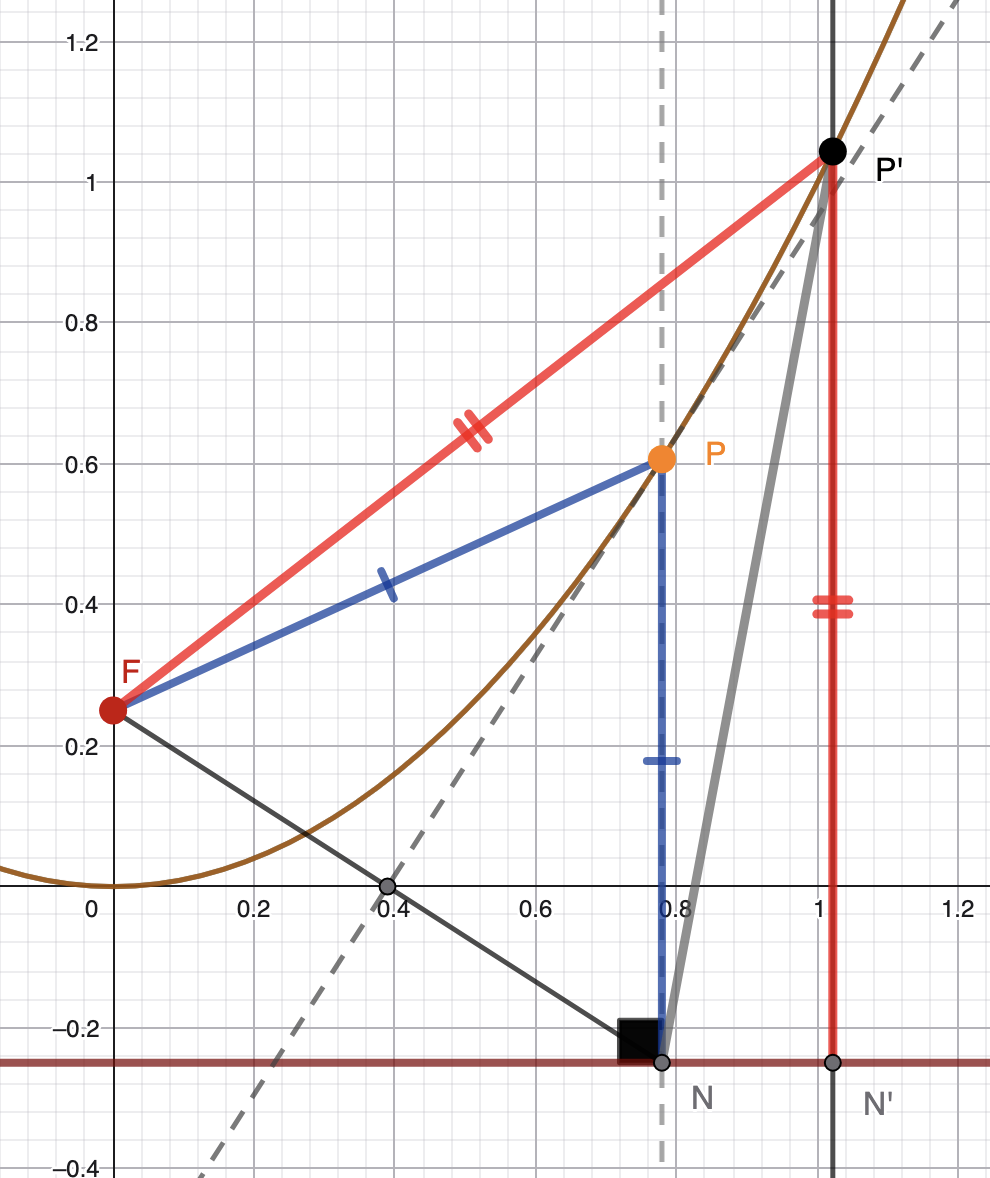
P’ is equidistant from F and N’ while P’N is the hypotenuse of a triangle with P’N’ and therefore P’ is not equidistant from P and N, not on the $\perp$ bisector.
-
That means the perpendicular bisector by definition is also the tangent to the parabola at point P since no other point beside P on the parabola lies on it.
-
Via the congruent triangles one can see the tangent line intersects the horizontal segment through vertex to the $\overline{\rm PN}$ exactly at its midpoint.
-
All three grey angles are congruent (two are from the perpendicular bisector and the last is from the transversal.
-
$\therefore$ that means a vertical wave or ray heading down will bounce off the parabola and hit the focus or put another way every vertical ray will converge at the focus.
Leave a comment