And yet more 15-75-90 fun
Continuing on the theme of 15-75-90 triangles (See: Last time and First Time) several interesting riffs on 15-75-90’s in a box have come up recently.
Example dividing a square with four 15-75-90 triangles:
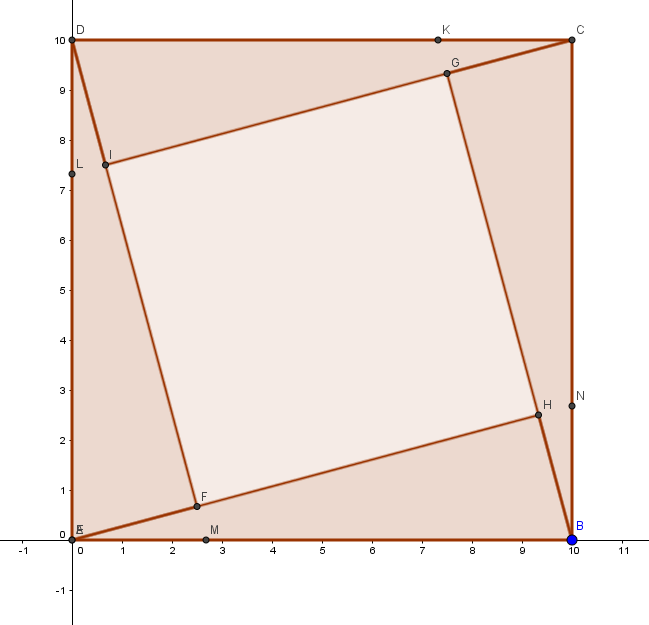
As is often the case, finding the relative area of the triangles and square is straight forward using trigonometry:
Let s be the length of the sides of the square:
The area of each triangle = $\frac{1}{2} s^2 cos(15)sin(15) $ and using the double angle formulas
$sin(30)=2sin(15)cos(15)$ so after substitution and knowing sin(30) = $\frac{1}{2}$ out pops the area = $\frac{1}{8}s^2$
But why is this happening? As usual a 30-60-90 triangle is usually lurking around that allows a Euclidean explanation.
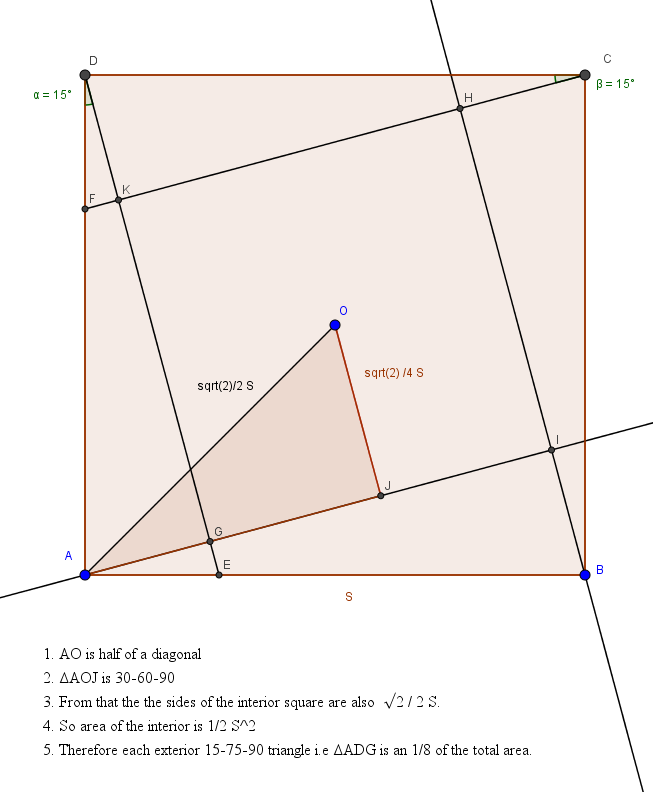
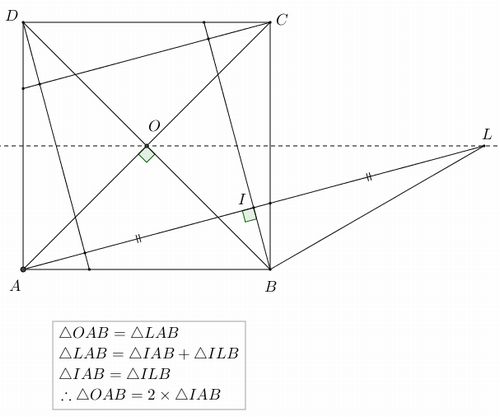
What’s particularly interesting about this is that it hints that dissections exist to transform a 1/4 or 1/8 of the larger square into the triangles and sure enough you slide the 1/4 triangle ABO until it becomes 2 15-75-90’!
!!
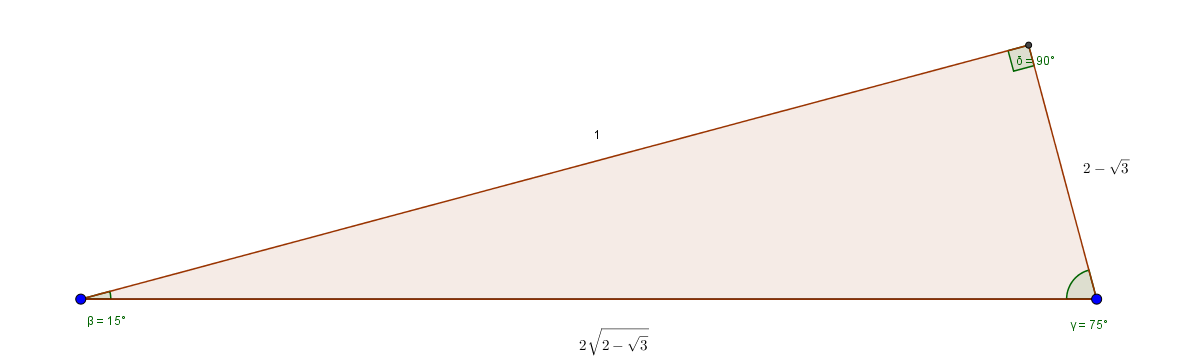
But let’s return to the original problem. There’s another easy explanation of what’s occurring that just uses the ratios of the triangle:
-
Note the area of this triangle is $\frac{1}{2}(2 - \sqrt{3})$
-
Squaring the hypotenuse you get $4(2 - \sqrt{3})$ which is 8 times the triangle area.
-
Or in other words each triangle is 1/8 of the square made on the hypotenuse.
And we’ve refound our original result.
Further questions: Are there other common triangles that divide the square into a unit or “simple” fraction.
I’ll leave it to the reader to decide which problem based on this property is more fun (from @eylem and @sansu-seijin):
!
! Given the square of length 6cm, how large is the shaded region?
Leave a comment