5/22 Cycles and Circles
[Memorial Day delayed me getting this one out. Hopefully it was worth the wait.]
Today’s theme was circle and cycles. The main motivation was the “King Chicken” graph theory problem which I’ll describe below. But after brainstorming a few other semi-related ideas came to mind that I thought would make a coherent session. I also experimented a little bit with format this time. I really wanted a “station” where I could work one on one for a bit longer than normal with kids. So I decided to setup the room with whiteboard problems and have the kids move among the problems and the table where I was curating the graph theory problem. This worked fairly well. I was able to focus more on the problem I wanted to highlight in a small group. The flip side was I did have to get up and refocus a few kids more often than I would have circulating around and I had less insight into group thinking on this part beyond the whiteboard artifacts (But these were all fairly interesting).
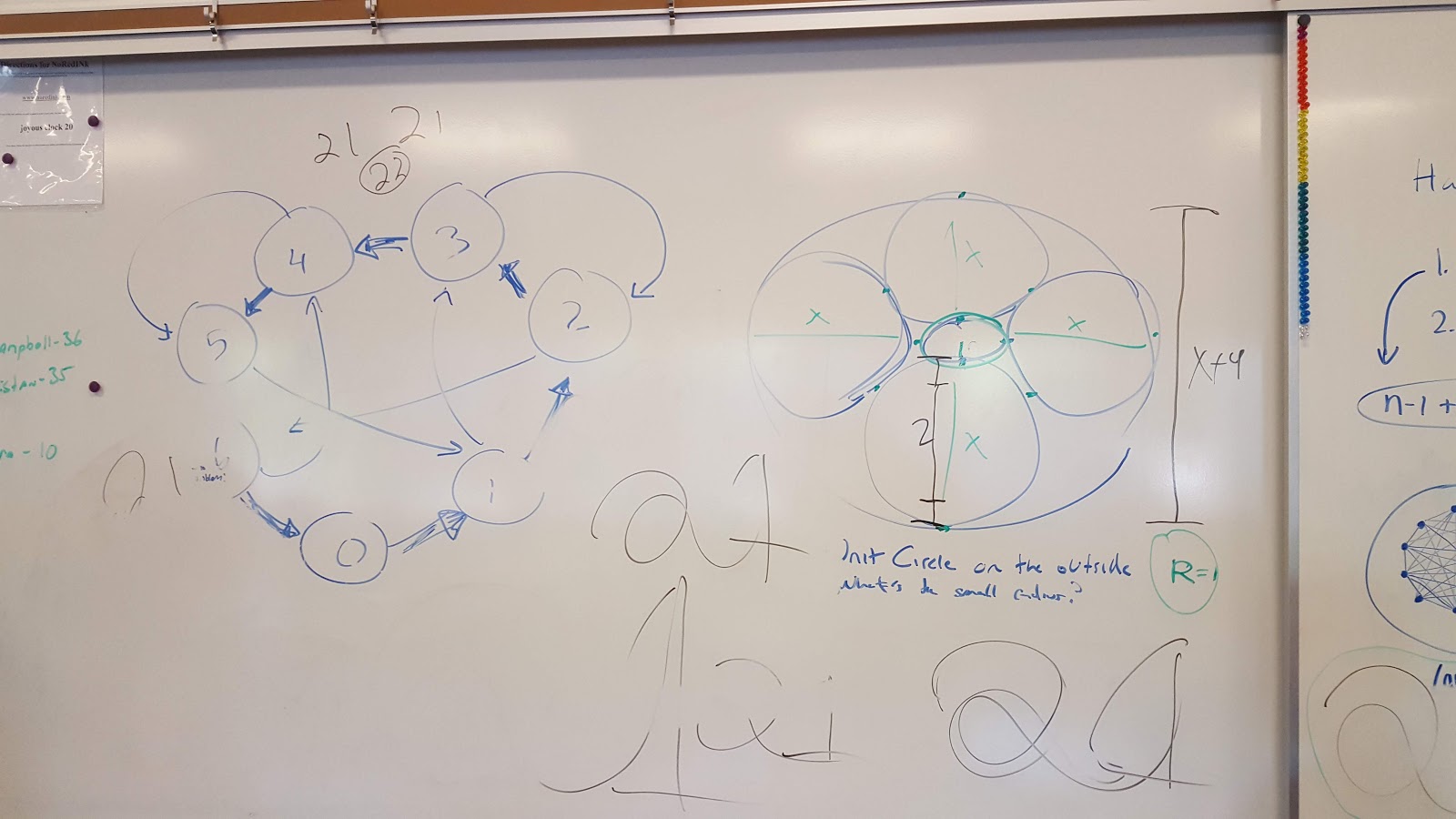
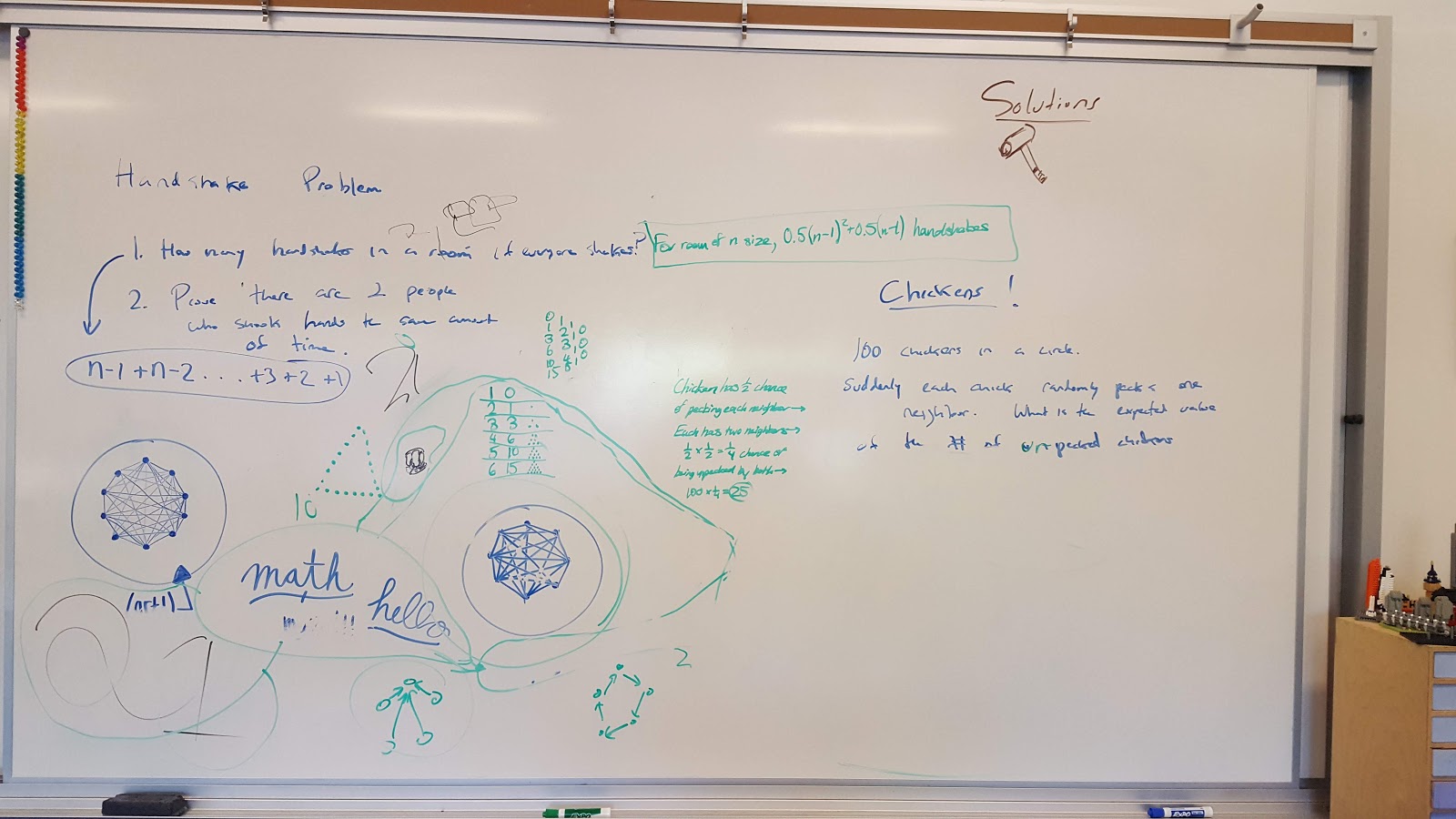
VNPS Carnival I worked through the beginning of the first problem as a group to get everyone going.
[Tanya Khovanova]
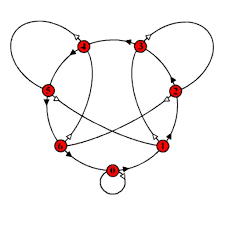
The 7 Divisibility Graph: To find the remainder on dividing a number by 7, start at node 0, for each digit D of the number going from left to right, move along D black arrows (for digit 0 do not move at all), and as you pass from one digit to the next, move along a single white arrow.
Example:547
-
Start at 0 and move 5 places counter clockwise following the black arrows to 5.
-
Follow the white arrow to 1.
-
Move 4 places along the black arrows to 5.
-
Follow the white arrow to 1.
-
Move 7 places along the black arrows back to 1.
The remainder is 1.
After trying this out with the kids supplying some test numbers. I asked them to consider why it worked and if they could come up with a similar graph for divisibility by 13.
Next to this was a geometry problem from “Geometry Snacks” This was probably my weakest thematic link but provided a needed problem and some more variety.
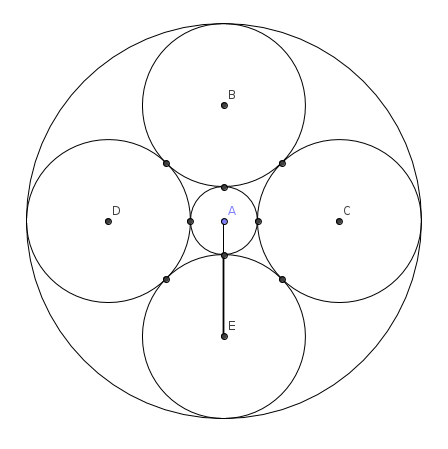
The outer circle is unit circle. There are 4 medium circles B,C,D, and E and 1 small inner one A. All the circles are tangent with each other as shown. What is the smallest circle radius?
Next came a return to the cyclic / graph space with a problem that I suspected was not new for some of the kids. So I added a part 2) with a less well known extension. This one generated the rather interesting circle art in the original photos from one student who was connecting evenly spaced participants on a circle to each other.
Part 1.
N people in a room each shake hands with each other - how many total?
Part 2.
Show that there will always be two people at the party, who have shaken hands the same number of times.
Chicken pecking probability
This was a great linkage and chosen for its connections to “King Chicken”.
The question: In a barn, 100 chicks sit peacefully in a circle. Suddenly, each chick randomly pecks the chick immediately to its left or right. What is the expected number of unpecked chicks?
King Chicken
See the middle of: http://legacy.mathcircles.org/GettingStartedForNewOrganizers_WhatIsAMathCircle_CircleInABox
The main idea is we define a strict pecking order between chickens in a coop and then explore the graph using the idea of “King Chicken” as a motivator.
I tended to emphasize coming up with a definition of what a King Chicken is first. Most kids arrived at the idea of pecking the most other chickens. The thing to emphasize is I’d like a definition where it defines a relationship between a chicken and every other one not just most of the other ones. From there I had the kids explore sample graphs on a size 5 flock:
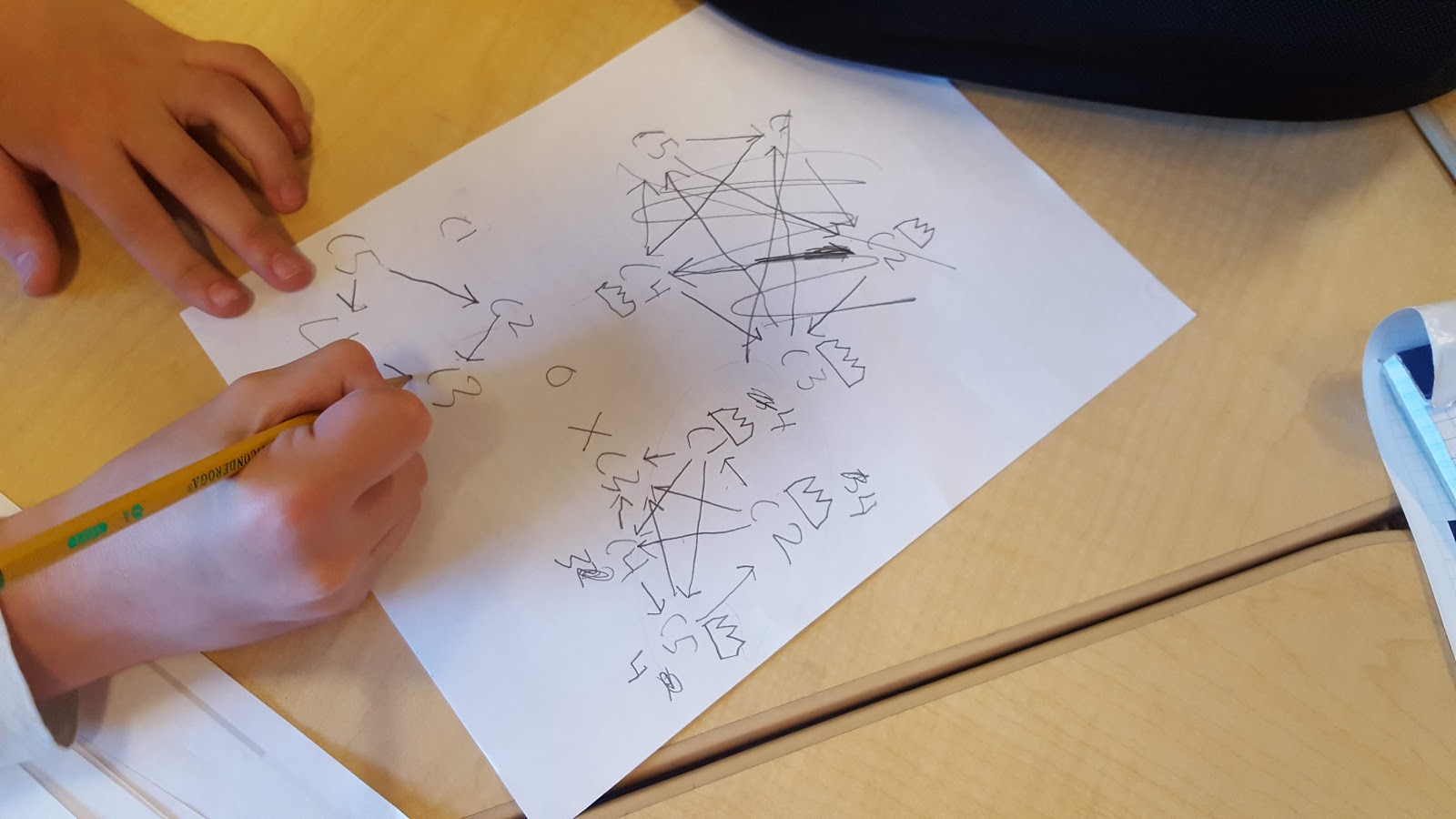
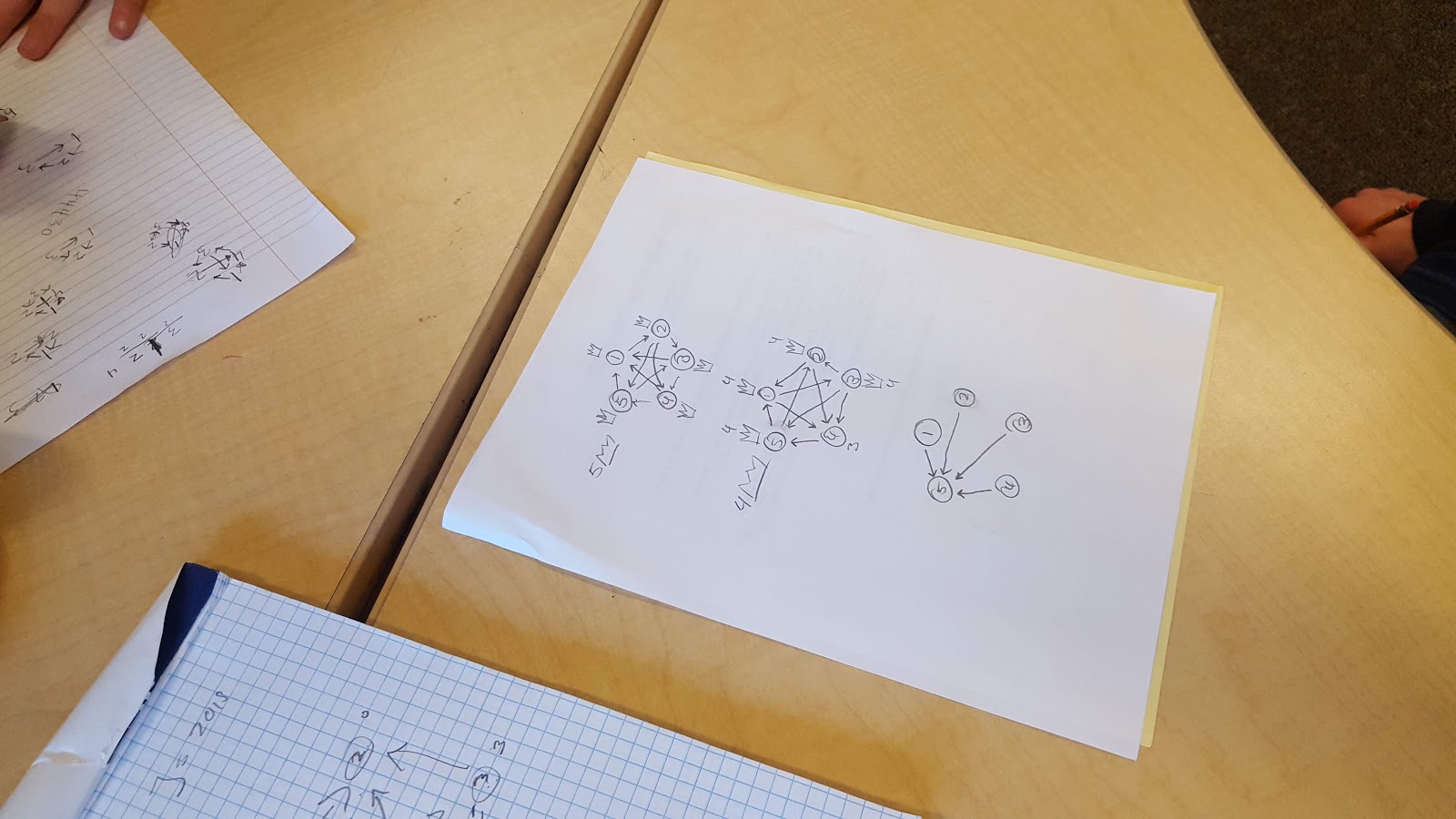
Most of the time was spent on developing ideas about whether we could find configurations with all the combinations 1 King, 2 Kings through 5 Kings. This by itself was probably a 30 minute exercise and engrossing.
P.O.T.W.
This geometry puzzle is actually a bit harder than I realized:
http://www.furthermaths.org.uk/docs/FMSP%20Problem%20Poster%205.pdf
Leave a comment