More connections
I’ve been thinking alot about polynomial deltas recently. See: polynomial-differences. It turns out, that there are a variety of problems where its fun to use them. Basically anywhere you think you have a polynomial function and you can curve fit is a good candidate.
For example: Find a formula for $ \sqrt{n\cdot (n+1) \cdot (n + 2) \cdot (n+3) + 1} $
You could do the algebra and factor cleverly or you could calculate the easy values around 0,1,2 … and calculate the deltas to do a quick fit.
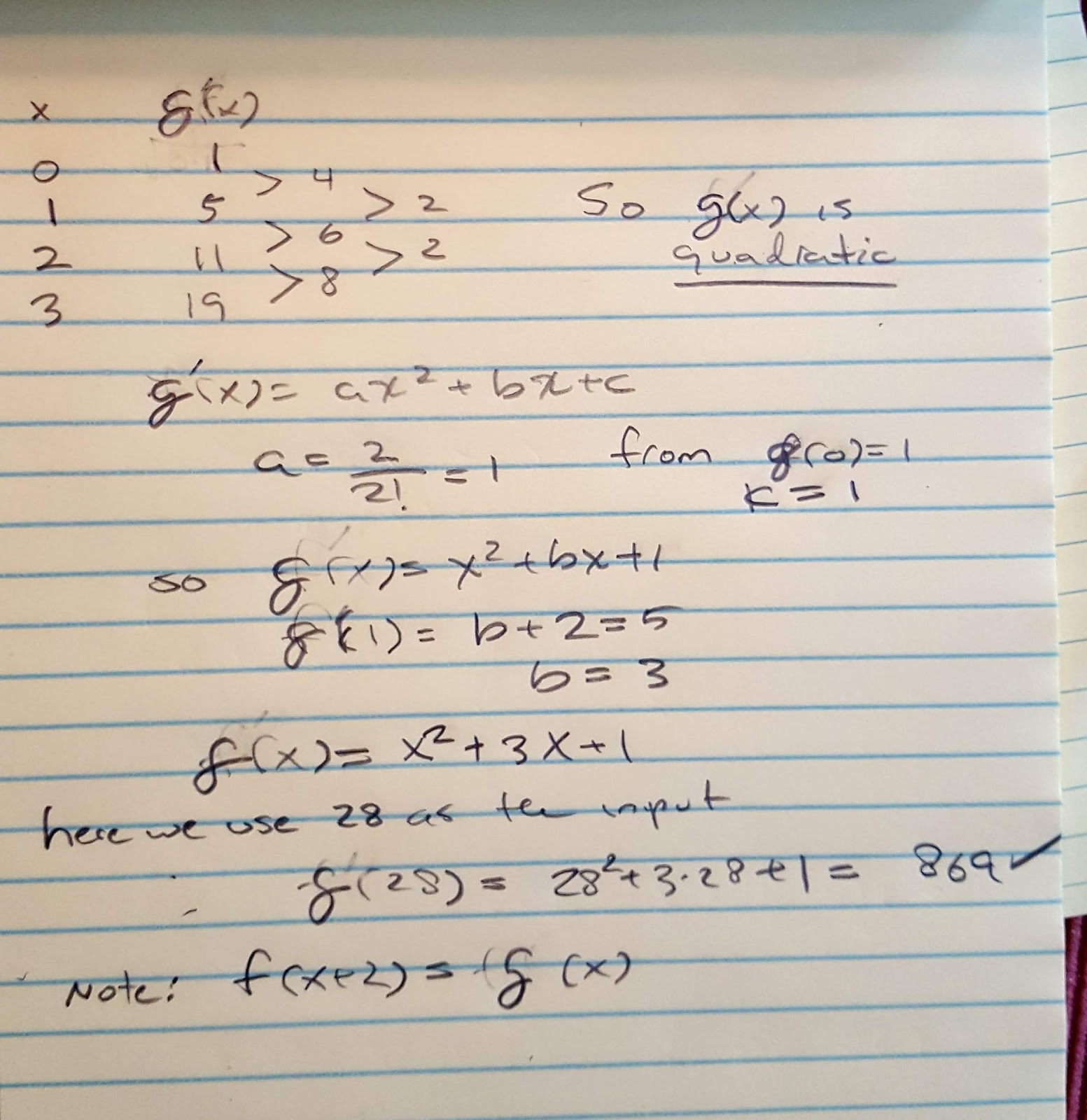
But I thought of another scenario this morning where I think they come in particularly nicely and answer a long standing philosophical question of mine. There’s a class of formulas that are usually proven inductively where one’s often left asking: “How did someone find the original pattern to test?” As a student I would just play around, but now I see these more as curve fitting exercises.
A good example of this is the sum of squares $ \sum_{i=1}^{n}n^2 = \frac{n (n+1)(2n +1)}{6}$
The inductive proof is not hard, and there are some beautiful visual versions (link to proof ) but it was always hard for me to think how this was actually discovered. Enter the deltas ….
When looking for a formula we just need to generate enough values and see if the deltas resolve. If they do its a nth degree polynomial and we can work out the coefficients.
n sum-of-squares deltas
0 0
1
1 1 3
4 2
2 5 5
9 2
3 14 7
16
4 30
This shows its a 3rd degree polynomial of the form $ Ax^3 + Bx^2 + Cx + D$
- from f(0) = 0 we see D = 0
- from the deltas we see $ A = \frac{2}{6!} = \frac{1}{3} $
- We can then substitute in f(1) and f(2) to get a simple system $B + C = \frac{2}{3} $ and $4B + 2B = \frac{7}{3} $
- After solving we find: $ f(x) = \frac{x^3}{3} + \frac{x^2}{2} + \frac{x}{6} $ which combines to exactly our original $ \frac{n (n+1)(2n +1)}{6}$
Note: you could also treat this like a linear system if you can tell what degree the function is likely to be but that’s actually more work anyway in many cases.
Leave a comment