geom walk through 40-40-100
-
Thought process - subdivision creates more interesting angles 2 possibilities 3x/4x or 4x/3x
-
First didn’t pan out despite isosceles and angle bisector.
-
Second created more ability to break everything down into combinations of two lengths.
-
Calc as many values as possible to prove the main triangle is isosceles
-
Went down the path of making a parallelogram on the right. Wasn’t useful but interesting.
-
Eventually found enough similar triangles to make an isosclese in the center and simplified a bit.
Alt:
-
Per trig is possibility.
-
You can translate the left hand subtriangle underneath the right hand one to make an isoscelese parallelogram! That makes its easy since it creates new parallel lines.
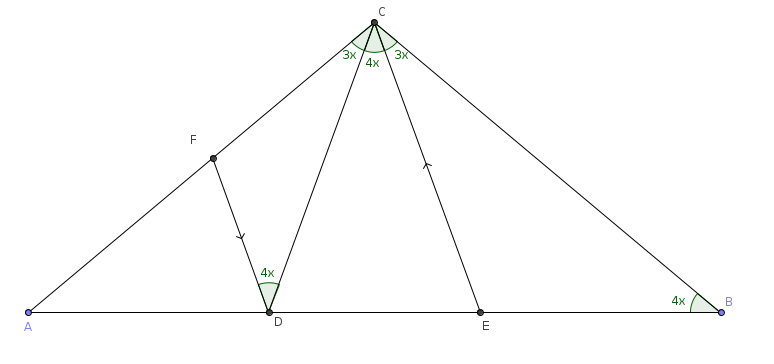
Constructions
- Subdivide $\angle{BCD}$ such that $\angle{BCE} = 3x $ That makes $\triangle{ACE}$ an isosceles and AC = AE = BD. This implies AD = BE.
Let a = AD and BE and b = DE
- Add a parallel segment DF to CE. $\triangle{AFD}$ is similar to $\triangle{ACE} $ and also isosceles so AF = a and CF = b.
Similar Ratios
- By similarity of $\triangle{ADF}$ and $ \triangle{ACE}$ , $ DF = CE \cdot \frac{a}{a+b} $ but triangles CFD and CEF are also similar implying $ \frac{b}{DF} = \frac{CE}{a} $
This simplifies to CE = $ \sqrt{(a +b)\cdot b} $
- Now consider triangles CDE and CBD which are also similar. So $ \frac{BD}{CD} = \frac{CD}{DE} $ or $ CD = \sqrt{BD \cdot DE} = \sqrt{(a+b) \cdot b} $ which is the same as CE above.
So CDE is an isoscleses triangle and and triangle ADC and BCE are congruent. That means 4x = 180 - 14x or x = 10 and $ \angle{CAB} = 40$
Leave a comment