Revisiting the 15-75-90
[This is an old post I kept around which seems appropriate to publish today before AMC 8 (which unfortunately makes for poor blogging fodder)]
I saw a post from Mike Lawler this morning that touched on one of my favorite constructions:
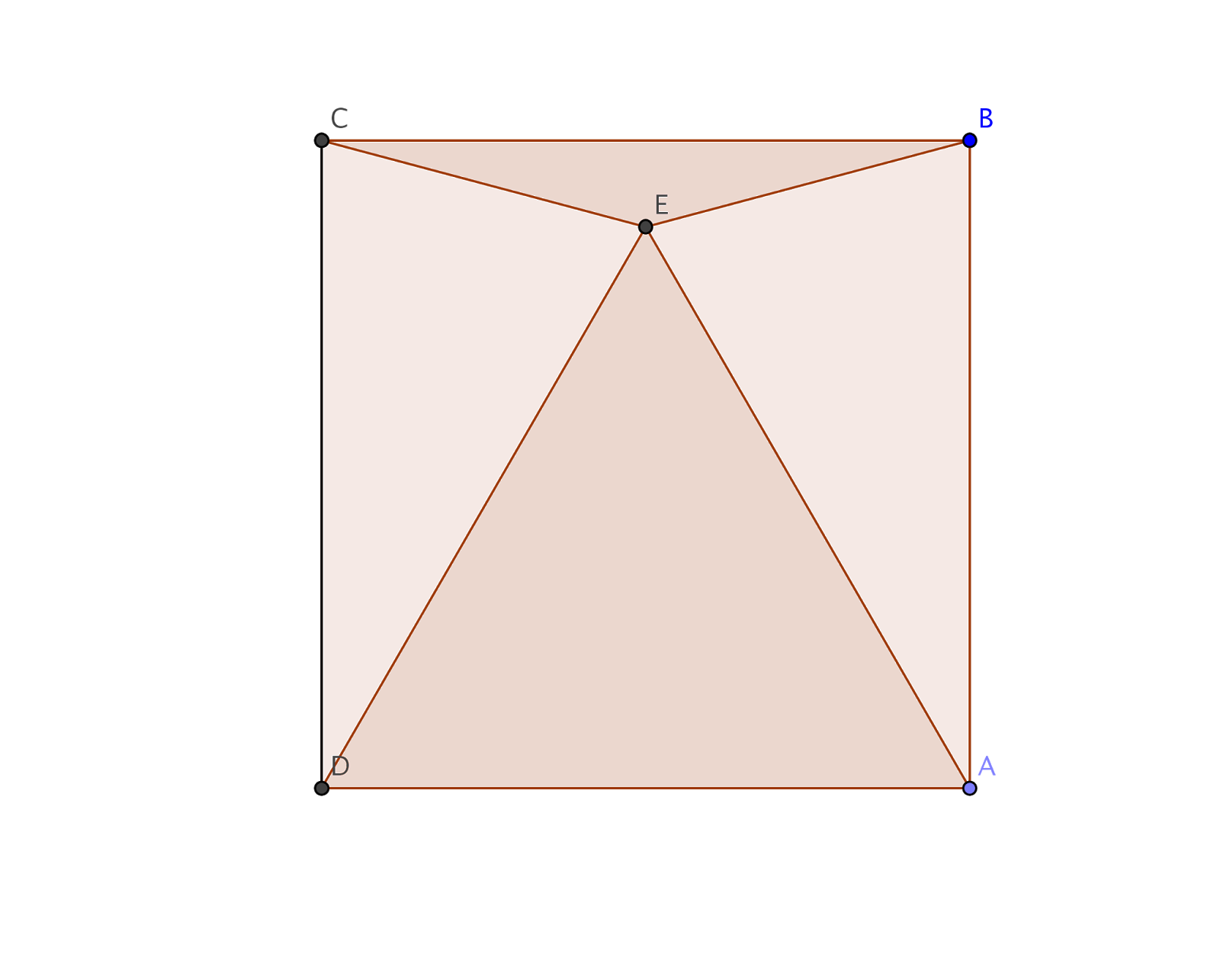
When I glanced at it, my first thought was to go back to my original thinking about the 15-75-90 triangle, two years ago: sometimes-its-harder-the-other-way-part-2
Some followup extensions:
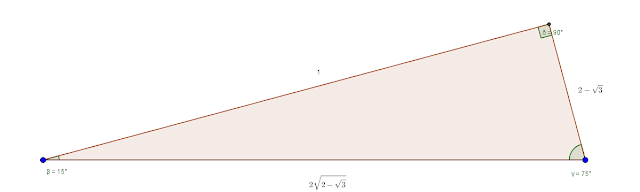
I generally always draw the figure above to derive the exact side ratios rather than remembering them (unless I’ve recently had to use them anyway)
!
In this case as soon as I started doing so, it occurred to me: “Wait this is the same problem. We’re given half of a square, if we just reflect it we end up with my original construction and I already know from that problem, that the square has the same side length as the equilateral triangle whose edge we were implicitly asked to find so the answer is 20.”
In a way this shows the power of experience when tackling more complex problems. As I remember, I spent several summer evenings thinking about the figure before I could see path forward the first time. This time around it was merely a case of recognizing the picture. I also felt it would be fairly unlikely a student would follow that chain of thought. So I also ended up thinking about what other solutions might occur to someone.
In the ensuing two years since I first saw this, another strategy I’ve found that’s very helpful with the 15-75’s is to find the hidden 30-60-90. This time around, I was very tempted to draw in a diagonal from B to D and subdivide to see what was there.
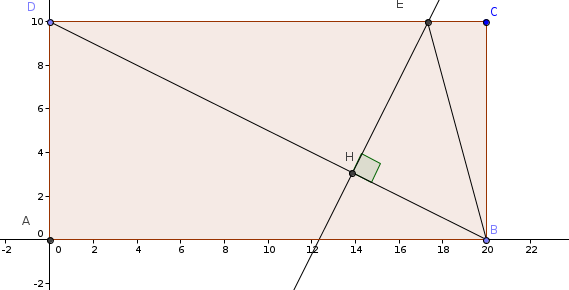
What I found instead was a bunch of 1:2’s like DEH and ABD but I couldn’t quite get a useful expression for triangle BHE to complete this approach. So in another attempt to find the 30-60-90 I reflected the triangle EBC across EB and dropped a perpendicular down from C’ to F.
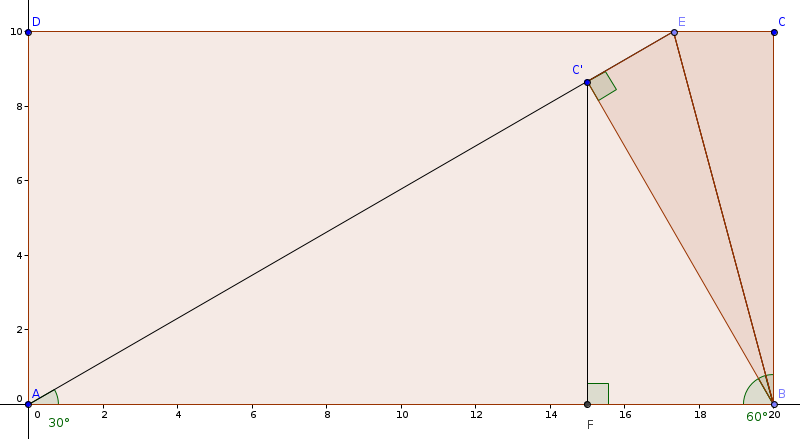
This creates a 30-60-90 at C’BF whose hypotenuse is congruent to BC and has a length of 10 so its base FB is 5 and its other side C’F is $ 5 \sqrt{3} $
Now looking at AC’F next to it we have a right triangle with 2 sides in a $ \sqrt{3} $ ratio so it also is a 30-60-90. That means doing the angle addition that the 3 angle at C’ add up to 180 and indeed C’ is on the line AE.
Triangle AEB is then a 30-75-75 and AE is congruent to AB and of length 20.
Leave a comment