Dot Product Discovery
I was reading twitter yesterday and saw this tweet:
The idea of the last two screens was to figure out that there were lots of different ways to get a dot product of 4 (here’s the overlay of from the last time that I ran this activity) pic.twitter.com/fkFTo1epa1 — Dan Anderson (@dandersod) November 16, 2018
So the last slide that shows all the endpoints of vector v such that the dot product of v and u is 4 is composed of points that make a line perpendicular to u, which is pretty cool… I’m thinking about why that is. — Anna Blinstein (@ablinstein) November 16, 2018
Normally I don’t click through to many Desmos Activity Builder pages that people share so I would have missed this one. I’m glad I didn’t since in this case, it pointed out something I never had noticed about the dot product: If one vector and the dot product itself are held constant, all the end points of the other vector form a perpendicular line.
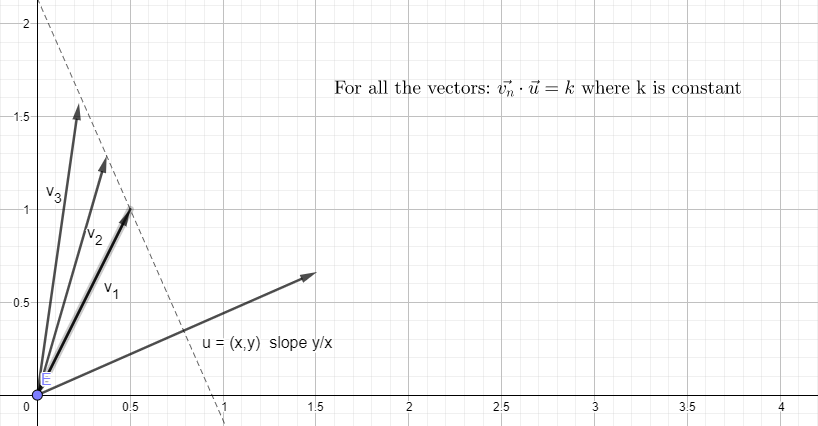
To paraphrase Anna’s explanation:
- Let $ u = (x_1,y_1) $ be one fixed vector and v the other vector that varies and let $ \vec{u} \cdot \vec{v} = k $ where k is constant.
- The slope of u is by defintion: $ \frac{y_1}{x_1} $
- $ \vec{u} \cdot \vec{v} = x \cdot x_1 + y \cdot y_1 = k $ : This is a line with slope $ -\frac{x_1}{y_1} $ Since the slopes are negative inverses this line and the original vector are indeed perpendicular.
Yes but why…
However, I usually find vectors and dot products more intuitive with the alternate definition:
$ \vec{u} \cdot \vec{v} = | u | | v | \cos {\theta} $ So it clearly should also fall out from this definition: but how?
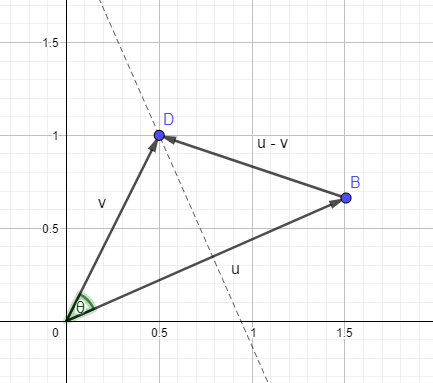
At first I thought this would come from the law of cosines: i.e. $ | u |^2 + | v |^2 - 2 |u | |v| \cos {\theta} = | \vec{u} - \vec{v} |)^2 $ But this didn’t really lead me anywhere beyond tautologies.
Then I went back to basics:
To make things easier without loss of generality I rotated everything so u lies on the x axis. v now decomposes into 2 orthogonal vectors:
$ | v | \cos{\theta}$ and $ | v | \sin{\theta}$
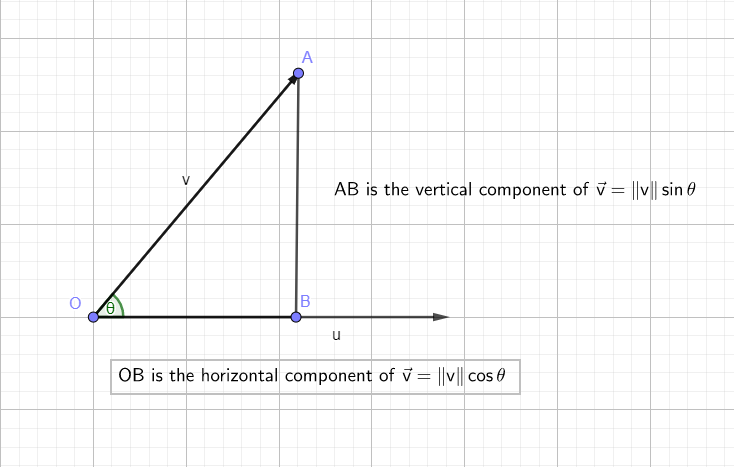
If the dot product is constant i..e $ \vec{u} \cdot \vec{v} = k $ and u is also fixed then we
get $ | u | | v | \cos {\theta} = k $ or $ | v | \cos{\theta} = \frac{k}{|u |} $
Since both k and the magnitude of u are fixed, this horizontal component of the vector v is also fixed and cannot vary. The orthogonal piece, $ | v | \sin{\theta}$ however can be of any length as you adjust either the angle or magnitude of v. So you end up with a string of vectors all ending on a perpendicular!
Leave a comment