The curious case of the equilateral triangle and 3 concentric rings or the hidden angle bisector
Each of the vertices of an equilateral triangle lie on one of the three concentric circles with radii 1, 2 and 3. Find the length of the side of the equilateral triangle
[@zeche63]
Several solutions to this were posted online but I kept thinking about pieces of the problem so I went ahead and started this write up.
First: when looking at the problem, I connected the vertices to the center of the circles. The 3 side lengths strongly suggested the law of cosines to me. All that was missing was the angle. And then I made a small leap. If all 4 points formed a cyclic quad then we could easily get the angle. So I gave it a shot, worked through the law of cosines in this case and found a solution. Most of the online versions I saw implicitly did the same thing.
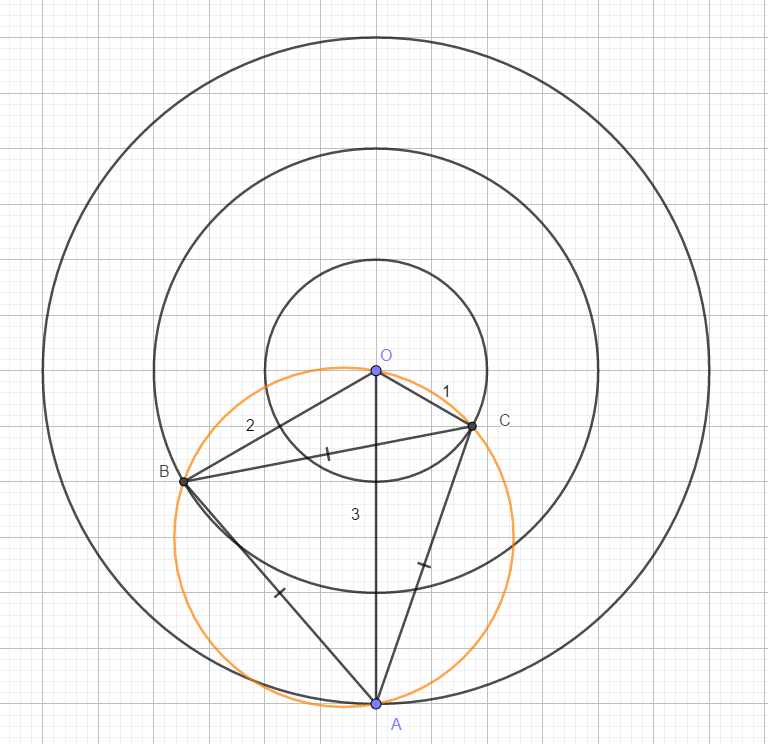
But that’s not really satisfying. Do the 4 points really lie on a circle? There are several ways to prove this is true in general but here the converse of Ptolemy’s Theorem is the one that works. $ BC \cdot OA = BO \cdot AC + AB \cdot OC $ or after putting the values in and letting s be the side length of the triangle: the sides do satisfy the theorem $ 3s = s + 2s $ Based on the cyclic quad it also falls out that $ \angle{BOC} = 120 $ and you can then immediately look at $ \triangle{OBC} $ via the law of cosines.
$ OB^2 + OC^2 - 2 \cdot OB \cdot OC \cos{(120)} = s^2 $
$4 + 1 - 2 \cdot -\frac{1}{2} = s^2 => s = \sqrt{7} $
Or alternatively extend OC to make a right triangle with BC and the extra triangle is also a 30-60-90. So you get $ BC^2 = 2^2 + \sqrt(3)^2 $
[Note: looking at things the other way via Ptolemy’s theorem its also true that $ BC \cdot OA = BO \cdot AC + AB \cdot OC \rightarrow AO = BO + CO $]
But the cyclic quad gives more than just that angle. From it you can also see $ \angle{BOA} = \angle{BCA} = 60 $ and $ \angle{COA} = \angle{CBA} = 60 $ or in other words OA is the angle bisector of $ \triangle{OBC} $ . (For other posts on this theme see: last post on the subject)
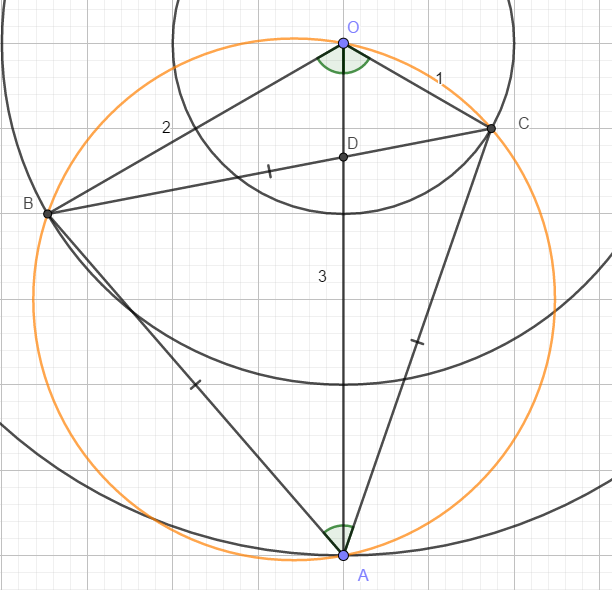
That’s particularly interesting here since via the angle bisector theorem OB : OC is in a 2:1 ratio, BD : DC is also 2:1 i.e. $ \frac{2}{3} s $ and $ \frac{1}{3} s $. In addition, via the cyclic quad triangle BOD is similar to ACD.
So $ \dfrac{DC}{AC} = \dfrac{OD}{OB} $
$ \dfrac{\frac{1}{3}s}{s} = \dfrac{OB}{2} $
$ OD = \frac{2}{3} $ and since all of $ OA = 3, DA = \frac{7}{3} $
Now via the cyclic quad: $ OD \cdot DA = BD \cdot DC $
$ \frac{14}{9} = \frac{2}{9} \cdot s^2 => s = \sqrt{7}$ once again but without any trig or really much more work!
Alternative For comparison here is a more analytic version which is more work but does have the nicety of giving coordinates for the final points:
Let O be (0,0) and A be (0, -3) on the graph.
- Then lets add a vector s = (a, b) to point A to get to C = (a, b -3). The magnitude of that vector is the side length of the triangle $ \sqrt{a^2 + b^2} $
- We now need to rotate the vector 60 degrees to get to B or $ s’ = ( \frac{1}{2}a - \frac{\sqrt{3}}{2}b, \frac{\sqrt{3}}{2}a + \frac{1}{2}b) $
- So B = A + s’ = $ (\frac{1}{2}a - \frac{\sqrt{3}}{2}b, \frac{\sqrt{3}}{2}a + \frac{1}{2}b - 3) $
- Next we get 2 equations from the distances from O for A and B
- Focusing on the 2nd one:
- Now substituting from the first equation $a^2 + b^2 = 6b - 8 $ we get:
- When plugged back into the first equation: $ (\sqrt{3}a -2)^2 + a^2 = 1 $ which factors to $ (2a - \sqrt{3})^2 = 1.$ So $ a = \frac{\sqrt{3}}{2} $ and $ b = \frac{5}{2} $.
-
Now reapply the magnitude formula $ s = \sqrt{ (\frac{\sqrt{3}}{2})^2 + (\frac{5}{2})^2 } = \sqrt{7} $
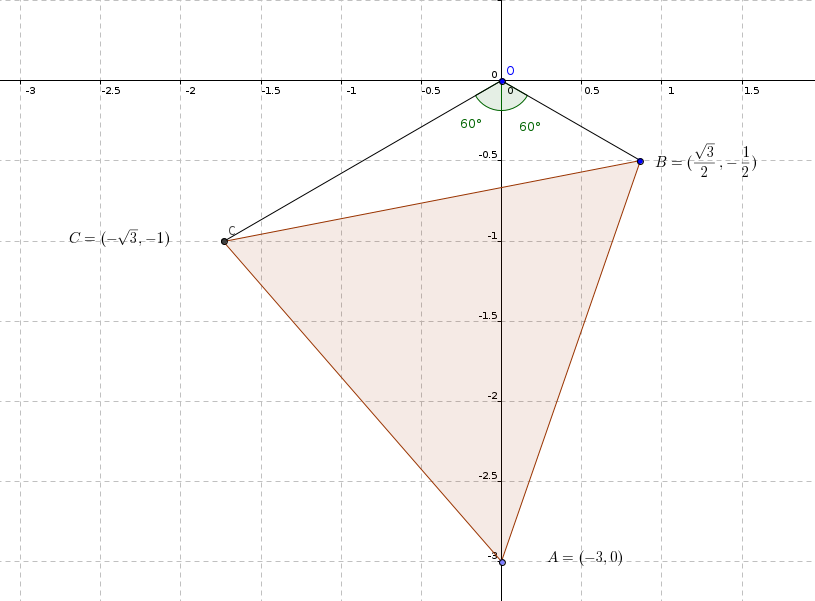
The coordinates of point B seemed suggestive of the unit circle. So I graphed them above and its easy to see the the ratio for the $ \frac{5}{3} \pi $ degree angle and point C is just a 2x scaled version of $ \frac{4}{3} \pi $ This of course brings us full circle back to our observations on the angles via the cyclic quad.
Leave a comment