15-75-90: Attack of the Dodecagon
!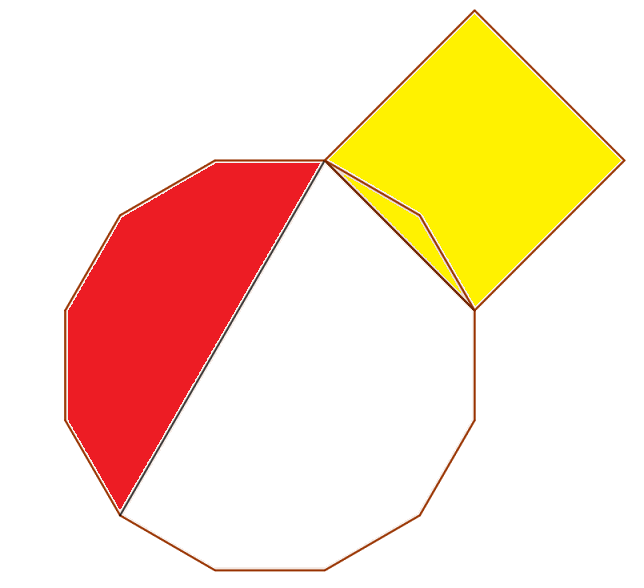
This latest problem is from @le_becachel . Given a regular 12 sided dodecagon: find the ratio of the area of the yellow square to the red polygon.
Because the dodecagon is made up of 12 75-75-30 triangles or alternatively 24 15-75-90’s this one is really also a riff on what is the area of the 15-75-90 triangle. That interested me since with the ratios of the 15-75-90 (See: revisiting-the-15-75-90 for the last time these were discussed) we can readily compute this value algebraically.
Note: all the triangles above are easy to express in terms of the radius of the dodecagon which is also the hypotenuse of the 15-75-90, so I’m going to also express the area in terms of it.
To start: we have the ratios: $1:2 - \sqrt{3}: 2 \sqrt{2 - \sqrt{3}} $ where the last is the hypotenuse. Letting r be that length we rescale to:
$ \dfrac{r}{2 \sqrt{2 - \sqrt{3}} }: \dfrac{r \cdot (2 - \sqrt{3})}{2 \sqrt{2 - \sqrt{3%} : r $
The area of the 15-75-90 triangle then equals:
$ \frac{1}{2} \cdot b \cdot h = \dfrac{1}{2} \cdot \dfrac{r}{2 \sqrt{2 - \sqrt{3}} } \cdot \dfrac{r \cdot (2 - \sqrt{3})}{2 \sqrt{2 - \sqrt{3%} = \dfrac{1}{2} \cdot r^2 \cdot \dfrac{ 2 - \sqrt{3}}{4 \cdot ( 2 - \sqrt{3})} = \frac{1}{8} r^2 $
This can also be seen geometrically by looking at the original construction used to derive the ratios:
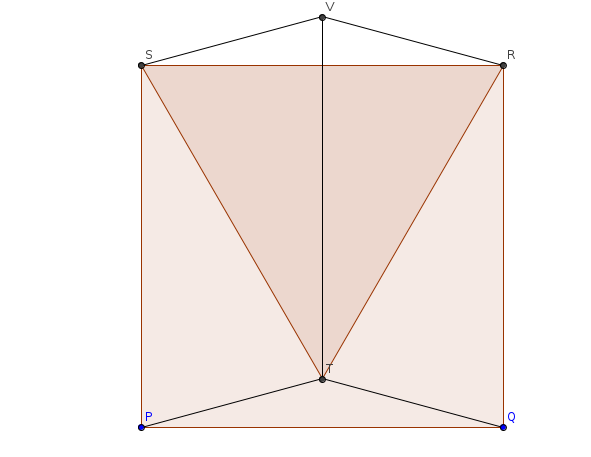
Dividing the square with an equilateral triangle we start off with two 75-75-30 triangles on the side and two 15-75-90 triangles on the bottom. We just have to translate the 15-75-90’s up to the top and we’re left with 4 of the 75-75-30’s each having a long side length which is the same as the square side length. That means each of them is $ \frac{1}{4}$ of the $ s^2 $ the square’s area. And if you divide them in half each 15-75-90 with a hypotenuse of length s must be $ \frac{1}{8} $ of $ s^2 $
Now moving back to the dodecagon which is made up of 12 of these 75-75-30 wedges
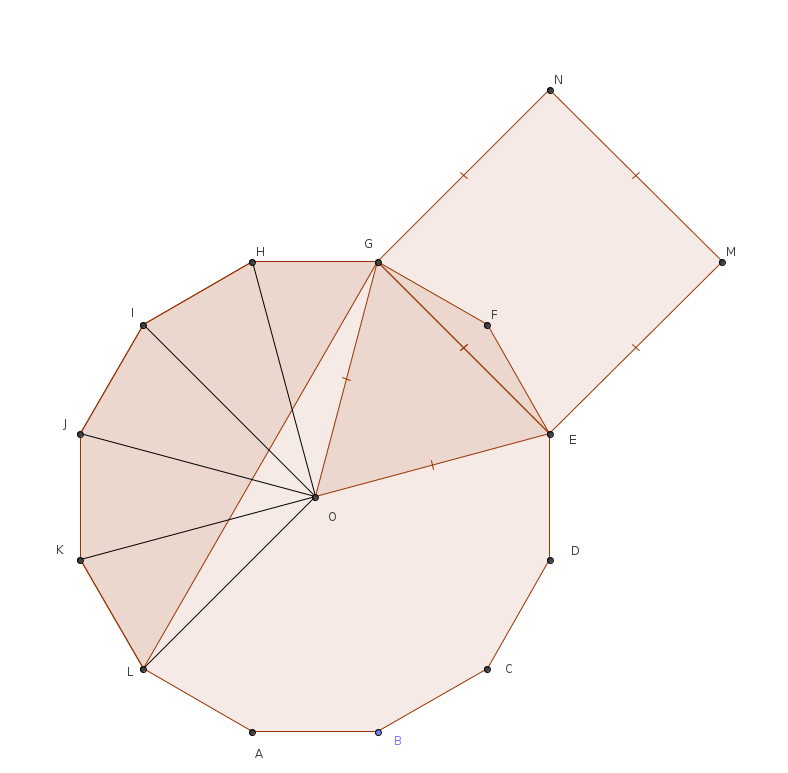
After drawing in the center O of the dodecagon and angle chasing: we find the that side length of the square is also the radius of the dodecagon. That means the entire dodecagon is made up of 12 75-75-30 wedges for a total area of $ 3 r^2 $ or visually 3 yellow squares.
The polygon GHIJKL is made up of of 5 wedges - OGL. But OGL is a 2 15-75-90 triangle with a hypotenuse each of length r. In other words OGL has the same area a wedge and therefore GHIJKL has an area of 4 wedges which is exactly the same as the square!
Leave a comment