Angle Pairs
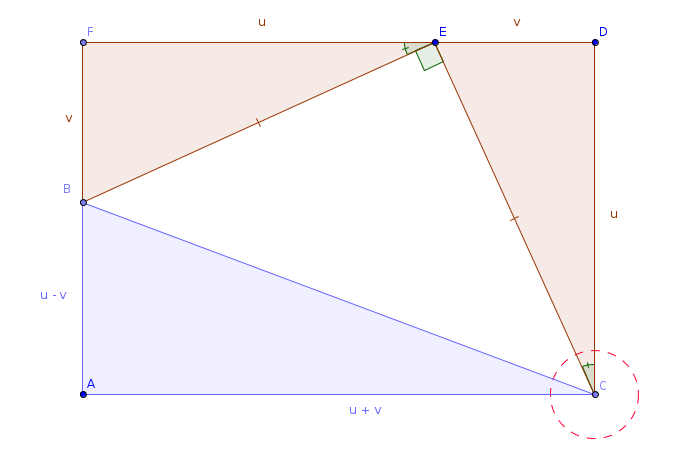
Visual proof that $ \angle{BCA} + \angle{DCE} = \pi / 4 $ or alternatively $ \arctan \left( \dfrac{u-v}{u+v} \right) + \arctan \left(\dfrac{v}{u}\right) = \pi / 4 $
Algebraically: $ \arctan(x) + \arctan(y) = \arctan \left( \dfrac{x + y}{1 - xy} \right ) $
In this case $ \dfrac{u - v}{u +v} + \dfrac{v}{u} = \dfrac{u^2 + v^2}{u(u+v)} = 1 - \dfrac{u - v}{u +v} \cdot \dfrac{v}{u} $
So altogether its the case : $ \arctan(\dfrac{u - v}{u +v} ) + \arctan(\dfrac{v}{u}) = \arctan(1) $
This is a generalization of some of the ideas in: previous post. Its not just the angles in 1:2 and 1:3 triangles that add up to 45 degrees. You can form an infinite number of pairs: 6:16 and 5:11 or 1:7 and 3:4 or 34:96 and 31:65 etc.
Sample Problem that uses this via [@sansu-seijin]:
Find angle x.
There’s more than one way to attack this one. I did it with some complicated computations around the cyclic quads you can form. But the core of the problem’s structure revolves around the relationship above.
Leave a comment