Book Review: Some Applications of Geometric Thinking
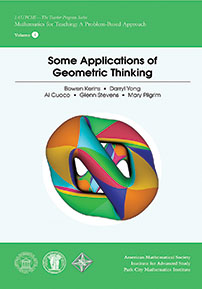
This summer, I’ve been doing a fair amount of Mathematics reading from Strogatz’s “Infinite Powers” to the Intermediate Algebra textbook from AoPS. I also have a copy of James Tanton’s “Solve This” on order which hopefully hasn’t been lost in the mail. But one of my favorite reads so far has been “Some Applications of Geometric Thinking” by Bowen Kerins et al.
I originally found out about this book via a tweet of a variation of problem set 13 on page 48. Personally, I was hooked from the first moment I read the tweet and had to play around and see what was going on.
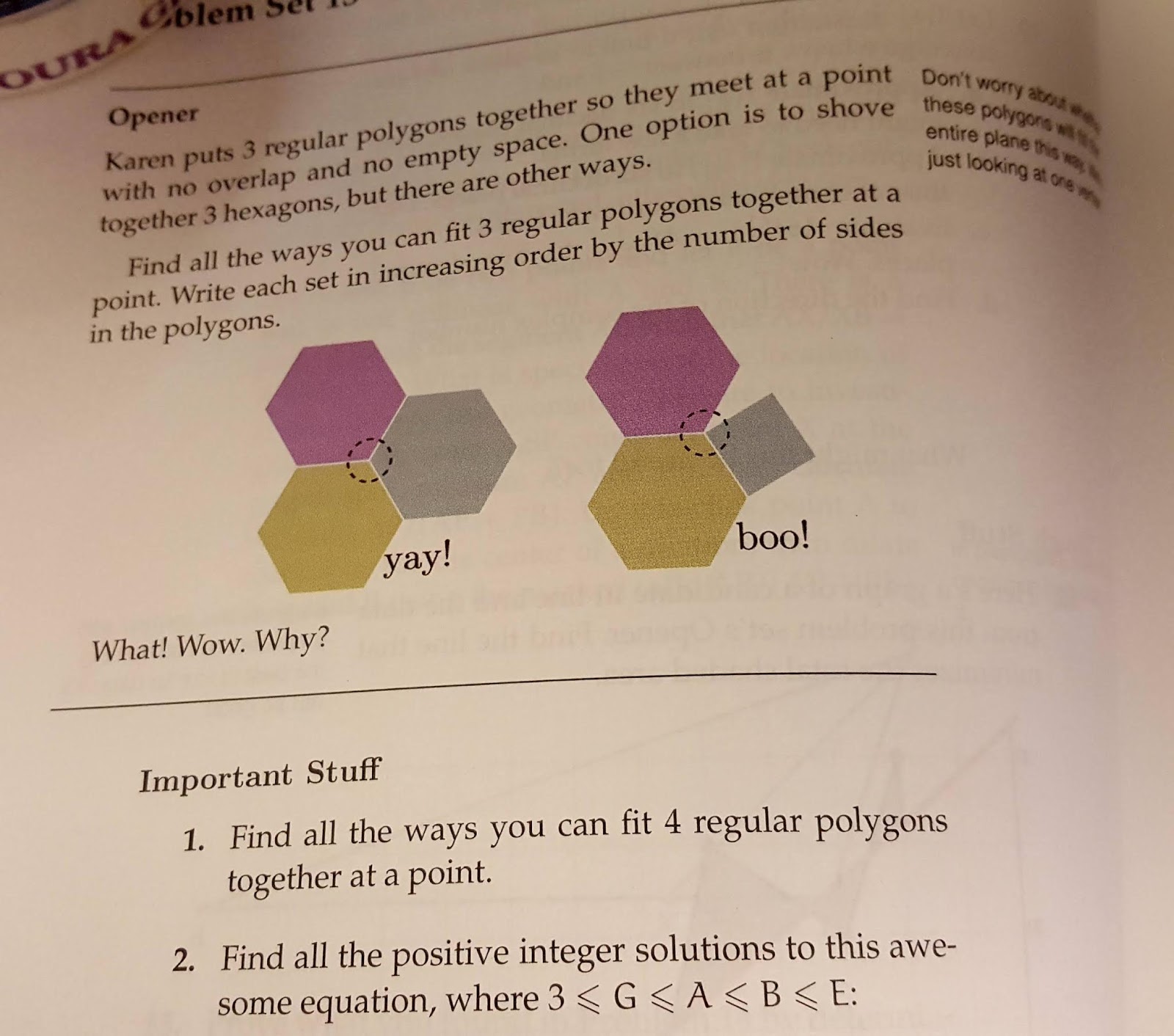
After a satisfying interval, I looked back at the problems and was really excited by the linkage between them. So I ended up running a session with my kids: 415-weve-found-a-correlation. This also went really well. In a second confirmation of intrinsic appeal the kids eventually presented it to the school during STEAM night at our Math Club table.
I decided at last that I needed to own the whole book. So about a month ago my copy finally arrived. The book is divided up into an sections:
- An short introduction outlining the history of PCMI.
- 14 problem sets each a few pages long.
- An extensive facilitators guide for each problem set.
- A solution set at the end.
One thing I immediately discovered was the problem sets were tied to geometer’s sketchpad. As far as I can tell this software has been completely supplanted by geogebra in the intervening years since the book was published. But I don’t think it would be a huge effort to translate the activities over assuming you understand what they are aiming at. Since I don’t have computers anyway at my disposal its moot point for me. Fortunately, the computerized investigations are not fundamental to the problem sets and this is still very usable without them.
What originally attracted me to the book is the high degree of integration between problems. By that I mean there is a fairly novel idea like finding a tangent line via polynomial division that is slowly built up over the course of several different investigations or a parallel modeling of an idea like the solution to an Egyptian fraction problem being equivalent to the geometric question about polygons around a point.
Looking over the whole book, however, I did notice that same themes were repeatedly stressed. This makes sense given how the problems were assembled day by day based on how the participants proceeded. I take this as an acknowledgment that you’re meant to modify as needed. For my group, splitting out a smaller piece made the activity fit properly into our meeting. Given our schedule for the most part I avoid activities that depend on the previous week too much. Not all the kids are here and/or remember everything over the week long gap and I like to reach a satisfying point before we close for the day.
Test Drive To give a better feel of what’s going on I’m going to do an abbreviated walk through part of one of the problem sets: (refer to the page below throughout the next section)
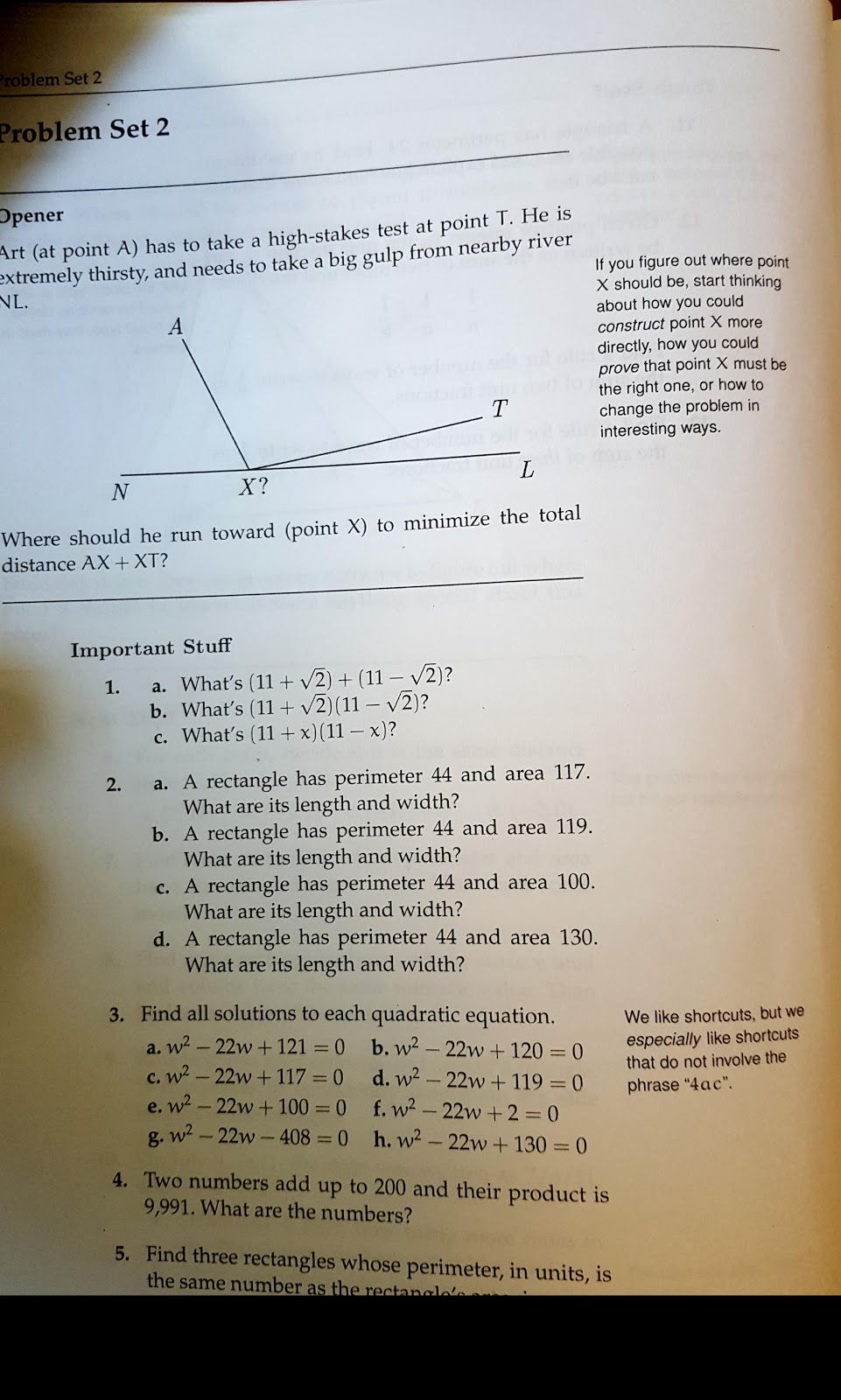
Opener:
This is a classic reflection problem but its given without much follow through yet. The comments on the side are a first glance of the very distinctive tone of the book. They are both informal and chatty. There’s “Important Stuff” rather than Key points and “Neat Stuff” rather than extensions. I’d probably break this out and deal with it in a unified day if I wanted to work on transformations.
Note: what this starts to highlight is how critical prepping and reading the notes is. You really want to understand what the problems look like from the learner’s perspective and how the author’s have imagined them being solved as guides. Some of the connections are non trivial and I often miss guessed what they were going for. (That’s not bad per se but I think its useful to understand the expected flow as well)
Important Stuff
We’re working towards properties of conjugates and differences of square, probably for use in the quadratic formula. But I wonder what kids would make of this? I think I would probably want to do this part as a group with some targeted questions. Look for this to come into use a few questions down.
Note how the same values are going to be reused between problems 2 and 3 with an eye towards connecting geometric and quadratic representations. (And again there is a distinctive remark about not using the quadratic formula). The authors are definitely nudging towards completing the square.
4) This problem also probably wants you to think of differences of squares but its very easy to imagine just solving this in a more straightforward fashion. I think I would need to drive this home in a group discussion because both solutions are very likely.
5) We’re once again driving at the relationship between sums and differences of numbers, completing the square and the geometric interpretation of them as a perimeter and area. At this point again I wonder what the kids would actually find?
Here come some transformations, mostly reflections in this case. But are they driving at the distance formula or construction triangles or equivalent slopes? Nope it turns out we’re looking for circles and perpendicular bisectors. I’d probably start with the line between the points and create the bisector without bringing the circles in. I bet there is a lot of wiggle room for different insights here.
Conclusion
I’m excited to try some more pieces of this book out with the kids this year and figure out more how I want to use the material. Like anything non-trivial I think the hard part will be preparing ahead of time and then managing the group discussions at the end. Also as you can see in my own questions, I think there are a lot of branch points in the discussion that could develop depending on what the kids try out.
Leave a comment