15-75-90 Alternate Forms
Its been a while since I’ve talked about one of my favorite triangles the 15-75-90. So here’s a short post on a new detail that I realized about them the other day while looking at this problem:
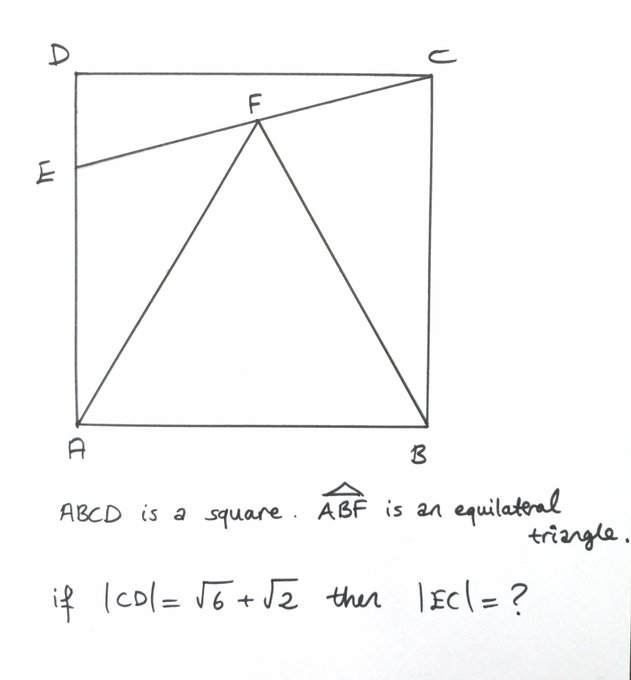
Via an angle chase or perhaps from the Previous Discussion you find the triangle CDE is a 15-75-90. We conveniently already know the ratios of this triangle from several investigations like that one to be:
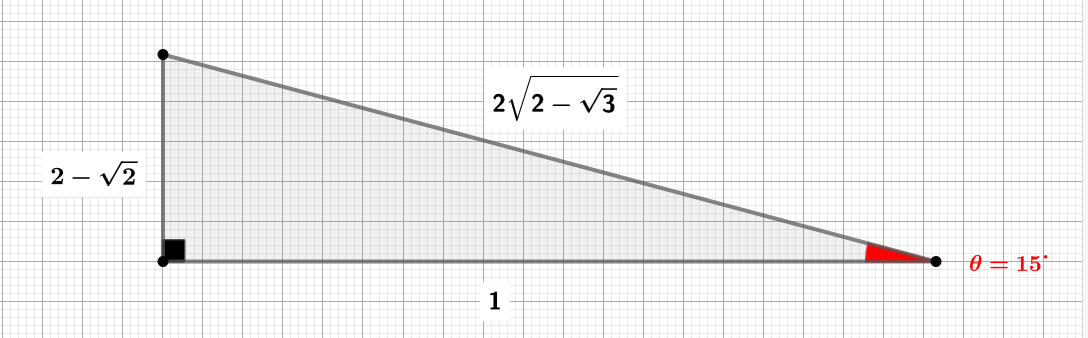
But in this case the long base is $ \sqrt{6}+ \sqrt{2} $ . We could scale directly:
$ EC = (\sqrt{6}+ \sqrt{2}) \cdot 2 \sqrt{2 - \sqrt{3}} $ but that’s pretty messy looking.
So instead we’ll go in stages:
- The short side ED scales to : $ (2 - \sqrt{3})(\sqrt{6} + \sqrt{2}) = \sqrt{6} - \sqrt{2} $ That’s interestingly the conjugate of the CD
- Then we can use the Pythagorean theorem and the conjugates conveniently mostly cancel out: $ EC^2 = (\sqrt{6} - \sqrt{2})^2 + (\sqrt{6} + \sqrt{2})^2 = 16 $.
- So EC = 4.
The whole problem is intriguingly demonstrating the following alternate ratios for 15-75-90:
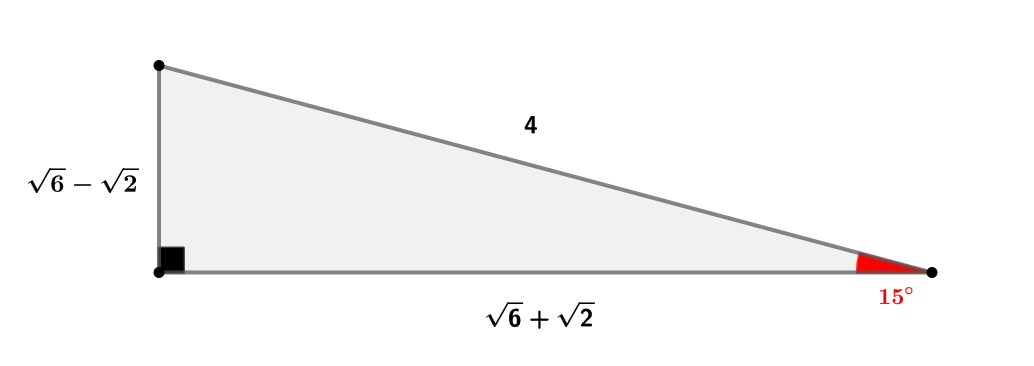
All of which still begs the question: how do we convert directly between the two forms? To do so we look for 2 number a and b such that: $ (a + b)^2 = (2 \sqrt{2 - \sqrt{3}})^2 = 8 - 4 \sqrt{3} $ After expanding that leads to:
- $ a^2 + b^2 = 8$
- $ a \cdot b = -2 \sqrt{3} $
- We can substitute for b and arrive at : $ a^2 + \frac{12}{a^2} = 8 $
- Simplifying we get: $ (a^4 - 8a^2 + 12) = (a^2 - 6)(a^2 - 2) = 0 $
- These two solutions are symmetric if $ a = \sqrt{2}$ then $ b = \sqrt{6} $ and vice versa. So accounting for the sign of $ a \cdot b $ we’ve shown $ \sqrt{6} - \sqrt{2} = 2 \sqrt{2 - \sqrt{3}} $
Note: both forms demonstrate the following defining constraint: the area of the triangle $ \frac{1}{2} ab $ is $ \frac{1}{8} $ of the area of the hypotenuse squared. (See: Prev discussion)
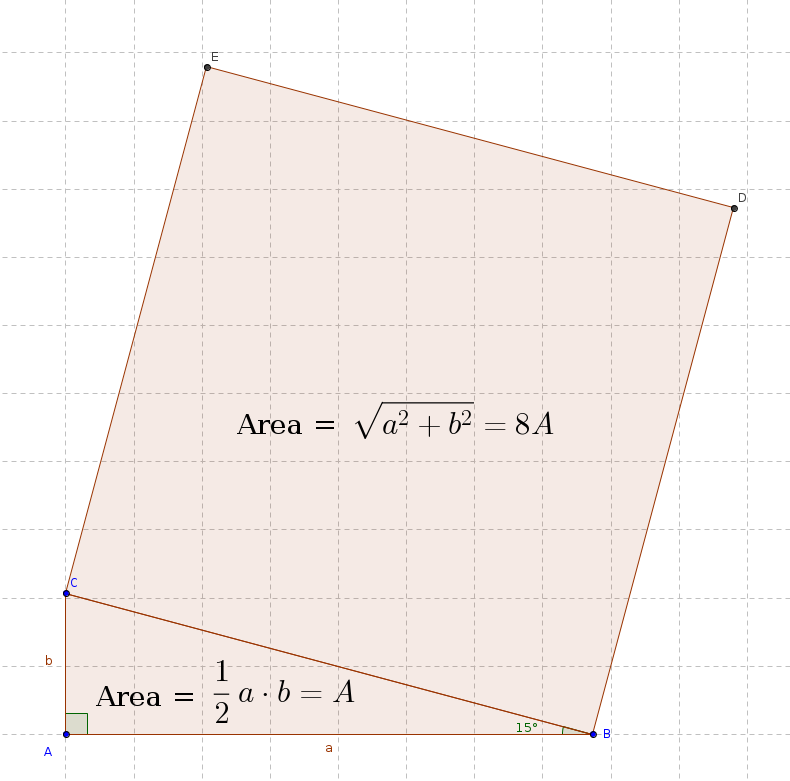
And as seen before this is highly consistent with the trigonometry. (Let s be the hypotenuse of the triangle)
- $ A = \frac{1}{2} ab = \frac{1}{2} s \cdot \cos{15} \cdot s \cdot \sin{15} = s^2 \frac{1}{4} \sin{30} = \frac{1}{8} s^2 $
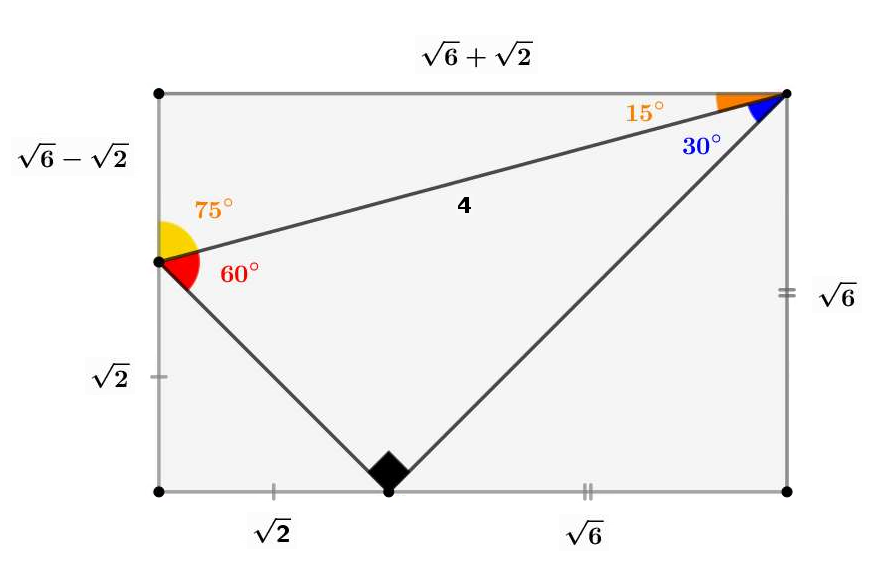
Bonus addon: Colin Beveridge told me about Aille’s rectange which gives another nice construction for deriving these ratios: (See: http://www.flyingcoloursmaths.co.uk/the-mathematical-ninja-and-ailles-rectangle/ for his version)
Leave a comment