Cool walk through for geometric transforms
[Since its AMC 8 today - here’s a geometry walkthrough instead for the week]
[@sansu_original]
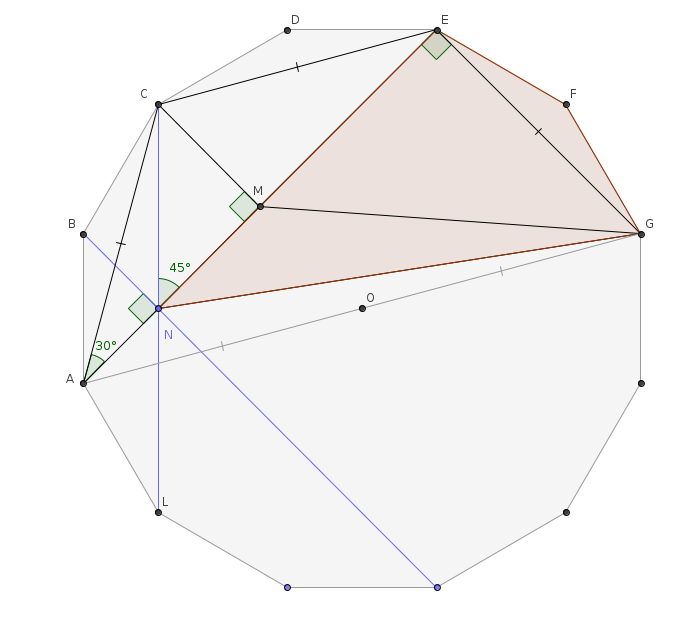 Find the area of the quadrilateral: EFGN
Part 1 - Deal with triangle ENG
-
I’ve added the diameter of the dodecagon AG and then note that connecting the center to 2 vertices like E and G or A and C form an equilateral triangle. So AC = CE = EG = OG = OA = r. Where r is the radius of the dodecagon.
-
From the inscribed angle $ \angle{CAE} = 30 $ and from internal arcs $ \angle{CNE} = \dfrac{\overparen{CE} + \overparen{AL}}{2} = 45 $
-
Dropping a perpendicular down at CM to build a 30-60 we get AC = r so $ CM = \dfrac{r}{2} $ and $AM = ME = r \cdot \dfrac{\sqrt{3}}{2} $ Since CNM is an isosceles right triangle $ MN = CM = \dfrac{r}{2} $
4. We can now find the area of $ \triangle{ENG} $ in parts ENG = NMG + MEG:
$ \triangle{NMG} = \frac{1}{2}MN \cdot EG = \dfrac{r^2}{4} $
$ \triangle{MEG} = \frac{1}{2}ME \cdot EG = \dfrac{\sqrt{3} \cdot r^2}{4} $
There are two things to note here.
- Since the area of the whole dodecagon is $ 3 \cdot r^2 $ one of the 12 wedges that make it up has area $ \dfrac{r^2}{4} $ which is the same as NMG.
- The area of any of the equilateral triangles with a side length of radius r is $ \dfrac{\sqrt{3} \cdot r^2}{4} $ which is the same as MEG.
Part 2: (Rearrange)
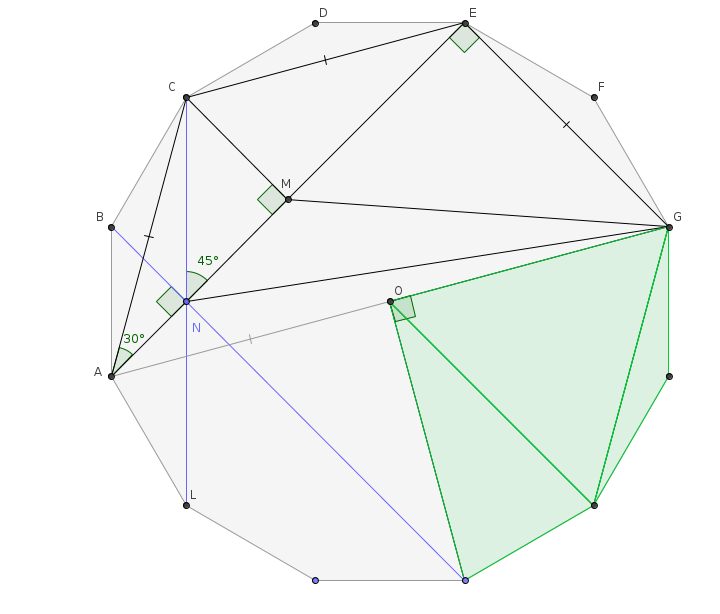
Its easy to show an equilateral triangle, wedge and edge triangle like EFG combine to a quarter
of the whole dodecagon.
So $ \triangle{NMG} + \triangle{MEG} + \triangle{EFG} = \dfrac{3}{4} r^2 $
Note: Directly calculating EFG based on 15-75-90 side ratios we get $ \frac{1}{2} \cdot r \cdot \dfrac{2 - \sqrt{3}}{2} \cdot r = \dfrac{r^2}{2} - \dfrac{\sqrt{3}}{4} \cdot r^2 $
And indeed: $ \dfrac{r^2}{4} + \dfrac{\sqrt{3}} {4} \cdot r^2 + \dfrac{r^2}{2} - \dfrac{\sqrt{3}}{4} \cdot r^2 = \dfrac{3}{4} r^2 $
Leave a comment