Four Triangle in a Box
I ran into an old problem I’ve seen multiple times but apparently never wrote a blog entry on.
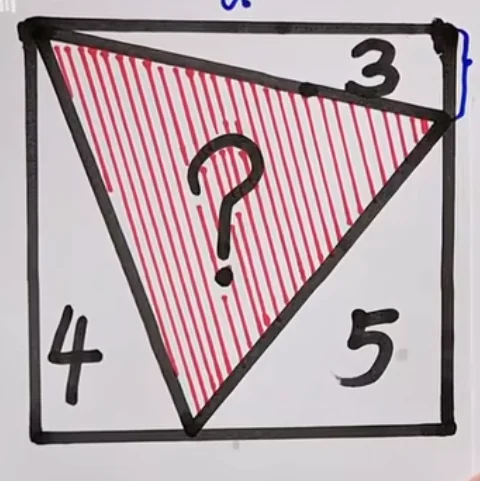
So today, I’m going to finally delve into it. I’ve seen a lot of variants on this in terms of orientation, the triangle areas and whether the outer rectangle is a square. Spoiler it doesn’t matter. The areas by themselves uniquely constrain the area of the remaining triangle tot he same value regardless of the rectangles proportions as long as they fit.
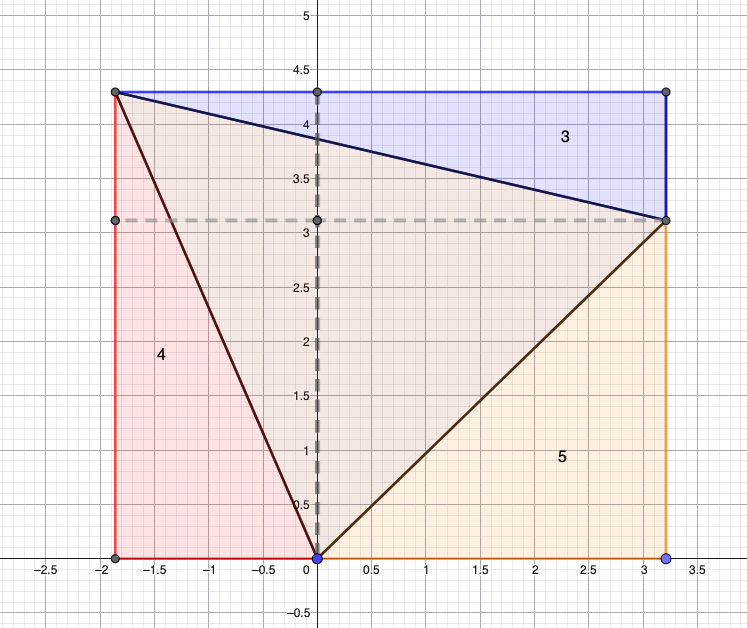
There are several approaches you can take but the simplest and most direct one since you’re given areas is to try to work in terms of areas and not drop down to segment lengths. (That will work but can be much more complicated)
Focal chords in a parabola
Intro
The following problem came up on reddit:
Show that the lines tangent to the parabola at the ends of a focal chord intersect at right angles on the directrix.
This has a nice proof based on the groundwork from post
Setup
Everything that follows will build on the fact the tangents to a point on a parabola lie on the perpendicular bisector of the segment from the focus to the perpendicular with the directrix shown in the previous post.
So to start let’s graph out the basic layout.
Last day of the semester
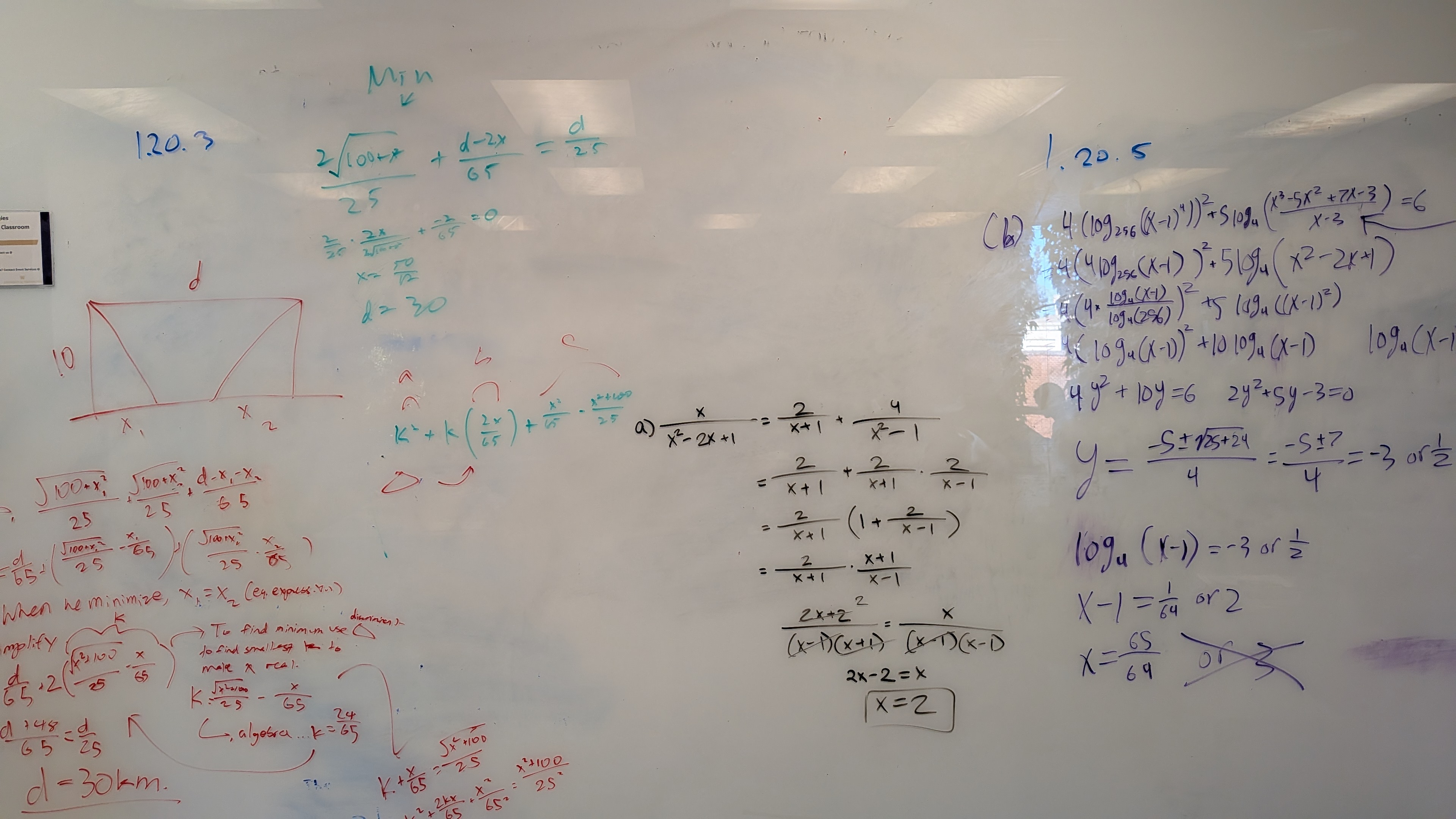
Another year draws to a close
Today was the last day of Husky Math Academy for the year and like all such closures its bittersweet for me. By the end of the year the weekly preparation starts to wear a bit thin. (I really should keep my workings somewhere so I can reuse them in future years rather than deriving from scratch again.) But also typically within about two weeks I start to miss the weekly interactions with the students. This year, the main section I was leading (6 girls and 5 boys) had really good flow most of the time. With a minimum of guidance, everyone in the room, worked really hard and often surprised me with interesting analyses. On the flip side, they were quiet enough that I often found myself cold calling on kids or surveying the room one by one more often as the months went by to encourage more talking. By contrast, the second section was more typical and you would enter the room and it would be quite noisy at first and take a few moments to really settle in.
What did the kids remember?
For the last day I decided to go around and ask everyone what they enjoyed the most during the Spring and two main themes emerged.
- Examining parabolas from the perspective of the Directrix and Focus
- Deriving the Cubic Equation via Cardano’s Method.
There were a lot of comments how everyone enjoyed when I went off the book and looked for extensions of the material.
Looking at a parabola and going off on 4 tangents
As the curriculum sequence is normally presented, we don’t usually consider tangent lines to curves until Calculus. As a result, taking a derivative might seem like the only way to find a tangent. Interestingly, that’s very far from the case. So here I’ll demonstrate 3 other ways to do it without Calculus
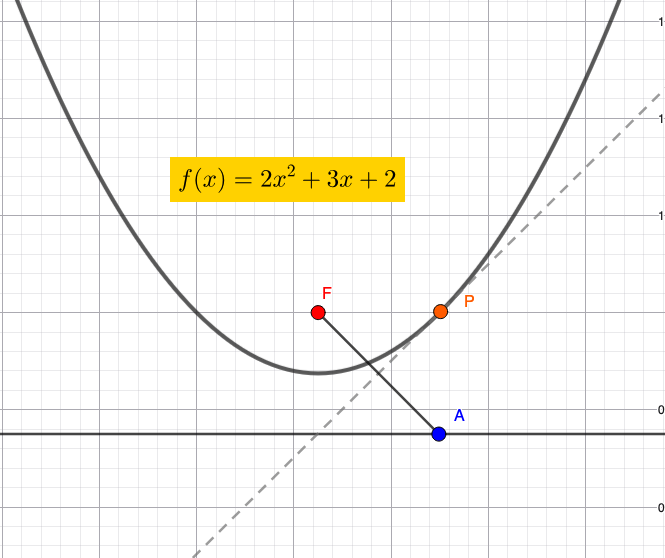
Our test parabola $ 2x^2 + 3x + 2$ and the point P at $(-\frac{1}{2},1)$
Algebra
With only the tools from Algebra I, we can already attack this problem.
-
First let’s assume there is some tangent line $y = mx + b$ that goes through b. In this case its more convenient to use point slope notation. $ m = \frac{y - 1}{x + \frac{1}{2}}$
Reflective Property of a Parabola
Reflective Property of a Parabola
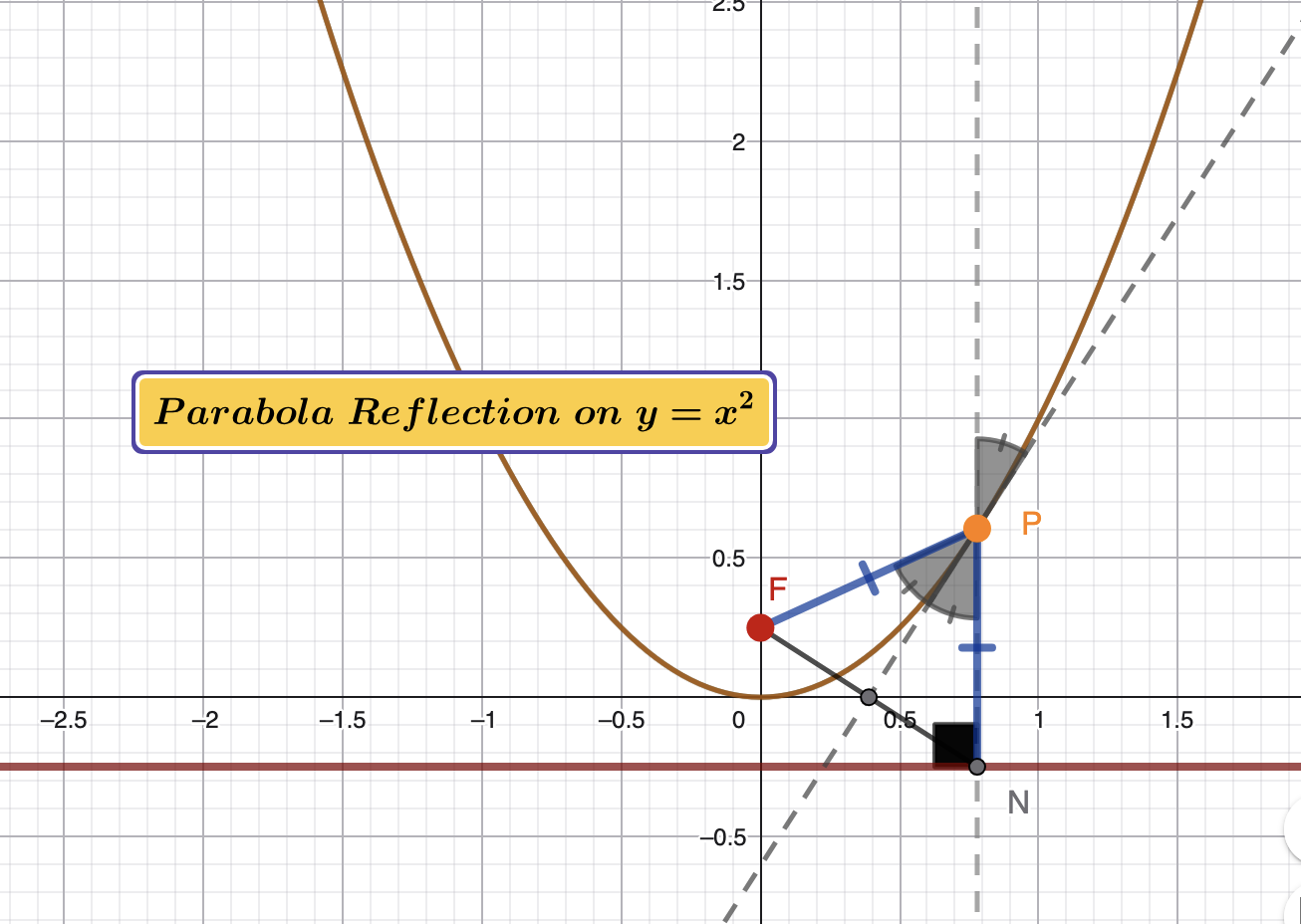
We’ve been going the reflective property for a parabola in class and I wanted to make my own diagram to illustrate a few nice points (and all without calculus).
First without loss of generality I’m going to use the simplest quadratic equation $y=x^2$ but remember “There is only true parabola”
That said to set the context, for this parabola the directrix is at $y=-\frac{1}{4}$ and the focus F is at $(0,\frac{1}{4})$
-
By definition every point P on the parabola is equidistant from the focus F and a perpendicular line down to the directrix $\overline{\rm PN}$
Two Boxes in a Circle
The March MathsJam had an interesting geometry puzzle.
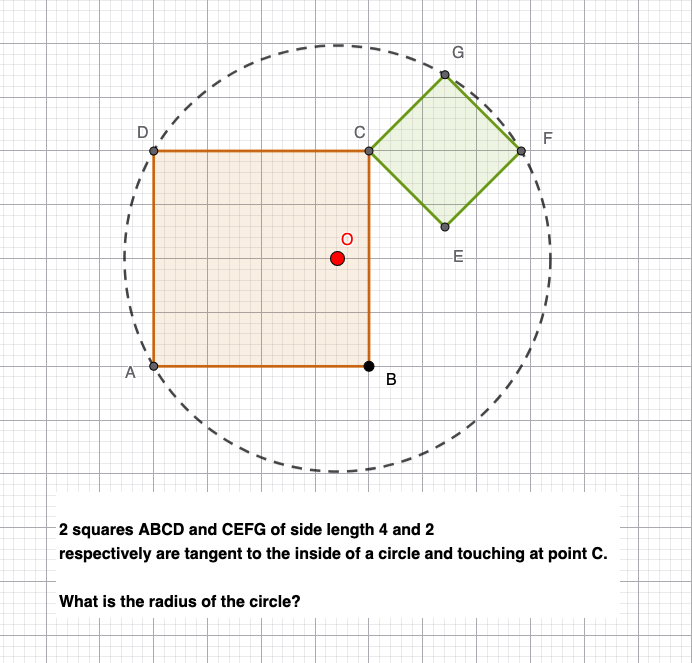
In the course of the evening, we noodled on this for a while and initially made no progress. So I decided to model it in geogebra to confirm whether there was a unique solution. What I found visually was that there appeared to be one when the smaller box was tilted 45 degrees. And that was in fact not hard to confirm because the triangle DFA inscribes the diameter in that case, along with the triangle FGA. You can then solve with the Pythagorean theorem and verify that they give the same result in this configuration.
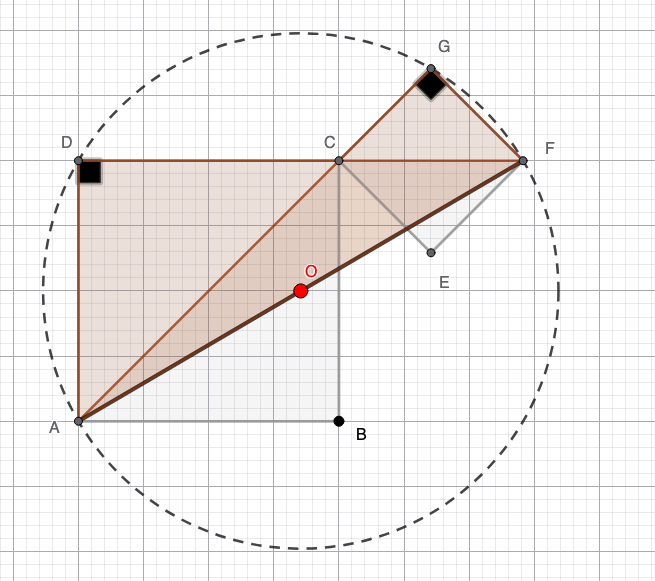
\(\text{the diameter: } AF^2 = AD^2 + DF^2 = 16 + (4 + 2\sqrt{2})^2 = 40 + 16 \sqrt{2}\) \(\text{and also the diameter: } AF^2 = FG^2 + AG^2 = 4 + (2 + 4 \sqrt{2})^2 = 40 + 16 \sqrt{2}\)
But this isn’t entirely satisfying because it basically presumes that answer and confirms it works and it doesn’t settle whether this is the only answer.
New Beginnings
I’m back

It’s been a long 3 years. In the course of Covid and life changes, I took a hiatus from my the old blog site and in the interim it broke down. But the itch to post math related posts has been growing along with the desire to migrate off of blogger and onto to a more open source platform.
Two Hinged Triangle Geometry Walk Through
Setup
It’s time for another geometry walkthrough motivated this week by this interesting problem from James Tanton.
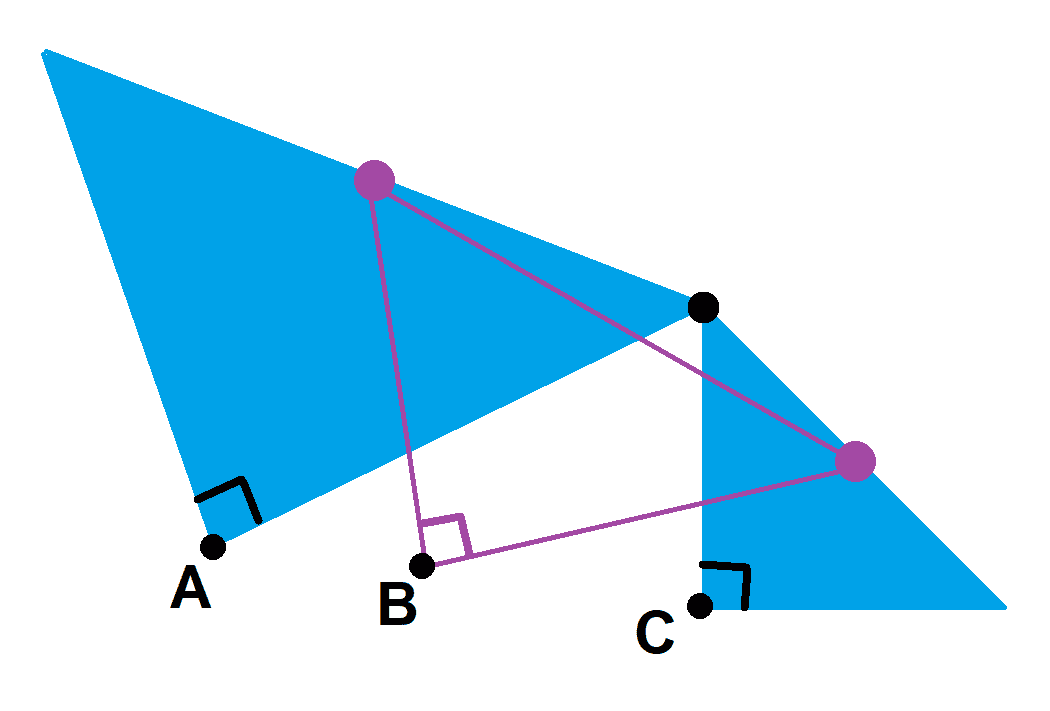
“Two isosceles right triangles are hinged at corners as shown. Line segment connecting midpoints of their hypotenuses is used as the hypotenuse of yet another isosceles right triangle.
Prove A, B, C lie on a straight line. Can anything be said about where B sits on segment AC?”
Trig identity Three Ways (at least)
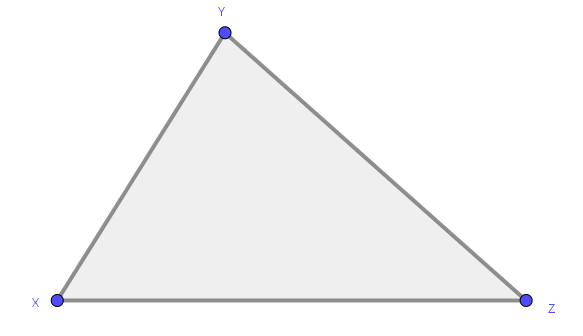
This post starts with reading elsewhere about someone struggling with the following trig identity given a triangle with three angles x, y, z show:
Mastodon: The Wild Wild Neolithic West
Its been a long while since my last social media post: how-i-use-twitter and everything is all of a sudden in huge flux. With all the turmoil on Twitter I’ve been exploring Mastodon on the math focused server a friend runs: mathstodon.xyz. However, a new platform means starting over again
- You have to rebuild your network of follows and followers. This is huge and discovering people has made my previous two attempts at using Mastodon unsatisfying. But this time is different due to the chaos at Twitter. Large enough groups of people I know have migrated that I could start with a core group of folks and participate in enough conversations to have fun while finding new people.
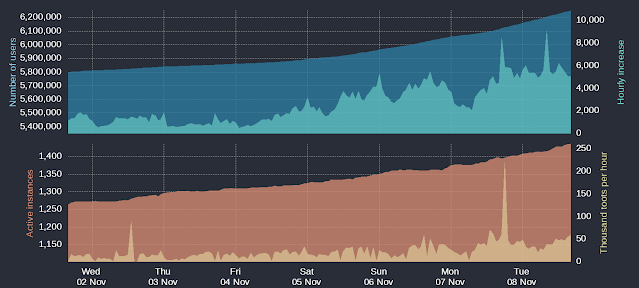 Why things are vital this time - The extraordinary growth of the network
-
Peculiarities. Mastodon isn’t twitter and has a few quirks that you have to get used. No quote tweets due to a fear of harassment (which seems overly paranoid to me - since you’re just a screenshot away from the same effect) and a general stance that makes discoverability harder. You have to use hashtags since full text search doesn’t exist across the fediverse. And sometimes the other instance’s data is an extra hop away from your server . For instance, you’re surfing a profile on another server and sometime have to click to it to get full info. Crucially, since each instance only stores the posts that users on it follows - there is a **deep effect on search **even for hashtags. You can only see what you know about or someone else on your instance knows about. As a consequence, the larger the server grows the more useful it becomes if you’re interested in finding things . There’s also an overly precious stance on content warnings that doesn’t fit my theory of action. But I can live with that.
-
Usability Once you have enough people in your network Mastodon is quite usable despite the large discoverability issues. Can it be your only microblogging platform? That remains an open question for me. The overall network is much smaller than twitter. I don’t need most of the twitterverse though just the parts I read. And on that front - the missing piece is probably government and media accounts. For now there are bridge sites like birdsite.wilde.cloud that will publish tweets to toots. But they aren’t quite realtime or completely reliable. But the network is growing very rapidly (See above) so the situation could very easily shift in the upcoming months.
-
Trust. This is a huge general issue. I went with mathstodon because I knew the admins and could implicitly assume they would operate in good faith. But how are millions of people going to make that leap? I feel like there needs to be some type of vetting process or change in structure for many of the instances to answer this question. Perhaps there will be multitudes of small sites where everyone personally knows someone involved - perhaps companies will enter the space and you’ll pay for some additional guarantees of stability/security? This also remains to be seen and I expect new developments as growth continues. But that’s the key as well - the network is growing despite this issue so its not an adoption blocker yet.