Distributive Law Worksheet
The Distributive Law
!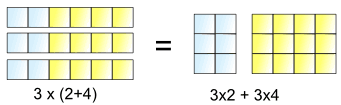
Multiplication distributes over addition: a(b +c) = ab + ac. We sometimes talk about factoring out a number using the distributive property ie. 81 + 45 = 9 * (9+5)
Problems:
Compute $51 \cdot 9 + 51 \cdot 31$.
What is the value of $17 \cdot 13 + 13 \cdot 51 + 32 \cdot 13$?
What is $a(b + c + d +e)$?
what is -(6 + 8)?
What is $-1 \cdot (5 - 9)$ also written $-(5 - 9)$?
What is $-(x + 1)$?
What is $−1 \cdot(a - b + c - d)$?
Find numbers a, b, and c such that $a + (b \cdot c)$ is not equal $(a +b)\cdot(a+c)$ In other words show we can NOT go the other way and distribute addition over multiplication.
Take a look at the first perfect squares from $1^2$ to $10^2$. Do you see a pattern to what number is in the units place?
Can you use the use distributive law to show why $8^2$ and $2^2$ for example end in the same digit. Hint: 8 = 10 - 2. Try the same technique with another pair of numbers.
We can also use the distributive law to show why a negative times a negative is a positive. Pick any two negative numbers x and y then try using the distributive law to find the sum $x \cdot y + x \cdot -y$.
Factor out x from $6x + 9x$.
Factor out x from $6x + 9x^2$
What is $x\cdot(9 +x)$?
What is $(x+1)\cdot(x + 1)$? (Hint use the distributive property multiple times)
What is $(x - 1)(x - 1)$?
*What is $(x -1)(x + 1)$?
The above answer lets you do a neat trick. Can you multiple $19 \cdot 21$ in your head? Using the above formula we can think of it instead as $(20 - 1)\cdot(20 + 1)$. What does that equal?
Try doing some other examples with a partner without writing anything down.
What is $(a + b)(c +d)$?
Multiples/Divisibility
We say a number x is a multiple of another one n if we can find another number such that
$x = y \cdot n$. Example: 20 is a multiple of 5 since $20 = 5 \cdot 4$. Can you use the distributive law to prove that if you add two multiples of the same number n that the result is also a multiple of n.
Example: 20 is a multiple of 5, 35 is a multiple of 5. 20 + 35 = 55 is a multiple of 5. How about if a number is not a multiple? For example 11 is not a multiple of 5. Is there a pattern for what numbers you can add to 11 to get a multiple of 5?
Leave a comment