10/18 More divisibility
After a slow start last week, this time almost all of the kids in the Math Club finished the problem of the week. (See the end of this post) I had one of the boys demonstrate his solution on the board. He’s one of the slower but more careful writers and almost always shows something interesting. So I tend to ask questions to the room to keep everyone involved while he gets his thoughts written down.
In point of fact, I don’t really have any kids that are good at talking simultaneously while they write on the board. That appears to be a learned skill. So in the beginning of almost all student work on the whiteboard I usually choose between narrating what’s being written or asking background questions to prep the room. One of these days I’d love to see what other people do.
As an amusing side note I found a very similar variant on the puzzle in the Moscow Math Club diary book I was rereading this weekend. (See below)
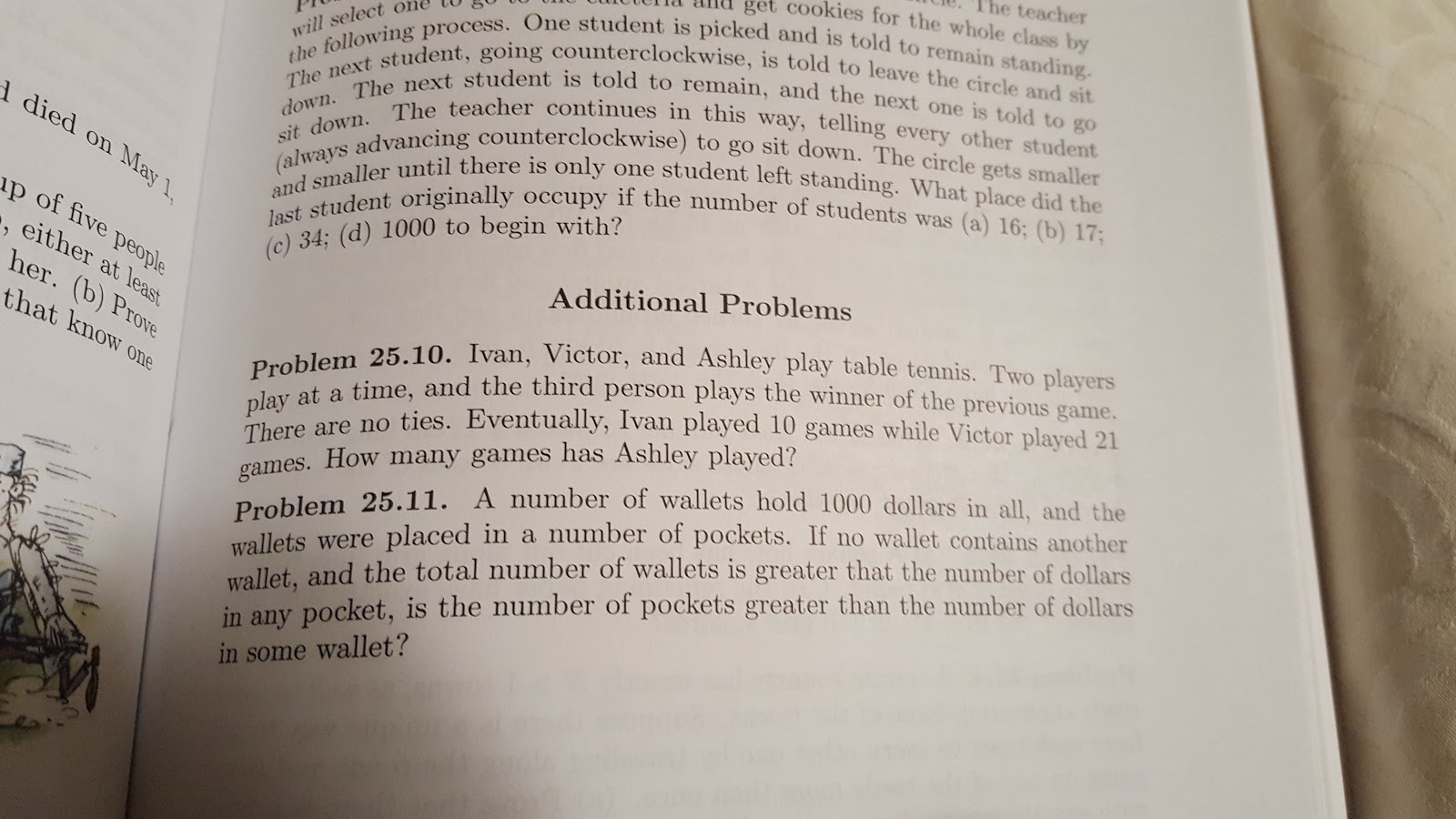
Besides the odd coincidence, two ideas stuck out for me in the book.
- *The importance of emphasizing games for younger students in a math circle. *In the context of this book, younger meant around 5th grade as opposed to High School students. I continually find evidence that supports this idea in the various sessions I run.
- The focus on working problem sets every week with relatively low student to facilitator ratios. This was my vision of how a Math club would work going into the process. I don’t really follow this model very often though. So I decided to go with a more pure problem set based day to see where we’re at.
To start up with, I decided to begin with the game of 100. This is a fairly simple two player game with the rules being:
- The score starts at 0.
- The goal is to be the first person to reach 100.
- Each player takes turn picking a number between one and ten and adding it to the score.
I was a little unclear in my first explanations so I ended up doing a few whole classs demos where I played against one of the kids and walking around the room to make sure everyone had understood the rules. After that startup activity, I let everyone play with the goal of finding a strategy to always win.
Gratifyingly, after about 5-10 minutes most groups had discovered part if not all of the structure of the game. [If you reaches 89 you can always win, which means you need to reach 78, which means you need to reach 67 …. all the way back to 1] I then had the group talk about their discoveries.
For the middle of the day, I returned to divisibility rules. I started with having everyone name all the rules for 2,4,5,6, etc. through 9. We then spent some time talking about adding multiples again and I brought up the question “How does this relate to adding odd and even numbers?” I then went over the logic behind the nine rules again on the board. I had the kids pick random digits for our sample number which worked well. Then I had them pick (mostly) random digits again so we could work on the rule for 11’s. My key question here was if “9 = 10 -1” led to the rule for nines what relationship would help with 11’s i.e. 11 = 10 + 1? We then did the follow exercises:
- Find a pattern for nearest multiple of 11 to a power of 10 and figure out why.
- Using that rule, and the distributive law breaking out the sample number to see how the divisibility rule worked.
This is all a bit trickier since for 11’s the numbers alternate between positive and negative i.e.
10 = 11 - 1
100 = (11 - 1)^2 = 11^2 - 2 * 11 + 1
1000 = (11 - 1) ^ 3 = 11^3 …. -1
Which was a pattern I wanted to emphasize without the benefit of knowing the binomial theorem.
We had about 18 minutes left at the end of this work and I gave the kids a choice between a worksheet with some extension problems about divisibility or a sample AMC 8 set of problems. Interestingly, everyone seemed to prefer the random set. I spent this period walking around, checking on progress and answering questions.
The most interesting moment was helping a student who had forgotten how to multiple decimals. I went through the idea of treating the decimal like this:
1 2 3 4 . 5 6
x 7 . 8 9
= $123456\times\frac{1}{100}\times789\times\frac{1}{100}=123456\times789\times\frac{1}{10000}$
Unfortunately, I didn’t have enough time to see how well that explanation resonated. Overall everyone worked fairly diligently through this experience but I was still left not feeling sure about the structure. I’d like to figure out how to get more insight into what everyone’s doing and to keep the interest level high.
Idea: I saw another teacher post about doing problem sets and stipulating all work must be done on the whiteboard to facilitate discussion. This seems interesting and I think I have enough space to make it practical.
P.O.T.W I went with a scaffolded version of the divisibility problem I found online:
I also at the very end asked if the kids would like a demo of the rule for divisibility by sevens. About half were interested so I may do so next week even though I don’t expect them to remember it. This is more aimed at impressing that complex divisibility rules exists and there are patterns that extend up through the integers.
Leave a comment