Elegant Solutions vs. Hacking
This is a study in contrasts around a fun problem by @eylem:
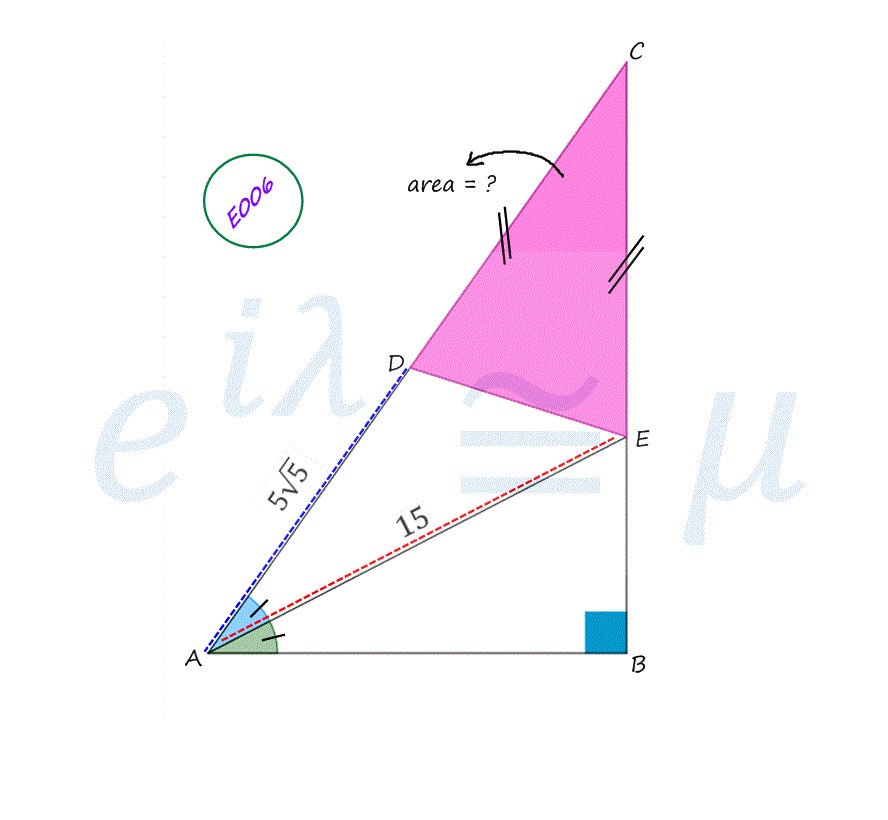 An elegant solution to this would be as follows:
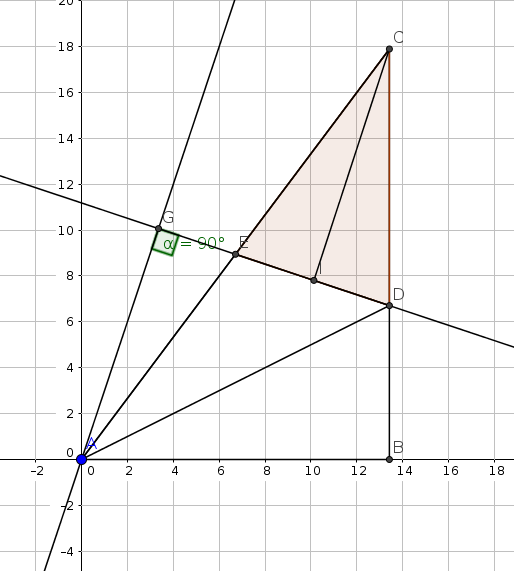
- After angle chasing to find angle DEA is 45 degrees extending DE to make a full right isosceles triangle with side lengths of 15 sqrt(2)/2.
- Use the Pythagorean Theorem to find the missing side length of AGE. This gives you the base of the triangle DE also,
- Then note AGE is congruent to the halves of CDEs so you also know the altitude.
- Apply the triangle area formula.
But there are other shadier options for solving the problem:
Instead, we can take advantage of patterns in the values of the lengths and the then use knowledge about 3-4-5 triangles (see: 12-triangles-and-their-link-to-pythagorean-triples) to crack the problem.
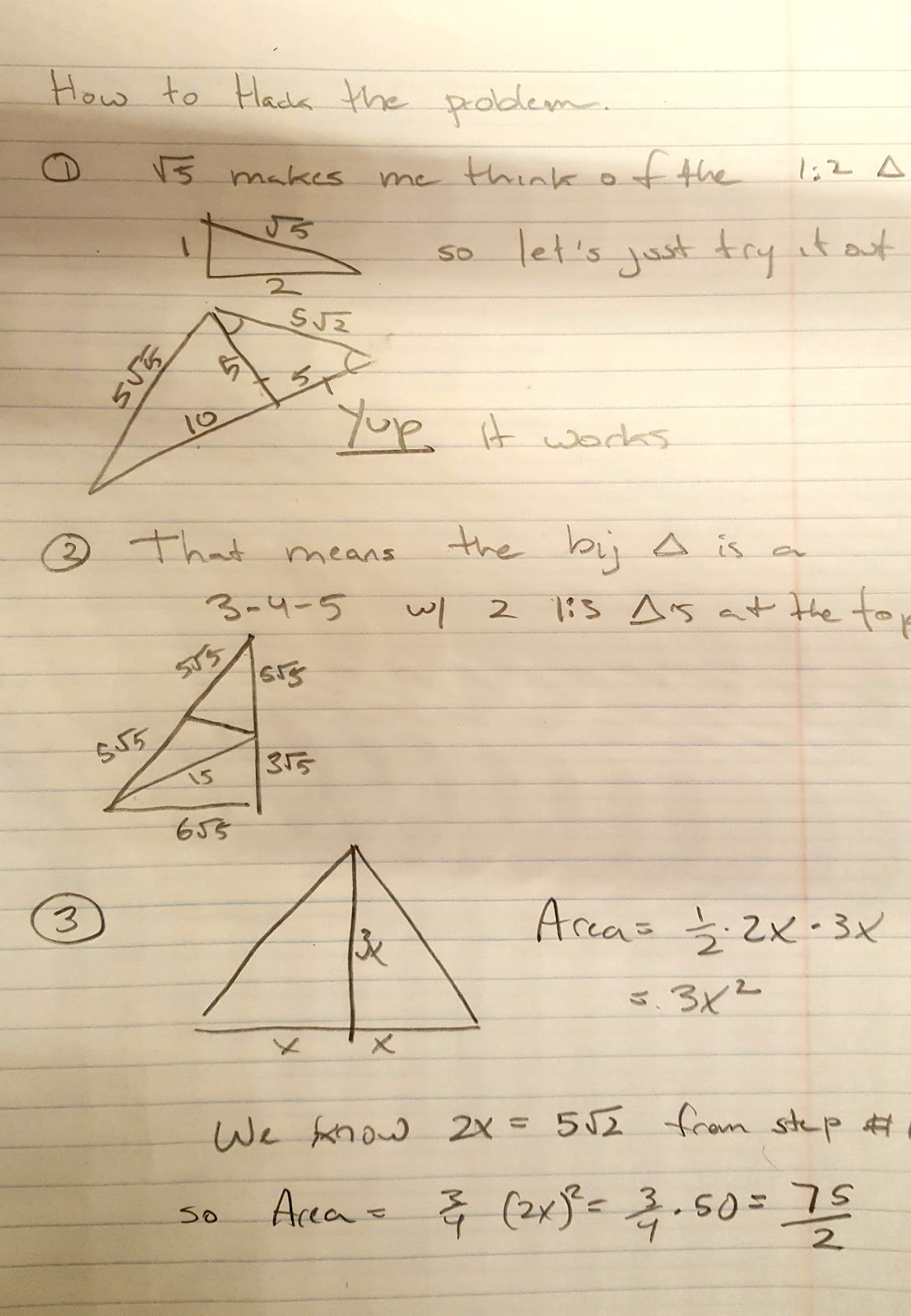
This actually exposes a bit of structure that was not seen in the first solution. If you didn’t think to try the educated initial guess, you could more directly find it by setting up a simple quadratic equation based on the Pythagorean Theorem:
\[(5\sqrt{5})^2 + (15 - x)^2 = x^2\]
Leave a comment